The meteorologists saw it coming days in advance. The grocery stores emptied of bread and milk. Batteries flew off the shelves. Everyone knew the storm was approaching, yet when it finally arrived, many still found themselves unprepared for its full force.
Life’s storms work the same way. Sometimes we see them gathering on the horizon – a organizational restructuring, a relationship reaching its breaking point, a business model that’s clearly running out of road. Other times, they hit without warning, leaving us scrambling to find our footing while everything we counted on gets rearranged.
The question isn’t whether storms will come. They will.
The question is: How will you prepare, how will you weather them, and how will you use what they teach you?
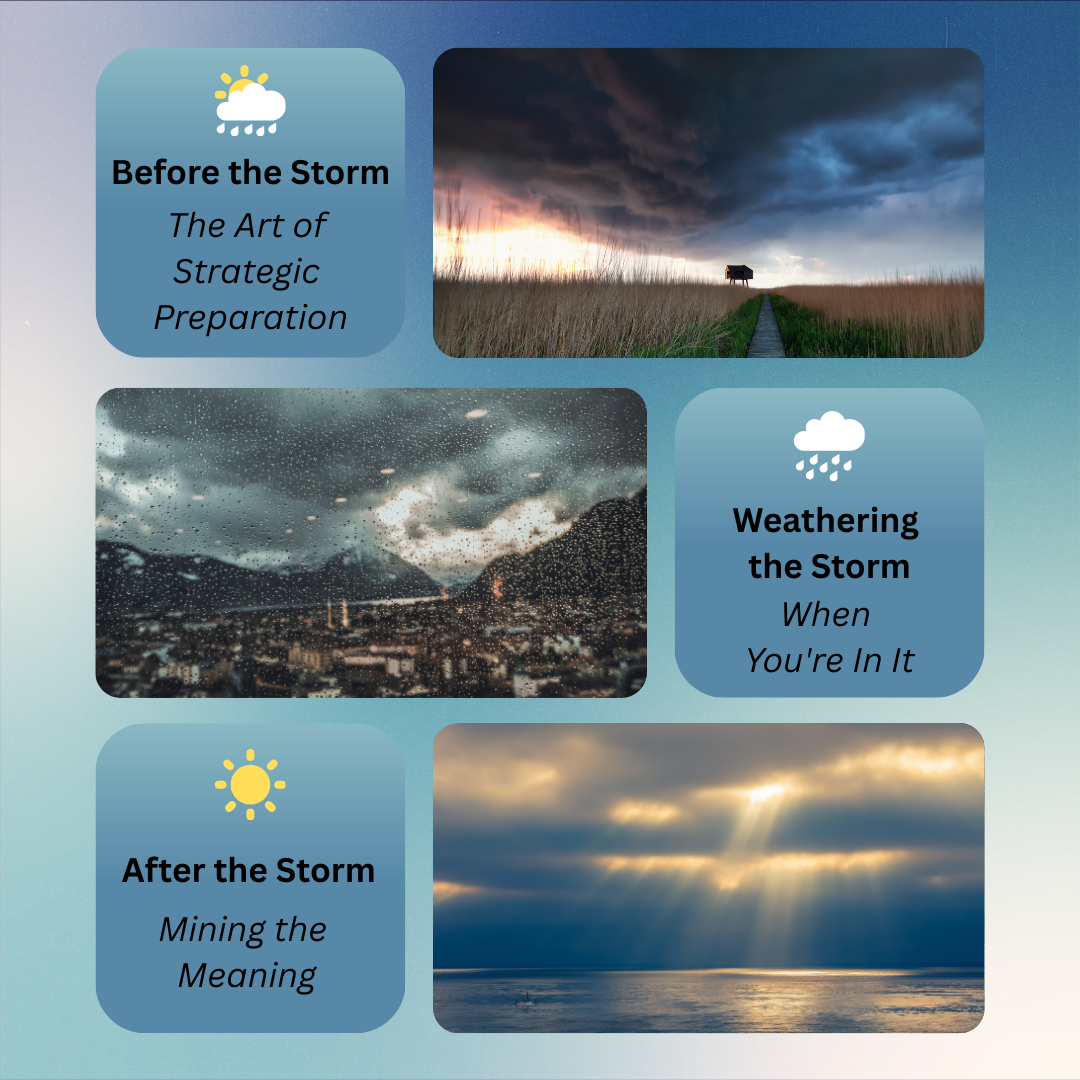
Before the Storm: The Art of Strategic Preparation
Here’s what most people get wrong about preparation:
They stockpile supplies, but they forget to strengthen their foundation.
When I work with leaders and entrepreneurs facing major transitions, I ask them a simple question: “What are you anchoring to?” When everything else is moving, you need something solid to hold onto. For some, it’s their core values. For others, it’s their sense of purpose or their commitment to the people they serve.
The coaches I work with who navigate industry changes most successfully aren’t the ones with the biggest emergency funds (though those help). They’re the ones who’ve built what I call “foundational flexibility,” which is a clear sense of who they are and what they stand for, combined with the agility to adapt their methods without compromising their mission.
Practical preparation looks like this:
Know your non-negotiables.
What absolutely must be protected?
What defines you at your core?
When you’re clear on this, you can let go of everything else with much less anxiety.
Build your support system before you need it.
The middle of a crisis is not the time to start looking for allies.
Invest in relationships during the calm, so you have people to call when the winds pick up.
Create options, not just plans.
Plans assume a predictable future.
Options give you choices when the unexpected arrives.
What are three different ways you could respond if X happens?
What resources could you access if Y occurs?
When You’re In It: Weathering the Storm
There’s a moment in every storm when you realize – this is happening.
The preparation phase is over.
Now you’re just trying to stay upright.
This is when your previous work pays off, or when you discover what you missed.
 The most important skill for weathering a storm isn’t strength; it’s presence.
The ability to stay aware, stay responsive, and resist the temptation to panic-react your way into worse problems.
I’ve watched brilliant people make terrible decisions in the middle of storms because they were so desperate to make the discomfort stop that they grabbed at the first solution that presented itself.
They pivoted their entire business model after one bad quarter.
They blew up a relationship because they couldn’t tolerate the tension of uncertainty.
They abandoned their vision because it got hard.
Weathering a storm means accepting that some things are out of your control while staying active in the things that aren’t.
You can’t stop the storm, but you can:
Protect your energy.
This is not the time to take on new commitments or push yourself to maintain “business as usual.”
Give yourself permission to focus on essentials.
Stay connected.
Isolation is the enemy of resilience. Reach out. Ask for help. Let people know you’re struggling.
The vulnerability you show now will deepen your relationships later.
Look for the small wins.
You don’t need to solve everything today.
You need to take one right action, then another, then another.
Progress compounds.
After the Storm: Mining the Meaning
Every storm deposits something. Sometimes it’s wreckage that needs clearing. Sometimes it’s nutrients that will feed next season’s growth. Your job is to examine what’s been left behind.
The entrepreneurs I know who’ve built the strongest businesses didn’t do it by avoiding failure. They did it by getting exceptionally good at learning from it. Each setback became data. Each crisis revealed something they didn’t know about themselves, their market, or their model.
The question isn’t “Why did this happen to me?”
The question is “What does this make possible that wasn’t possible before?”
Maybe the storm cleared out deadwood – projects that were draining energy without producing results, relationships that had run their course, assumptions that were holding you back. Maybe it revealed strengths you didn’t know you had. Maybe it showed you who really has your back.
Coming out positive doesn’t mean pretending the storm didn’t hurt.
It means refusing to let the hurt be the only thing that defines what happened.
The storms will come. They always do.
The only real question is: When the next one arrives, who will you be?
Someone who merely survives it, or someone who uses it to become more of who you’re meant to be?
Start preparing now. Not because you’re pessimistic, but because you’re committed to staying in the game no matter what the weather brings.