
Category: Lessons Learned

  • Visibility – Make This Your Year to Be Visible

    Visibility – Make This Your Year to Be Visible

    Visibility creates opportunity. It’s that simple.

    When you show up consistently – whether in meetings, on social media, or at networking events – you put yourself in the right place at the right time. Those “lucky breaks” people talk about? They happen because someone chose to be visible.

    Why Visibility Matters

    Visibility builds trust and credibility over time. When people see you regularly, they begin to recognize your expertise and value. And here’s the thing: visibility compounds. The more you show up, the more opportunities find their way to you. Careers are built on this foundation.

    How to Build Visibility as an Employee

    If you work in a company, visibility starts with speaking up. Make sure you get credit for your great work. Contribute thoughtfully in meetings – not just to be heard, but to add real value.

    Volunteer for high-visibility projects. Not the ones nobody else wants, but the strategic initiatives that will showcase your skills and get you noticed by decision-makers. Build relationships across departments and levels. Your network inside your organization is just as important as the one outside it.

    Visibility - Make This Your Year to Be Visible by Laura Berman FortgangHow to Build Visibility as an Entrepreneur
    Show up on platforms where your ideal clients are, but don’t stop there.
    Get involved in your community.
    Volunteer for opportunities that put you in front of the right people.

    Make it easy for people to understand exactly what you do. I recently worked with a new coach who attended one networking meeting, made themselves visible to the group’s leader, and landed a speaking engagement that will put them in front of hundreds of potential clients. That’s the power of visibility.

    Remember:
    There’s visibility on a small scale (one-on-one relationships) and visibility on a larger scale (platforms and speaking).
    Both matter.

    For Those Who Hate Being Visible

    Let me be honest: Being self-conscious is a little egotistical.
    You’re assuming everyone is judging you probably because you’re judging yourself and others.
    Get straight with yourself.
    Stop judging yourself.
    Stop judging other people.

    You need to adopt a healthy “I don’t care” attitude. Not that you don’t care enough to do good work, but you can’t care so much about what others think that you hide your light.

    Here’s the key: You need a mission bigger than you.
    When you focus on the impact you want to make and the people you want to serve, visibility becomes about that mission, not about you.

    And introverts, I don’t want to hear that you can’t be visible.
    You just need to know yourself, do things your way, and stay connected to your bigger purpose.

    Common Visibility Mistakes

    Assuming good work speaks for itself.
    It doesn’t. You need to share your wins, whether you’re presenting results to your boss or sharing client success stories on LinkedIn.

    Confusing visibility with bragging.
    They’re not the same thing. Sharing your accomplishments and expertise is not bragging; it’s informing people about what you can do and who you can help.

    Being inconsistent.
    Disappearing for long periods and then showing up only when you need something (a sale, a favor, a promotion) doesn’t work. Consistency builds trust.

    Your Action Step

    We’re still in the energy of a new year. Make this your year to be visible.
    Be consistent.
    Put yourself forward.
    Don’t be afraid to be vocal about your accomplishments.

    Visibility creates opportunity, and opportunity is what you’re after.

  • When the Storm Hits: Your Guide to Weathering What Comes and Emerging Stronger

    When the Storm Hits: Your Guide to Weathering What Comes and Emerging Stronger

    The meteorologists saw it coming days in advance. The grocery stores emptied of bread and milk. Batteries flew off the shelves. Everyone knew the storm was approaching, yet when it finally arrived, many still found themselves unprepared for its full force.

    Life’s storms work the same way. Sometimes we see them gathering on the horizon – a organizational restructuring, a relationship reaching its breaking point, a business model that’s clearly running out of road. Other times, they hit without warning, leaving us scrambling to find our footing while everything we counted on gets rearranged.

    The question isn’t whether storms will come. They will.
    The question is:
    How will you prepare, how will you weather them, and how will you use what they teach you?

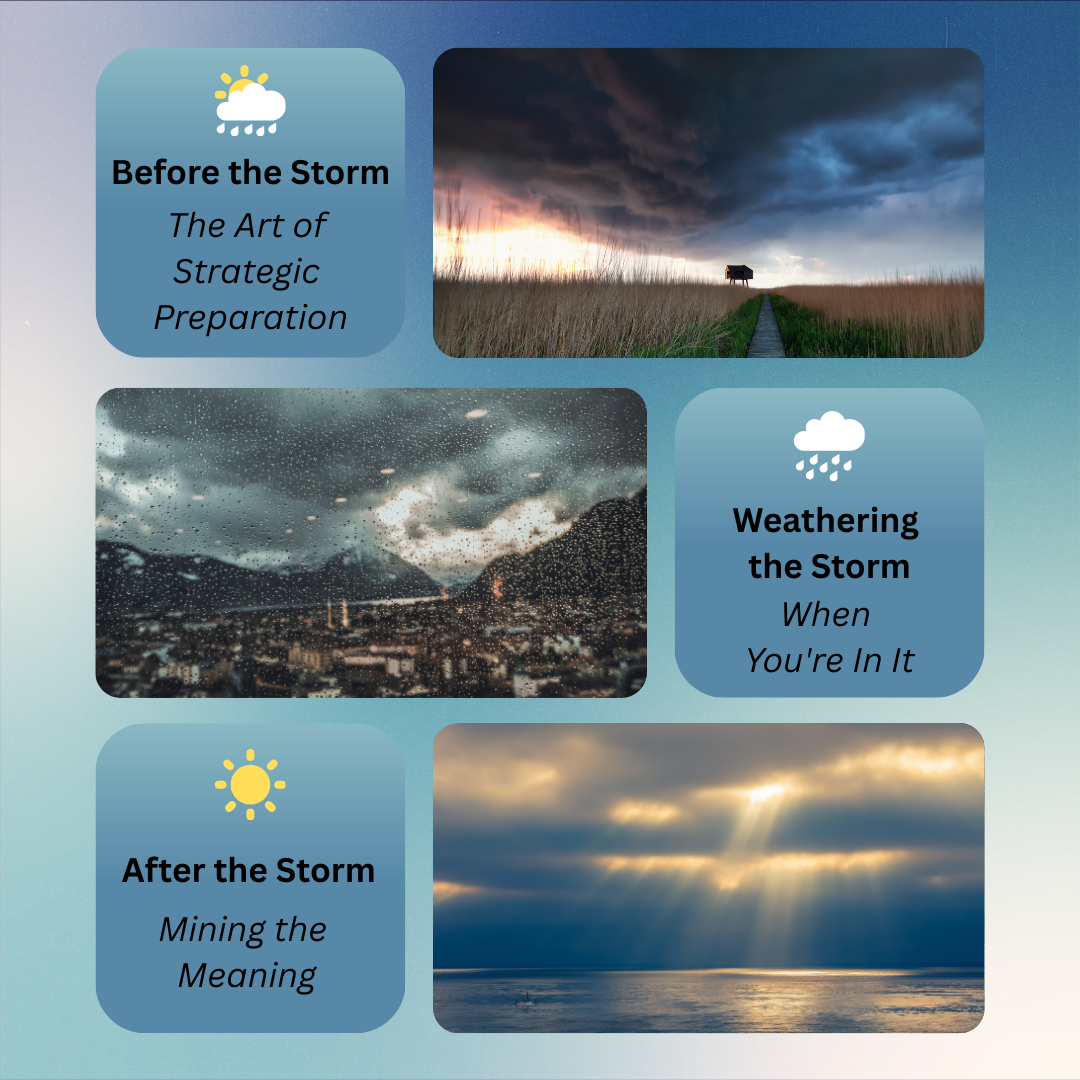
    Before the Storm: The Art of Strategic Preparation

    Here’s what most people get wrong about preparation:
    They stockpile supplies, but they forget to strengthen their foundation.

    When I work with leaders and entrepreneurs facing major transitions, I ask them a simple question: “What are you anchoring to?” When everything else is moving, you need something solid to hold onto. For some, it’s their core values. For others, it’s their sense of purpose or their commitment to the people they serve.

    The coaches I work with who navigate industry changes most successfully aren’t the ones with the biggest emergency funds (though those help). They’re the ones who’ve built what I call “foundational flexibility,” which is a clear sense of who they are and what they stand for, combined with the agility to adapt their methods without compromising their mission.

    Practical preparation looks like this:

    Know your non-negotiables.
    What absolutely must be protected?
    What defines you at your core?
    When you’re clear on this, you can let go of everything else with much less anxiety.

    Build your support system before you need it.
    The middle of a crisis is not the time to start looking for allies.
    Invest in relationships during the calm, so you have people to call when the winds pick up.

    Create options, not just plans.
    Plans assume a predictable future.
    Options give you choices when the unexpected arrives.
    What are three different ways you could respond if X happens?
    What resources could you access if Y occurs?

    When You’re In It: Weathering the Storm

    There’s a moment in every storm when you realize – this is happening.
    The preparation phase is over.
    Now you’re just trying to stay upright.

    This is when your previous work pays off, or when you discover what you missed.

    When the Storm Hits: Your Guide to Weathering What Comes and Emerging StrongerThe most important skill for weathering a storm isn’t strength; it’s presence.
    The ability to stay aware, stay responsive, and resist the temptation to panic-react your way into worse problems.

    I’ve watched brilliant people make terrible decisions in the middle of storms because they were so desperate to make the discomfort stop that they grabbed at the first solution that presented itself.
    They pivoted their entire business model after one bad quarter.
    They blew up a relationship because they couldn’t tolerate the tension of uncertainty.
    They abandoned their vision because it got hard.

    Weathering a storm means accepting that some things are out of your control while staying active in the things that aren’t.

    You can’t stop the storm, but you can:

    Protect your energy.
    This is not the time to take on new commitments or push yourself to maintain “business as usual.”
    Give yourself permission to focus on essentials.

    Stay connected.
    Isolation is the enemy of resilience. Reach out. Ask for help. Let people know you’re struggling.
    The vulnerability you show now will deepen your relationships later.

    Look for the small wins.
    You don’t need to solve everything today.
    You need to take one right action, then another, then another.
    Progress compounds.

    After the Storm: Mining the Meaning

    Every storm deposits something. Sometimes it’s wreckage that needs clearing. Sometimes it’s nutrients that will feed next season’s growth. Your job is to examine what’s been left behind.

    The entrepreneurs I know who’ve built the strongest businesses didn’t do it by avoiding failure. They did it by getting exceptionally good at learning from it. Each setback became data. Each crisis revealed something they didn’t know about themselves, their market, or their model.

    The question isn’t “Why did this happen to me?”
    The question is “What does this make possible that wasn’t possible before?”

    Maybe the storm cleared out deadwood – projects that were draining energy without producing results, relationships that had run their course, assumptions that were holding you back. Maybe it revealed strengths you didn’t know you had. Maybe it showed you who really has your back.

    Coming out positive doesn’t mean pretending the storm didn’t hurt.
    It means refusing to let the hurt be the only thing that defines what happened.

    The storms will come. They always do.

    The only real question is: When the next one arrives, who will you be?
    Someone who merely survives it, or someone who uses it to become more of who you’re meant to be?

    Start preparing now. Not because you’re pessimistic, but because you’re committed to staying in the game no matter what the weather brings.

  • The September Advantage: Get On The Bus

    The September Advantage: Get On The Bus

    Another summer is in the books! I hope you enjoyed your holiday weekend. . .

    Because now it’s time to go back to school.

    Whether you’re growing a coaching practice or searching for your next big role, the pace likely slowed down this summer, and let’s be honest, so did the income. Not for everyone, but if you’re looking at your bottom line and feeling anxious, you’re not alone. I heard from many clients that things were slow.

    I know the headlines aren’t exactly comforting right now. The economy feels shaky, the job market is awry, and you might be wondering where the heck we’re headed.

    But here’s what I want you to remember:​
    The lull of the past few months was seasonal.
    A summer slowdown happens every year.

    Right now, you have a major advantage, if you’re willing to take it.

    Specifically, I call it the September advantage – that unique burst of collective energy that comes with a fresh start. You just had time to rest (even a little). Now you’ve got a clear runway ahead . . . until the holidays hit.

    Presently, we have two solid months to make some serious progress, so treat this like your own personal breakthrough semester and plan to ace it.

    Even if you weren’t the kid who looked forward to a new school year, think back to the last time you started something new and exciting with a beginner’s mindset, such as trying out a new fitness class or exploring a new country for the first time.

    Clear your desk. Buy yourself a few office supplies – some nice pens, a new journal, a fall-scented candle – and put on your thinking cap.

    Just like students reviewing their new syllabi, I want you to take a look at your work through fresh eyes:​
    ​What do you want to learn?
    How do you want to grow?​
    ​What skill, system, or shortfall needs your attention?​
    ​What’s one area you know you’ve been avoiding that could change everything if you focused on it now?

    Maybe you need to practice your sales conversations to improve your conversions, or streamline your systems and optimize operations. Perhaps you should be working on deepening your relationships, or finally showing up for the visibility you’ve been avoiding.

    It’s time to tap into that back-to-school energy. The holidays will be here before you know it.

    Pick ONE specific thing that’s been lagging. Then give it everything you’ve got with a deadline of Halloween.

    Don’t wait for Q4. ​
    ​Don’t tell yourself it’s too late for this year.​
    ​Don’t let the doomsdayers break your spirit.

    The bus is here. The door is closing. This is your moment to jump on.

  • Don’t Beat Yourself Up! 10 Reasons Why New Year’s Resolutions Don’t Work

    Don’t Beat Yourself Up! 10 Reasons Why New Year’s Resolutions Don’t Work

    Pulling a classic from our archives . . .

    Admit it. Even though you predictably set them year after year, your New Year’s resolutions rarely stick. 23% of us break them in a week and 45% by the end of the month. A lot of people don’t even bother anymore.

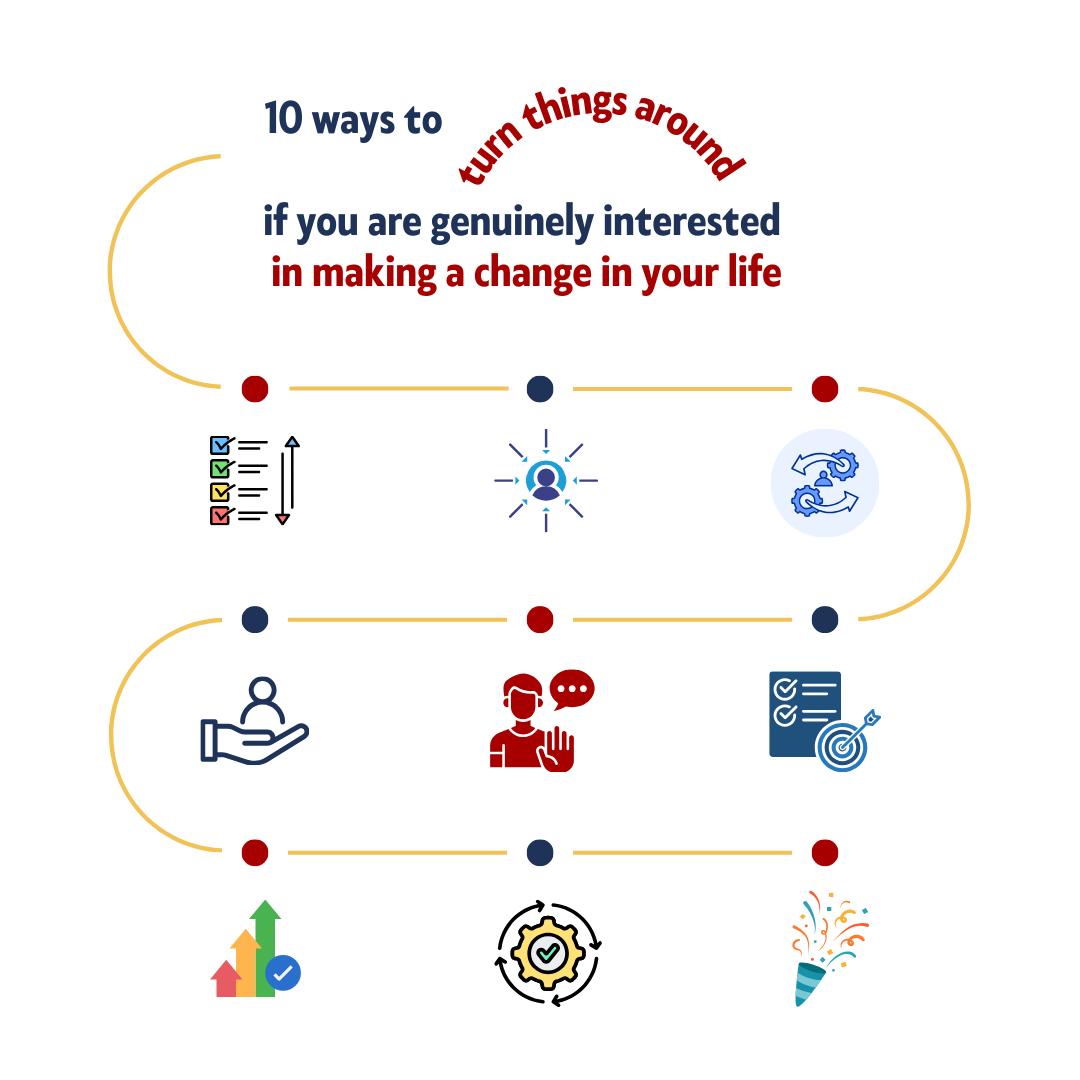
    Don't Beat Yourself Up! 10 Reasons Why New Year's Resolutions Don't Work by Laura Berman FortgangLet’s take a look at ten reasons why you may be frustrated, and how to turn things around if you are genuinely interested in making a change in your life.

    1. You haven’t made room in your life for a new priority.

    The odds are that something’s got to go if you’re really serious about achieving a new goal. Determine and declare your top 3-5 priorities (research shows we can only focus on five areas or less and succeed) and be willing to let go of the rest – at least for now.

    2. You’re trying to change something that’s a symptom of a bigger issue.

    You may be trying to change a bad habit or a certain behavior, like smoking or overeating, by developing more self-discipline. Why not do the real work by looking within yourself to understand how you got there in the first place?

    3. You’re changing something because you think you should change it, not because you want to change it.

    External pressures or doing the “right” thing won’t cut it in the end. What really counts is what you want. Figure out what inspires you from the inside and then devote yourself to it.

    4. You’ve chosen a goal that’s too big.

    Although you may be initially excited about the prospect of achieving a large goal, you could feel deflated once reality sets in. Chop your resolution down into bite-size pieces and accomplish it one bite at a time.

    5. You haven’t learned to say “no” to people and projects that’ll distract you.

    As much as you want your resolutions to stick, you may find yourself devoting precious time and energy elsewhere, whether it’s on “want-tos” or “have-tos.” You can only do so much, so get comfortable using the word “no” to avoid distractions.

    6. You don’t set up the structure for making change happen.

    You may be adding a resolution into your mix without coming up with a master plan and schedule to make it a part of your life. Put a system in place that’ll support the change by giving you the structure you need.

    7. You don’t seek out someone to hold you accountable.

    It’s easy to lose focus when we don’t have accountability. Whether it’s a coach, trainer, doctor, relative, or close friend, seek out someone who you can trust to be there for you. Plus, tell him or her on the front end when and how you want support.

    8. You let the resolution rule your life.

    If you go overboard pursuing your resolution, you may put too much pressure on the rest of your life and find it hard to maintain it. Set realistic expectations, plan for them, and get support. Plus, give yourself some extra room by telling your family, friends and colleagues in advance that your attention may be off them for a while. Full obsession starts to affect other areas of your life and become unsustainable.

    9. You don’t take consistent action.

    You won’t go the distance with sporadic spurts of activity. Commit to do one thing a day – no matter how small – that puts you closer to your goals. Consistency is key.

    10. You don’t celebrate the small victories.

    If your eyes are glued on the prize, you may be “living in the gap” between where you are and where you want to be. Set yourself up to succeed by celebrating the small victories. Success breeds success, so make them all count.

    If you’re going to bother to use January 1 as a RESTART button, just remember that you can pick any day or hour to start again.

    Take the pressure off, and gift yourself the gift of change with these tips.

  • Dealing with Regret: Finding Peace During the Holidays and Beyond

    Dealing with Regret: Finding Peace During the Holidays and Beyond

    The holiday season arrives with twinkling lights and promises of joy; yet for many, it brings an unwelcome companion: Regret. As we gather with family or scroll through social media images of picture-perfect celebrations, old wounds can resurface. We remember the relationships we damaged, the opportunities we missed, the words we wish we could take back. The contrast between cultural expectations of happiness and our internal reality can make regret feel especially heavy this time of year.

    Dealing with Regret: Finding Peace During the Holidays and Beyond by Laura Berman FortgangBut regret, while painful, isn’t inherently destructive. It’s actually a sign of growth – evidence that your values have evolved and you now see situations with greater wisdom. The question isn’t whether you’ll experience regret, but how you’ll respond to it.

    Acknowledge Without Dwelling
    The first step in processing regret is simple acknowledgment. Name what you’re feeling: “I regret how I handled that conversation with my sister” or “I wish I’d taken that job opportunity.” This clarity prevents vague, overwhelming guilt from consuming your thoughts. However, acknowledgment doesn’t mean rumination. Set a mental timer – give yourself ten minutes to fully feel the regret, then consciously redirect your attention.
    Dwelling keeps you stuck; acknowledging allows you to move forward.

    Distinguish Between Regret and Shame
    Regret says, “I made a mistake.” Shame says, “I am a mistake.” This distinction matters profoundly. Regret focuses on behavior you can change; shame attacks your core identity. When regret spirals into shame, challenge it. Ask yourself: Would I speak to a friend this way? What would I tell someone else in this situation? Usually, we extend far more compassion to others than ourselves.
    Practice self-compassion not as self-indulgence, but as a practical tool for healing.

    Extract the Lesson
    Every regret contains information. What does this particular regret teach you about your values? If you regret missing important moments with loved ones, perhaps presence matters more to you than career advancement. If you regret staying silent during a crucial conversation, maybe authenticity has become non-negotiable. Write down the lesson in one clear sentence.
    This transforms regret from a source of pain into a guide for future decisions.

    Make Amends Where Possible
    Sometimes regret can be addressed directly. If your regret involves another person and repair is possible, reach out. A sincere apology – one that takes responsibility without making excuses – can be profoundly healing for everyone involved. But remember, the goal isn’t to erase what happened or guarantee forgiveness. It’s to align your current actions with your values.
    Some things can’t be fixed, and that’s okay too.

    Practice Radical Acceptance
    For regrets that can’t be changed or amended, acceptance becomes essential. This doesn’t mean approval or resignation; it means acknowledging reality as it is. You cannot undo the past, but you can stop fighting with it. Try saying aloud: “I did that. I wish I hadn’t. I can’t change it. I can learn from it.” Repeat as needed.
    Acceptance frees up the enormous energy we waste on wishing things were different.

    Redirect That Energy Forward
    The final and most powerful step is asking, “What now?” Regret often signals a need for different choices moving forward. Channel the emotional energy of regret into concrete action. Commit to weekly calls with the parent you’ve been avoiding. Sign up for the class you’ve been postponing. Have the difficult conversation you’ve been dreading.
    Small, consistent actions prove to yourself that you’re different now than you were then.

    This holiday season, if regret shows up at your table, don’t turn it away.
    Sit with it briefly, learn from it genuinely, then let it go with grace.

    You’re allowed to move forward, even from your biggest mistakes.
    That’s not just permission; it’s the path forward.

  • All I Want For Christmakkuh…

    All I Want For Christmakkuh…

    If this year didn’t go as planned for you – maybe your career hit a wall, your business stalled, or you’re just tired in your bones – you’re in good company. It’s been chaotic; the world’s been noisy and tumultuous, and that background static affects us as we work toward our goals.

    This has been a particularly sad stretch.
    And as painful as it is, we continue to move forward as best we can.

    Therefore, I’m focusing on what matters most.
    I invite you to do the same.

    Think about what you want and what you wish for.
    Not just in your work, but in your world.

    All I Want For Christmakkuh by Laura Berman FortgangHere’s what’s on my wish list:

    I want health for all of us.
    Not just good health, but health care. No one should have to choose between their prescriptions and their mortgage.

    I want peace – the kind where kids grow up with safety instead of sirens.
    Where disagreements don’t destroy relationships. Where the news is boring because nothing terrible happened.

    I want sanity (remember that?).
    When morals mattered, and civility was the goal. I’d like that back, please.

    I want kindness.
    Simple, everyday, radical kindness. The kind that demonstrates patience in traffic, listens during conflict, and gives grace when someone’s struggling.

    As we light the candles, trim the trees, and maybe even both (yes, we have a menorah and a Christmas tree at my house; if the rabbi asks, just tell them it’s my Hanukkah bush…)

    As we hold different traditions in my home (I’m an Interfaith Minister, and Christmas trees are really a Pagan tradition), I’m reminded that we don’t have to choose between light and light.

    We can hold multiple truths.
    We can hold space.
    We can hold each other.

    From my heart to yours:
    Happy Hanukkah, Merry Christmas, Happy Kwanzaa, and all the ways you celebrate!

    Wishing you health, peace, sanity, and kindness.