
Category: Career Burnout

  • Do you have a capacity problem?

    Do you have a capacity problem?

    Let me share with you something I’ve observed repeatedly, especially in my most driven clients:
    They have big goals, but all too often, not nearly enough capacity to carry them out.

    Your dreams need room to breathe and to grow. For this reason, that means you need to create the capacity for that to happen.

    Capacity is your ability to handle more: More responsibilities, more opportunities, more failures and wins, more meaning and fulfillment. If your capacity is maxed out before you hit your goal, you probably won’t make it. In the off chance that you do reach the finish line, chances are you’ll be too run down to enjoy it.
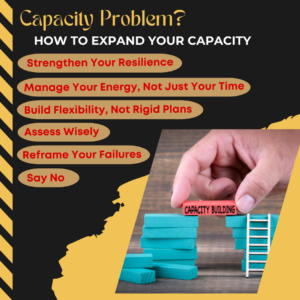
    Do you have a capacity problem by Laura Berman FortgangThe good news? It’s even more likely that your capacity has room for expansion.

    Building More Capacity to Achieve Goals and Dreams

    How do you build more? Here’s what I teach my clients (and practice myself):

    1. Strengthen Your Resilience
    Your body, mind, and spirit need elasticity and toughness. Healthy habits like meditation, movement, and maintaining a balanced diet keep you from cracking under pressure and help you recover faster when life hits.

    2. Manage Your Energy, Not Just Your Time
    You’ll never create more hours in a day, but you
    can use your energy differently. Prioritize what matters most at any given moment, and protect your energy from distractions that drain you. Accomplishing one paramount thing each day beats attempting to check off a bunch of insignificant to-dos.

    3. Build Flexibility, Not Rigid Plans
    Real life changes. Sometimes pivoting is the only way to avoid hitting a brick wall.
    Having backup resources in place is the best way to create wiggle room – setting aside financial reserves, establishing trustworthy relationships, and developing skills that keep you adaptable.

    4. Assess Wisely
    When you’re overwhelmed, everything feels urgent; it’s not. Building capacity requires discernment. Stop reacting, and start asking yourself questions such as, “What actually matters right now, and what’s just noise?” or “What’s immediately urgent versus non-critically important?”

    5. Reframe Your Failures
    Stop viewing setbacks as defeat. They’re data. Ask yourself: What can I learn from this? Then move forward with your newfound information.

    6. Say No
    No is a complete sentence. Every yes is a tradeoff. Say yes to what matters most and only that.

    In essence, the people who achieve big things don’t just have talent or drive. They’ve built the capacity for what they want.

    In short, if you’re maxed out, it’s time to retool so that capacity can expand. 

  • Are You Addicted to Your Reality?

    Are You Addicted to Your Reality?

    I recently had a powerful conversation with Shiraz Baboo, author of ​How to Rewrite Reality​, on my Friday Focus livestream. (If you’re not following me there yet, you can catch future episodes on​ LinkedIn​ or ​Instagram​. He calls himself a reality interventionist, and after hearing what he shared about being addicted to your reality, I can see why.

    What Purpose Being Addicted to Your Reality Serves

    Here’s the short version:
    Most of us are addicted to our reality – even when it’s uncomfortable or even when it’s holding us back – because it gives us something we crave. Even if that seems unthinkable (i.e., “Why would I WANT this mess?”)

    I see it all the time in my work with clients. They’re stuck in patterns – under-earning, overworking, chasing impossible standards, feeling “not ready” to make the next move – and what we discover is that those patterns aren’t just habits; they’re serving a purpose. There’s a payoff, even if it’s subconscious.

    Shiraz gave the example of a client who complained that he was constantly solving problems. His life and business were overrun with problems. But he also owned it, with pride, as an identity: “I’m an amazing problem-solver.”

    The Issue with Being Addicted to Your Reality

    The issue? To feel valuable, he had to create problems to solve. That identity gave him a dopamine hit. When he let go of the identity, the problems disappeared . . . but then he got anxious without his daily dose of validation. He was addicted to the reality he’d created, even though he no longer wanted it.

    Are You Addicted to Your Reality?This isn’t just about “problem-solver” types. It shows up in heart-centered professionals, too, particularly when it comes to money.

    Some people stay under-earning because, deep down, they believe wealthy people are selfish or unethical. If that’s your belief, you’ll subconsciously make sure you never become one of them. You’ll seek evidence to prove you’re right and get a little dopamine hit every time you find it.

    But here’s the thing: Just because a reality feels familiar doesn’t mean it’s true or permanent.

    Changing Being Addicted to Your Reality

    My philosophy is simple: Your purpose lives in who you already are. Sometimes that purpose is buried under outdated beliefs or old stories about what’s possible. But I’ve coached enough people through big transformations to recognize most of us already know what we want. We’re just afraid to want it out loud.

    That’s the work. Not pushing harder. Not ignoring your feelings. But being honest about the identity, story, or belief you’re clinging to, and choosing something different.

    You can become addicted to ease, to peace, to fulfillment.
    You can rewrite your reality.

    If you’re ready to step out of the old script and into something better, I’d love to help you find your “Now What?”

  • Are You Multi-Passionate?

    Are You Multi-Passionate?

    If you consider yourself multi-passionate or know someone who does, you’re going to want to read this.

    At face value, “multi-passionate” sounds like a wonderful trait to have. What could be wrong with having lots of passions – many different interests that you consider fun and exciting? The more, the merrier, right?

    Not exactly . . .

    As fun as it sounds to have lots of passions, many of my clients and the people I speak to every day are overwhelmed by their multi-passionate outlook.

    They have a myriad of interests that don’t fit in one neat box and a mixed bag of talent, experience, and abilities that open up a world of opportunities.

    Ahh . . . the possibilities!

    Being multi-passionate means your path isn’t straight or narrow; it’s one filled with options, alternatives, and potential. Sounds great!

    But it also means you can get lost in the twists and turns.

    Here’s what I recommend:

    1. Audit your interests.
      What brings you joy? Where are you most skilled? What’s the required time commitment? What’s the income potential?
    2. Consider the bigger picture.
      What aligns best with your core values? Does this option fit into this season of your life?
    3. Find the congruencies.
      Can you integrate one interest with another? How can you infuse creativity into what you’re already doing? How can you use talents and skills in different ways?
    4. Commit mindfully.
      How will you juggle everything? Do you have the time? Do you need new skills or support to handle things efficiently? How will this impact your bottom line?
    5. Find your pace.
      What’s primary and secondary, and how will you allocate your limited resources? What boundaries do you need to establish?             

    You can thrive in a multi-passionate career and life. I do it and have coached many to do so successfully.

    But if you’re not intentional about it, multi-passions can become nothing but distractions. You can’t allow yourself to get too scattered or spread all over the place.

    Success requires focus – in the moment, on one passion at a time.

  • Joy: A Survival Tactic

    Joy: A Survival Tactic

    You don’t need an update from me about the state of the world.

    We can all agree that there’s a lot going on and much of it is concerning. I almost added, “. . . if you’re paying attention” out of habit, but I can’t tell you the last time I spoke to someone who wasn’t on edge.

    You might not need an update from me, but there’s a good chance you could use an uplift.

    You’re in for a real treat because I have a lifetime of worrying experience! I’m good at overthinking my way straight into worst-case scenarios.

    But you can see I haven’t let it hold me back. The truth is, I’ve relied upon many different coping tactics over the years. However, when things started getting nasty, fear tried to take hold.

    As a coach, I’m surrounded by positive thinkers; it’s a perk of the job. I kept hearing them say, “I’m not going to let this steal my joy.” I understood it intellectually; it just didn’t seem practical. I look for strategies to implement – things I can work on, step-by-step.

    Joy is a feeling, an emotion. It’s something intangible, and I wasn’t convinced I could simply claim it on demand. So I worked on it . . .

    Here’s what I understand now —

    When we don’t have control over what’s going on around us, it’s our natural inclination to look for what we CAN control. It’s how we’re wired as human beings.

    But when we consider what we DO have power over, emotions are at the top of that list. Sure, they can take over briefly, but we’re ultimately in charge from moment to moment.

    We have the power to feel joy in almost any moment.

    Claiming joy doesn’t mean we’re in a constant state of happiness. We can take delight or pleasure in something, even if the feeling is fleeting. Appreciating that instant can be an impetus for survival.

    Think about each moment of joy as a driving force; the motivation that propels you to endure and overcome challenges. Consider joyful moments as momentum.

    What’s one small thing you can do each day to experience joy?

    Writing in a journal, riding a bike, playing with your pet, putting your feet in the grass, taking up a new hobby. It must be something personal to you.

    As for me, I’ve decided to start singing again! I was a musical theater performer for many years, so I’m dusting off the old vocal cords, practicing in the car every day, and going on an audition – simply for the joy of it! (I’m not sure I even want the part. I just want to sing for people!)

    Now it’s your turn. I challenge you to do one thing each day to claim your joy.

    Joy is a survival tactic, and it’s a powerful one!

  • How to Recession-Proof Your Business

    How to Recession-Proof Your Business

    One of the best things about being in business for yourself is that you’re the one in charge. But it’s also one of the hardest things about it. When things get tough, the buck stops with you!

    Well, I’m no economist, but last year’s whispers of a looming recession are turning into shouts lately.

    Some of my clients and colleagues are starting to panic (“I hear ya!”). But let’s not get ahead of ourselves and throw up our hands in defeat. Remember, you’re in charge, which means you have options.

    It’s time to start recession-proofing your business. Here’s what I recommend:

    Diversify your portfolio.

    Just like your financial advisor would tell you to avoid putting all your eggs in one basket, I’m telling you to add some variety to what you offer.

    What can you do to make your services more accessible?
    How can you bring clients in at different price points?
    Where can you add new revenue streams?

    Retain the clients you have.

    Excellent customer service should always be a pressing matter, but now more than ever, do what it takes to keep your current clients happy! Think of creative ways to add loyalty perks for staying on board, such as bonus one-on-one time or retainer discounts for paying ahead. Retaining a client is cheaper and easier than attracting a new one in any economy.

    Enhance your value proposition.

    Make sure prospects know you’re worth the investment. What kinds of returns will they get from working with you? The results you deliver should make the kind of impact they would regret missing out on.

    Keep up with your marketing.

    If you’re looking for things to cut out of the budget, put marketing near the bottom of the list. Staying top of mind should be a top priority. Switch up your messaging to meet the moment if necessary, but don’t you dare go quiet. Stay out there, and stay consistent.

    Upgrade your skills.

    The key is to stay relevant, to stay nimble, and to pivot if you have to. Be smart about it, but focus on how you can best add value right now, and how you can make your business more profitable. Do you need to learn new technology or a new method?

    Streamline your operations.

    What things are nice to have, and what’s a necessity? How can you make your business run more efficiently (truly)? Be mindful and strategic about cutting costs and eliminating time sucks.

    Most importantly, stand in your power! Lean into your strengths and gifts. People may be discerning about where they spend their money, but they need you. Remember that.

    We’ll get through this!

  • The Cost of Doing it ALL

    The Cost of Doing it ALL

    In my line of work, people come to me with all kinds of challenges. The solutions aren’t always easy, but the answer to getting unstuck is often simpler than expected.

    Feeling anxious, overwhelmed, and exhausted? Hitting a ceiling no matter how hard you work? Wondering why opportunities keep passing you by?

    It’s not because you aren’t doing enough. You’re doing too much. Chances are, you’re doing it ALL (or at least trying to).

    How do you move past what’s holding you back? The simple answer: delegate!

    Whether pouring your whole self into your own business, place of employment, family, or all of the above, you need help.

    The Cost of Doing it ALL by Laura Berman FortgangYou might be resistant to the idea; I’ve heard it all.
    Who has money for that?”
    “I’ve tried; nobody can do it like me!”
    “I just can’t trust another person to…”
    “It would take me longer to explain it.”
    Here’s the truth —

    Think you’ve got it covered? Deep down, even the most stubbornly independent, headstrong among us realize they can not (and should not!) do it all.

    Think you’re the only person who does it right? You’ve never met a happy control freak; they’re the most stressed-out person in the room. Clinging to control is about trying to make the outside world reflect perfection so that you feel safe and worthy inside, which never works.

    To delegate or not to delegate? That’s not the question. Case closed.

    Now you’re probably wondering what to delegate. Again, the answer is nowhere near as mind-boggling as you might think.

    Delegate anything that’s not in your zone of genius.

    If it’s not something only YOU can do, get somebody else to do it. If it feels like a drag, it needs to go. Bookkeeping, errands, tech stuff, housecleaning, administrative tasks – farm it out.

    The next question I get is, “What about the expense?” (“In this economy?!”)

    I hear you. Think about it this way —

    Your time is money, and you’re investing in yourself to get a return. Do the math. What’s your hourly rate when doing your best work? That’s what each hour is worth. When you buy back time at a lower rate, delegating pays dividends.

    There’s no reward for trying to do it all; in fact, it comes at a hefty cost. Living your highest quality life requires operating in your zone of genius, focusing on what matters most.

    When you get your time back, you can use it to grow your business, pursue better career opportunities, or practice nourishing self-care that enriches your soul.

    What would you do next if you didn’t have to do . . . that?