Tag: life coach

  • When the Storm Hits: Your Guide to Weathering What Comes and Emerging Stronger

    When the Storm Hits: Your Guide to Weathering What Comes and Emerging Stronger

    The meteorologists saw it coming days in advance. The grocery stores emptied of bread and milk. Batteries flew off the shelves. Everyone knew the storm was approaching, yet when it finally arrived, many still found themselves unprepared for its full force.

    Life’s storms work the same way. Sometimes we see them gathering on the horizon – a organizational restructuring, a relationship reaching its breaking point, a business model that’s clearly running out of road. Other times, they hit without warning, leaving us scrambling to find our footing while everything we counted on gets rearranged.

    The question isn’t whether storms will come. They will.
    The question is:
    How will you prepare, how will you weather them, and how will you use what they teach you?

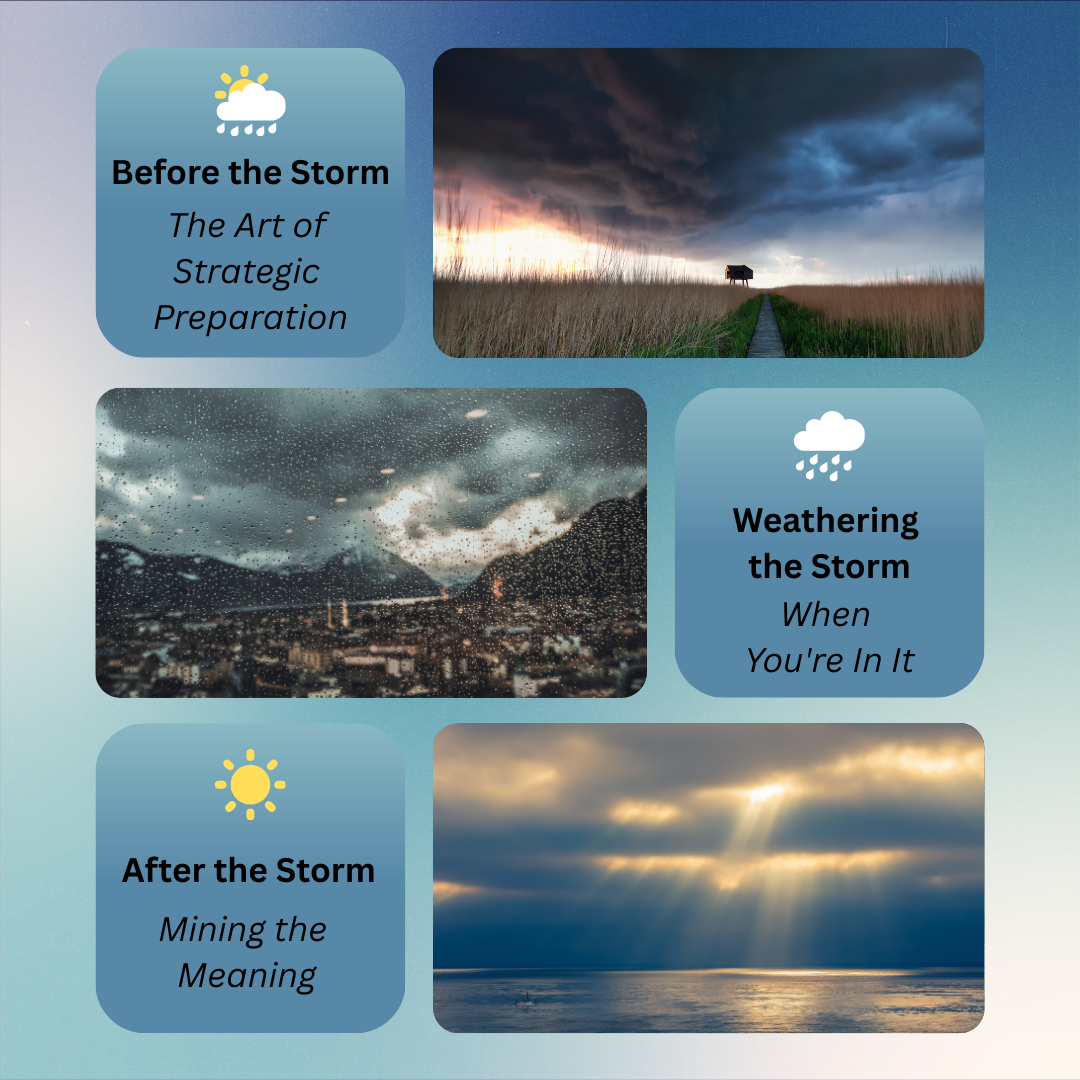
    Before the Storm: The Art of Strategic Preparation

    Here’s what most people get wrong about preparation:
    They stockpile supplies, but they forget to strengthen their foundation.

    When I work with leaders and entrepreneurs facing major transitions, I ask them a simple question: “What are you anchoring to?” When everything else is moving, you need something solid to hold onto. For some, it’s their core values. For others, it’s their sense of purpose or their commitment to the people they serve.

    The coaches I work with who navigate industry changes most successfully aren’t the ones with the biggest emergency funds (though those help). They’re the ones who’ve built what I call “foundational flexibility,” which is a clear sense of who they are and what they stand for, combined with the agility to adapt their methods without compromising their mission.

    Practical preparation looks like this:

    Know your non-negotiables.
    What absolutely must be protected?
    What defines you at your core?
    When you’re clear on this, you can let go of everything else with much less anxiety.

    Build your support system before you need it.
    The middle of a crisis is not the time to start looking for allies.
    Invest in relationships during the calm, so you have people to call when the winds pick up.

    Create options, not just plans.
    Plans assume a predictable future.
    Options give you choices when the unexpected arrives.
    What are three different ways you could respond if X happens?
    What resources could you access if Y occurs?

    When You’re In It: Weathering the Storm

    There’s a moment in every storm when you realize – this is happening.
    The preparation phase is over.
    Now you’re just trying to stay upright.

    This is when your previous work pays off, or when you discover what you missed.
    When the Storm Hits: Your Guide to Weathering What Comes and Emerging StrongerThe most important skill for weathering a storm isn’t strength; it’s presence.
    The ability to stay aware, stay responsive, and resist the temptation to panic-react your way into worse problems.

    I’ve watched brilliant people make terrible decisions in the middle of storms because they were so desperate to make the discomfort stop that they grabbed at the first solution that presented itself.
    They pivoted their entire business model after one bad quarter.
    They blew up a relationship because they couldn’t tolerate the tension of uncertainty.
    They abandoned their vision because it got hard.

    Weathering a storm means accepting that some things are out of your control while staying active in the things that aren’t.

    You can’t stop the storm, but you can:

    Protect your energy.
    This is not the time to take on new commitments or push yourself to maintain “business as usual.”
    Give yourself permission to focus on essentials.

    Stay connected.
    Isolation is the enemy of resilience. Reach out. Ask for help. Let people know you’re struggling.
    The vulnerability you show now will deepen your relationships later.

    Look for the small wins.
    You don’t need to solve everything today.
    You need to take one right action, then another, then another.
    Progress compounds.

    After the Storm: Mining the Meaning

    Every storm deposits something. Sometimes it’s wreckage that needs clearing. Sometimes it’s nutrients that will feed next season’s growth. Your job is to examine what’s been left behind.

    The entrepreneurs I know who’ve built the strongest businesses didn’t do it by avoiding failure. They did it by getting exceptionally good at learning from it. Each setback became data. Each crisis revealed something they didn’t know about themselves, their market, or their model.

    The question isn’t “Why did this happen to me?”
    The question is “What does this make possible that wasn’t possible before?”

    Maybe the storm cleared out deadwood – projects that were draining energy without producing results, relationships that had run their course, assumptions that were holding you back. Maybe it revealed strengths you didn’t know you had. Maybe it showed you who really has your back.

    Coming out positive doesn’t mean pretending the storm didn’t hurt.
    It means refusing to let the hurt be the only thing that defines what happened.

    The storms will come. They always do.

    The only real question is: When the next one arrives, who will you be?
    Someone who merely survives it, or someone who uses it to become more of who you’re meant to be?

    Start preparing now. Not because you’re pessimistic, but because you’re committed to staying in the game no matter what the weather brings.


  • How to Stop Imposter Syndrome in Its Tracks

    How to Stop Imposter Syndrome in Its Tracks

    Do you ever feel like an imposter?

    Are you sometimes afraid that someone’s going to discover you have no idea what you’re doing — that you’re not the expert you proclaim to be, you’re not as skilled as you’ve made yourself out to be, and you’re not quite qualified to be in the position you’ve found yourself in?

    Maybe you’re worried that you don’t measure up somehow, so it makes you feel like you’re pretending to be someone you’re not.

    Here’s what this looks like.

    Them: We’d like to interview you [for a dream job]!
    You: Maybe they didn’t notice I don’t have enough experience.

    Them: Congratulations! We’d like to offer you the [dream] job.
    You: I’ll surely be fired by Tuesday, once they figure out I’m a fraud.

    Them: We’ve selected your proposal to speak at the next conference.
    You: Oh no! I’m probably going to make a fool out of myself.

    Them: I’m looking for a coach, and I’d love to work with you.
    You: But what if I can’t help you get results, and you tell everyone I’m a con?

    I’m not a doctor, but as a Master Certified Credentialed Coach with 30 years of experience, I can confidently assess what’s happening here.

    Imposter Syndrome

    Don’t worry; it’s not fatal to your career or success.

    Most people struggle with it from time to time, and it’s entirely “treatable.”

    If you feel like your Imposter Syndrome is flaring up, here’s what I suggest you do —

    1. How to Stop Imposter Syndrome in its Tracks by Laura Berman FortgangPause and accept what’s happening. No sense in ignoring the symptoms. Denying it only makes things worse by trying to overcompensate.

    2. Learn to recognize your triggers (comparisons, someone else’s recent success) and how you respond, so you can head it off at the pass. Before you go into a full-on panic, tell yourself, “This is just imposter syndrome flaring up again. Nothing alarming. You can do this.”
    3. Notice your self-talk. As soon as you start beating yourself up, STOP. It may sound easier said than done, but you can tell yourself “no.” No more negative self-talk; you’re not listening.
    4. Ask yourself what success looks like. Are you trying to measure up to a perfect ideal? Scratch that and aim for progress instead.
    5. Keep learning. The best way to keep Imposter Syndrome at bay is to continue seeking out new knowledge and ways of doing things, evolving, and growing your skill set.
    6. Celebrate wins! I can’t say enough about this. Remind your brain that you’re doing good things.

    Do this again and again, every time Imposter Syndrome starts to creep up, and you’ll start experiencing it less and less.

    Don’t get caught up in calling yourself an expert. Instead of thinking of yourself as someone who’s supposed to know everything, think of yourself as someone who makes it your business to learn everything you can about your particular topic of choice.

    You’re not an imposter, so keep showing up as the best of who you are. You’ve got this!

  • How to Deal with Difficult People

    How to Deal with Difficult People

    Let’s face it; people can be difficult.

    Even if you consider yourself a people person, dealing with various needs, personalities, priorities, and quirks can be challenging.

    There’s always going to be conflict.

    Whether it’s a tough client, boss, or coworker, your overall success and happiness ultimately depend on how well you’re able to navigate that relationship.

    The good news – it’s not as hard as you might think — as long as you keep these three tips in mind:

    Tip #1: In any given situation, you have two realities:
    1. The facts and 2. The interpretation of the facts.
    We are not always going to agree on the interpretation. Here is an example:

    How to Deal with Difficult People by Laura Berman Fortgang

    Person A: This stinks! I was planning to go to an arts festival; my day is ruined!

    Person B: How wonderful! My lawn needed this, and now I can curl up with a good book.

    We all view facts differently. When you’re dealing with a difficult person or situation, you have to remember — there’s what happened, and there’s what each person thinks about what happened. Once you’ve considered this, it’s easier to resolve any friction.

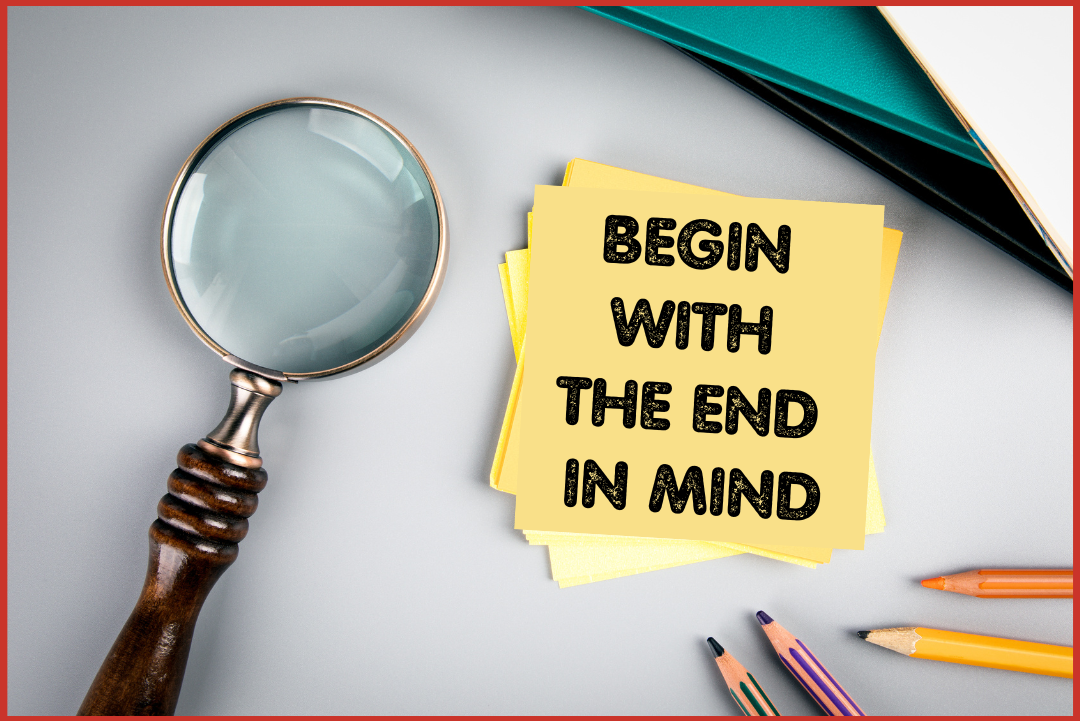
    Tip #2: Follow Stephen Covey’s advice to begin with the end in mind. (That’s habit #2 in his blockbuster book, The 7 Habits of Highly Effective People.)

    People don’t like drama because they’re afraid they’ll get stuck in whatever nastiness ensues.

    When you find yourself in conflict, focus on what you want to get out of it. What’s your goal? What do you want to resolve? Keep your eye on the prize, and stay focused on moving forward.

    Tip#3: Avoid the word “you” unless it’s used in a positive light.

    Saying “you” in the heat of conflict triggers an inflammatory response. People feel blamed and berated, and they don’t like it one bit.

    Instead, frame the conversation with the word “I.” I hear you,  understand,  see we have a difference of opinion, and I want you to know I want to resolve this to your satisfaction.

    This keeps the other person off the defensive and out of “fight or flight” mode. It allows for a reasonable conversation and coming to a resolution.

    These three tips will make a big difference, and the more you use them, the more you’re able to build rapport and trust, even with the most difficult people. The next time a conflict arises, you can build on the successful outcome you created the last time. Before you know it, that person no longer ruffles your feathers because you know how to deal with them.

    Remember: The customer isn’t always right. Your boss isn’t always right. And that overbearing coworker isn’t always right.

    You don’t have to let difficult people walk all over you. It’s okay to disappoint people, agree to disagree, and move on. You’ll have more respect for yourself, garner more respect, and win in the end.

  • The Significance of the WIN

    The Significance of the WIN

    When you’re looking to reinvent your career or start a business, resilience is crucial.

    Because sooner or later, the going will get tough. You’ll need to not only stay motivated but also recover quickly and bounce back whenever you encounter difficulties.

    One of the best ways to do this is to focus on your wins.

    When facing challenge after challenge, it can feel like losing is imminent. Directing your attention toward your triumphs is like a continuous reminder that you’re actually someone who wins — and keeps winning — every day.

    So whenever I work with a client, we start our session with a win.

    Sometimes it’s something big — secured a dream job interview, landed a new client, booked a speaking gig, nailed a program launch.

    But sometimes it’s something seemingly small — updating your resume, sending a newsletter, booking a discovery call, attending a networking event.

    But a win is a win!

    The Significance of the WIN by Laura Berman FortgangEven if you have to dig for it and rack your brain, always keep in mind that you’re a winner at something this month, this week, this morning… here’s why —


    A win is something you WANT.
    It’s INTEGRAL to your well-being.
    And it NEGATES problems.

    W.I.N.

    If you have a challenging goal to tackle, wins can be the boost you need to get you there. Celebrating your victories leads to more favorable results.

    A win changes your physiology. Focusing on your wins makes you shift from a stress-oriented mindset to one of possibility, wonder, and what’s next.

    Your creativity amplifies, your problem-solving improves, and your confidence flourishes. You’re ready to take on the next step knowing there will be a positive outcome — if not exactly what you’re aiming for, something better than where you are. A win is imminent!

    I’ll admit, this is easier said than done.

    In fact, it’s been a personal challenge for me over the years. I thought my problems made me interesting, and I used them as comic fodder, part of my personality. But the self-deprecating humor wasn’t serving me.

    It wasn’t until I learned to focus on what was right in my life that things began to shift. By focusing on what was right, I started doing more of what was right, and my wins beget more wins.

    Success breeds success.

  • Break Out of the Norms You Set for Yourself

    Break Out of the Norms You Set for Yourself

    Break Out of the Norms You Set for Yourself
    I had to take a forced break from my usual live broadcast and my newsletter topic plan this past week due to my mother being in the hospital.

    Between both my parents, other family members, and one of my children’s childhood spent in hospitals, I’ve been here all too many times.

    HERE is disrupted, in hyper-vigilance, learning on the fly. It’s making important decisions while watching the American healthcare system flail and often fail to meet the needs of those that require care.

    HERE is sitting with loads of time on my hands while I’m bedside to advocate for my loved one’s care, but not having enough brain power to do anything productive or move business forward.

    HERE is going through every full-time job in your mind of what will be required to get your loved one to the next stage of care (or resuming their life) without being able to do anything to prepare because you have no idea when you have to activate a plan or what level of functioning you have to prepare for.

    You can’t know until you know, which makes everything a last minute rush to an invisible finish line.

    Good healthcare workers are heroes. Truly. I’m so grateful for those that truly care and fight alongside me for the care my loved ones need.

    What I want to impart here is a call to action to wake up to your own life and shake yourself out of inertia. As I watch my mother struggle with a watershed moment where she is only likely to get worse and not better, I put forth this message to not let your life pass you by.

    I’m not sharing about this personal challenge for your attention or sympathy. I don’t need it nor want it. I’m sharing to encourage you to shake off whatever is holding you back and take a bold action to move your life forward.

    As hard as it seems, as impossible it appears to reach your desired outcome, as hopeless as your past results may make you feel, do something to break out of the norms you have set for yourself.

    Yes, you have set them for yourself. You’ve accepted certain behaviors from yourself or others, you’ve let circumstances curb your possibilities, you may have even given up.
    An All Too Familiar Place by Laura Berman FortgangSTOP THAT NOW.

    Imagine sitting bedside (maybe some of you have) watching a loved one deteriorate to a shadow of their former selves. Imagine the things they never did and wanted to do.

    The things they didn’t know how to say and never will. The wonderful things they did that they could never repeat again. What would that stir you to do?

    Maybe it’s time to look at your bucket list. Maybe it’s just your to-do list that need a glance where you might find all the items are absurd in the bigger scheme of things.

    Maybe it’s a look at your goals to find out if they’re really yours or better represent things you think you SHOULD do vs. really want to do. Maybe it’s just doing NOTHING and enjoying your life for a while that is the call. I don’t know, but you likely do.

    I have nothing cataclysmic to share about what another round of being bedside is doing for me. Right now, it’s just draining and anxiety producing to not know what I’m preparing for.

    So please, take heed. Break out of your fog. Take the driver’s seat of your life.
  • How to Bounce Back After Disappointment

    How to Bounce Back After Disappointment

    At some point, we all face disappointment.

    Whether you get passed over for a promotion, lose a big client, your new program launch flops, or your business partner bails on you — things don’t always go as we hoped…and frankly, it sucks

    But although feeling let down is perfectly normal, dwelling in disappointment won’t do you any good

    It’s okay to be a little bummed, but you also need to be able to bounce back

    And the key to bouncing back is a little trick called letting go.

    The Buddhists believe that any pain we have is because we’re attached — to an outcome, to a person, to an expectation, etc. So their tradition, it’s all about practicing non-attachment.

    Letting go is easier said than done, but it’s a powerful practice.

    Think about it this way — nothing is permanent anyway. When the trees bloom in the springtime, the beauty is fleeting and followed by blossoms shriveling and falling away.

    The idea is to feel emotions and experiences, be with your feelings, and let it go.

    How does this apply to disappointment?

    When you face disappointment, the level of pain you experience depends on how attached you were to the outcome.

    But you might be thinking to yourself, “Wait, Laura, how am I supposed to achieve my goals if I don’t care about results?”

    I get it; this advice seems counterintuitive for people who are ambitious, looking to make a career change, or eager to grow a business.

    But here’s the thing —

    When you’re working on something, of course you want it to come to be. However, the success journey is a fine dance of duality and rationality.

    If you face disappointment, you’re going to mourn. Allow the feeling, sit with it, and set some parameters. How long are you going to give it?

    That dream job or dream client slipped through your fingers? Give yourself three days to wallow mire, get back up, brush yourself off, and keep going.

    How to bounce back after disappointment by Laura Berman FortgangHere are a few tips that work for me.
    1. Say to the universe or whatever higher power you believe in: This or something better! If one thing doesn’t work out, let it be what clears the path for something meant for you.
    2. Become a student and ask, “What did I learn from this?” Remember, whatever you picked up in this process is valuable, and regret is useless.
    3. Focus on what you do have. Whether than giving all the power to the thing you lost, put your attention on what’s already yours or what you’ve gained or can gain because of the loss.
    4. Stay in action. Movement is your friend and stagnant is an enemy that’s sure to set you back.

    No matter how gut-wrenching it might feel at the time, you’ll get through it and on to bigger and better things. Soon enough, the disappointment will be behind you, and it’ll all work out in the end.