
The Feelings Gap: Why Emotions Are the Real Bottleneck in Your Business
What’s on your to-do list that you are quietly not doing?
The sales call you should have made three weeks ago.
The follow-up email you keep rewriting and deleting.
The pitch you’re afraid to send.
The offer you’ve been meaning to launch for six months.
All the things you’ve been quietly avoiding.
Now be honest — Is it because you don’t know how to do it? Or is it because of how you feel about doing it?
Today we’re talking about The Feelings Gap.
I want to make a case that the biggest bottleneck to your business and your success isn’t a lack of business acumen.
It’s not that you don’t know what to do.
It’s the emotions about doing it — the ones you haven’t yet learned to navigate.
The Reframe
Most entrepreneurs — and honestly most professionals — think business success is all about business skills.
Learn the marketing. Master the pitch. Build the funnel. Refine the offer. Get better at closing.
Those things matter, but they’re not what’s stopping you.
What’s stopping you is that pit in your stomach before you hit send.
That dread when you sit down to write the sales copy.
The disappointment you can’t quite shake from someone who said no a few weeks ago.
The anxiety about the prospect who ghosted you.
The rejection wound you didn’t even realize was still active.
Those emotions aren’t just unpleasant. They quietly determine what your business actually looks like because they quietly determine what you’re willing to do and what you’re not.
Dr. Marc Brackett, the emotional intelligence researcher at Yale, has done fascinating work studying this for decades. He talks about students at Ivy League schools: they all have great grades, they’re all really smart, they all know what to do. So why do some make it and some don’t? The differentiator wasn’t intelligence, and it wasn’t work ethic. It was their ability to recognize, name, and manage what they were feeling.
That’s the difference, and it’s the difference in your business too.
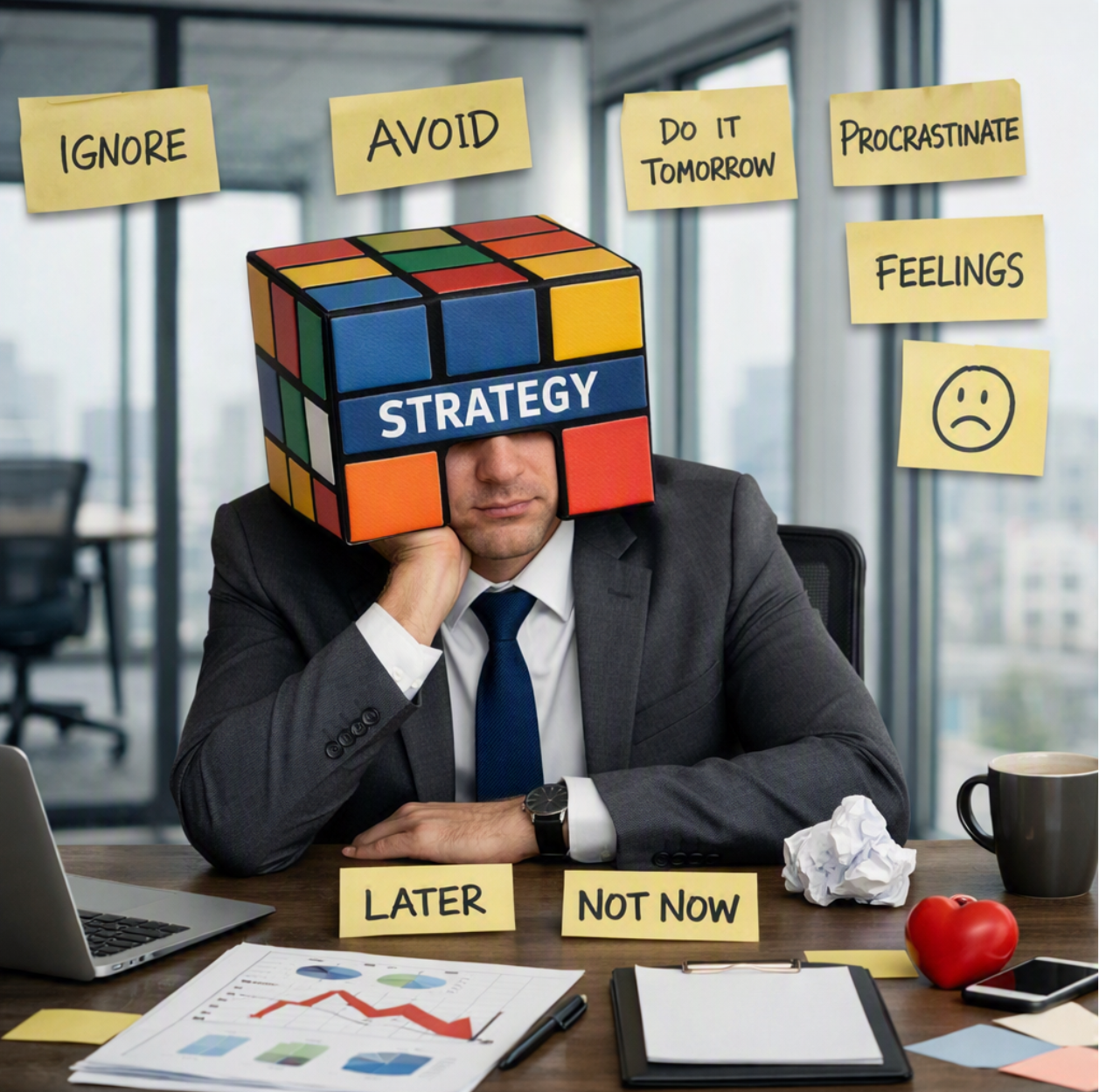
Emotions in a Business Costume
Here’s how it plays out. You know you need to make ten sales calls this week.
Strategically and business-wise, you know that’s the move, and it’s obvious.
Somewhere between knowing what to do and doing it, the emotions show up. Anxiety about being told no. Dread about seeming pushy. Old rejection wounds that you didn’t even realize were still there.
So what happens? You don’t make the calls.
Here’s the sneaky part — you don’t say to yourself, “I’m avoiding this because I’m scared.”
You say, “I need better messaging first.” Or, “I need to fix my CRM.” Or, “I need to redesign my website before I reach out.”
It’s not a strategy problem at all. It’s just avoidance and emotions wearing a costume as a business problem.
If you’re an entrepreneur, this is the difference between succeeding and not. Your business doesn’t grow from what you know; it grows from what you do. When what you do is governed by what you feel, and you don’t do it, your business isn’t growing.
If you’re in a corporate arena — whether it’s firing somebody, leading your team through change, or having a difficult conversation — same mechanism, different meeting.
Three Practices to Close the Gap
Name what you’re actually feeling.
Marc Brackett’s research shows that most people can only name three emotions — happy, sad, angry. But there are hundreds of feelings on the spectrum, and precision matters. Are you sad, or are you actually disappointed? Are you angry, or are you scared? Are you mad, or are you hurt? The more specifically you can name the emotion, the less power it has over you, and the easier it is to move through.
Separate the feeling from the action.
Most people wait to feel okay before they take action. They want everything to feel perfect before they act. But you can feel terrible and still do something. This is doing the hard things. You do it while you feel scared. You do it while you feel uncertain.
Build a recovery ritual.
Rejection is going to happen. Disappointment is guaranteed. So what’s your ritual for shaking it off: A five-minute walk? A journal entry? A workout? A snack? A call with a friend who gets it? Whatever ritual moves the emotion through you instead of letting it pool up and drown your motivation. Without a recovery ritual, one hard “No” can take you offline for a week.
The Mindset That Makes It Stick
Here’s what I want you to internalize:
Emotional intelligence isn’t a soft skill; it’s a hard skill.
In business and in life, it’s one of the most important skills you can develop, especially in this age of AI, where we think we can replace people with machines. Your emotional intelligence is what’s going to keep you in the game.
Business acumen without emotional intelligence is a Ferrari with no driver. You’ve got the best going on, but no one’s driving the car. Most people spend all their money on the car and none on learning how to drive it.
Your Homework This Week
Take one thing you’ve been avoiding — the call, the copy, the pitch, the presentation, the conversation, and ask yourself one question: What am I actually feeling about this?
Not thinking. Not planning. Feeling.
Name it as specifically as you can.
Then — without waiting for the feeling to go away — do one small piece of the thing you’ve been avoiding.
Because the people building the boldest, most enduring businesses and careers in the world became more emotionally fluent. They learned to feel it and do it — at the same time.
You can do that too.