
• Skip to primary navigation
  • Skip to main content
  • Skip to primary sidebar
Now What?® Coaching

Now What?® Coaching

from Laura Berman Fortgang

  • Login
  • About
    • About Laura
    • Our Philosophy
    • Praise
  • Hire a Facilitator
    • Hire Laura
  • Become a Facilitator
  • Online Courses
    • Career Clarity & Direction
    • Career Clarity & Direction: Self-Guided Course
    • Job Search Academy
  • Products
  • Blog
  • Contact

Kelly Johnson

Ghosting: Ghoulish Habits You’ll Want to Drop

By Kelly Johnson on November 15, 2026

Ghosting: Two Ghoulish Habits to Bury

With the recent celebration of Halloween, millions of people put on masks, knocked on doors, and pretended to be someone they’re not.

Here’s my problem: a whole lot of you have been doing that all year.

And some of you have been doing something even spookier – you’ve been ghosting people.

I’m staging a little post-Halloween intervention.
If you missed it live, grab your candy corn (or favorite candy).
This one’s for corporate leaders and entrepreneurs alike because nobody gets a pass on these two habits.

Habit #1: The Masks We Wear

I’m not talking about the rubber ones. I’m talking about the everyday ones.

In corporate, it often looks like the Agreeable Mask. You sit in a meeting, nod along, and say you love the idea. Then you walk into the hallway and tell three colleagues what a disaster it is. That’s not diplomacy. That’s a costume and that’s being fake.

Maybe you wear the Superhero Mask. The executive says, “We’re fine, totally fine,” while the project is on fire, the burnout is real, and the budget left the building last August. Nobody can help you fix what you won’t admit is broken.

Entrepreneurs, I see you too. You might wear the Big Business Mask. You say “we” on your website when it’s just you and your laptop at the kitchen table. You copy a competitor’s tone, their offers, even their colors because you think their face sells better than yours.

Ghoulish Habits You'll Want to Drop by Laura Berman FortgangMasks are exhausting. They’re hot, you can’t breathe, and you can’t see very well with one on. More importantly, you can’t build trust while you’re wearing one.

People don’t buy from, follow, or promote a costume. They connect with a person.

The coach who admits she’s still figuring something out? More credible. The leader who says, “I got that wrong, here’s my fix.” More respected. Your realness isn’t a liability. It’s your competitive advantage.

So drop the mask.

Habit #2: Ghosting, The Real Horror Story

This is the one that drives me crazy. It’s my biggest pet peeve.

You know what ghosting is. Somebody’s there, the conversation is flowing, and then they vanish. No reply. No “no thanks.” Just silence and a chill down your spine.

It’s not just for dating apps anymore; it’s a business epidemic.

Corporate folks, this one’s for you. You interviewed a candidate. You made her do a project. She bought a new blazer and rearranged her life for four, five, sometimes nine interviews. And then nothing. No email. Not even a form letter. That’s not “busy.” That’s bad manners with a logo on it. Cut that out.

Or it’s the colleague who asks you to read something over. It takes you two hours, you send your feedback, and you never hear another word. Boo. Ghosted.

Entrepreneurs, don’t think you’re excluded because you do it too. You’d never want someone to ghost you, and yet you do it to others. You meet with a vendor, you’re interested in their services, and then you decide not to move forward and just disappear because you’re too afraid to say no. Or a vendor sends you an invoice, and you go dark because you can’t pay it this month. Or you quietly stop showing up to your networking group without a word.

Let me be really clear: Ghosting is not a strategy. It’s avoidance.

Here’s what makes it so bad. It doesn’t save anyone any pain – it causes more. When you’ve been ghosted, you go to that place where you blame yourself and start looking for what’s wrong with you. So why would you do that to somebody else?

Your reputation takes a quiet hit, too. People remember who left them hanging.
Industries are small, and your name travels further than you think.

So be a freaking grownup. So what if you have to say no to somebody? They’re a grownup too. Let them handle it.

Turn Your Tricks Into Treats: 2 Steps to Break These Ghoulish Habits

1. Drop one mask this week.
Say the honest thing in the meeting. Show your real face in your marketing. Admit what you don’t know.

2. Un-ghost one person.
Somebody is waiting on you right now: a candidate, a client, a prospect, a colleague.
Send the message. It can be three sentences:
Thank you. This isn’t the right fit. I wish you well.
That’s it. Thirty seconds of courage beats a lifetime of being that person.

Clarity is kindness. A clear no beats a ghostly silence every single time.

I hope you enjoyed the candy.
But now it’s time to take off the mask and stop haunting people.
Be real. Be clear. Be the person who answers.
Filed Under: Now What? Newsletter Articles Tagged With: agreeable mask, big business mask, Career coach, Career Coaching, entrepreneurs, ghosting in the workplace, Laura Berman Fortgang, Now What Coaching, superhero mask

The Visibility Gap: The Most Expensive Lie You’ve Been Told

By Kelly Johnson on July 19, 2026

The Visibility Gap: Why Doing Great Work Isn’t Enough (And What to Do Instead)

Have you ever watched someone with objectively less talent than you land the client, get the promotion, do the podcast interview, get the book deal, get the recognition — and thought to yourself, how, how, how? I do better work than that person.

Yeah – me too.

I want to tell you the uncomfortable truth about why that keeps happening. It’s called the Visibility Gap. If you’re not paying attention to it, it’s quietly costing you clients, opportunities, and money; if you’re in corporate, probably that promotion too.

What Most People Get Wrong About Success

Most people believe that if they just do really excellent, undeniable work, the recognition will follow.
Clients will find them. Opportunities will show up. The promotion will be theirs. The market will reward the best.

That is one of the most expensive lies you’ve ever been told.

The truth is that great work and visible work are two completely different skills.
The market doesn’t reward the best work. It rewards the best work
that people know about.

If you’re an entrepreneur, this is life or death. Nobody can hire you if they don’t know you exist. Nobody can refer you if they can’t say what you do. Nobody can buy from you if you’ve been quietly building in a corner while somebody louder — and often less qualified — is out there taking up all the oxygen in your niche.

The Visibility Gap: Why Doing Great Work Isn't Enough (And What to Do Instead) by Laura Berman Fortgang

If you’re in corporate, it’s the same problem in a different costume. The promotion doesn’t go to the person doing the best work. It goes to the person doing great work whose boss, whose boss’s boss, and whose peers can see it and name it.

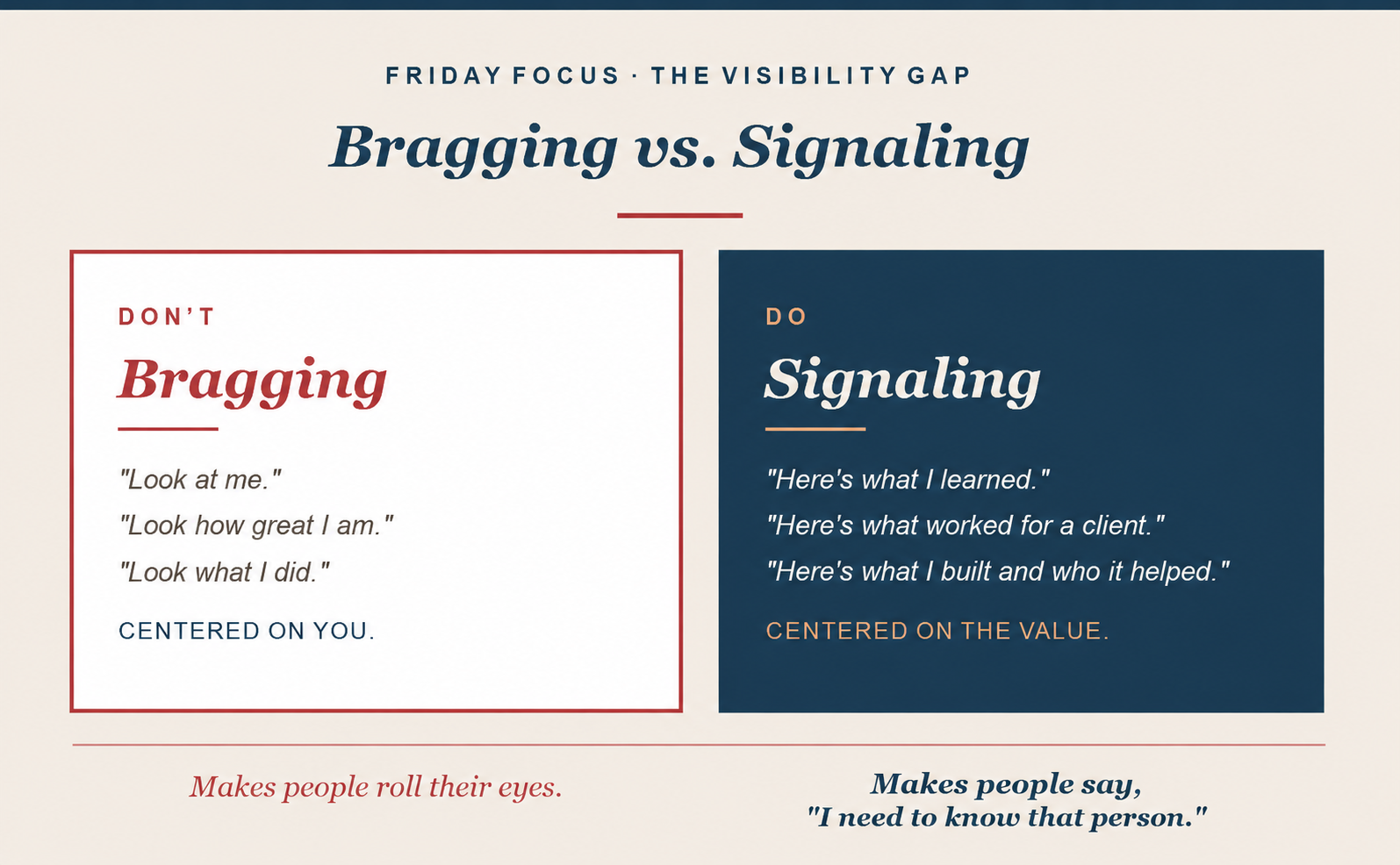
Bragging vs. Signaling

Here’s where most people freeze because the minute you start talking about visibility, people get squeamish. They think, “I don’t want to be one of those people. I don’t want to brag. I don’t want to be on LinkedIn every day performing.”

Good news — that’s not what we’re talking about.

There’s a huge difference between bragging, and what I call signaling.
Bragging is centered on you — Look at me, look how great I am, look what I did.
Signaling is centered on the value — Here’s what I learned, here’s what worked for a client, here’s what I’m noticing in the market, here’s what I built and who it helped.

Bragging makes people roll their eyes. Signaling makes people say, “Ooh, I need to know that person.”

The best entrepreneurs I know are constantly signaling. They’re sharing wins framed as lessons. They’re posting about client transformations without making it about themselves. They’re writing about the problem their work solves. The effect over time is powerful; the market starts to understand exactly who they are and what they do, and the right people come to them.

Same for leaders inside a company. The people who get promoted aren’t the ones bragging in meetings. They’re the ones who make their work visible and legible — sending the quick update email, naming what their team accomplished, taking the meeting with the senior VP when it’s offered instead of being intimidated by it.

Three Practices to Close the Visibility Gap

Pick a lane and stay in it. Visibility comes from repetition, not variety. If you’re all over the place — one week you’re talking about leadership, the next about branding, the next about your dog — nobody knows what you do. Pick a message, pick a topic, and hammer it. The person who’s known for one thing wins over the person who’s kind of known for five things.
Entrepreneurs, this is your niche and your signature message.
Leaders, this is the one thing you want to be known for inside your company.

Share your work, not just the win. Remember taking a math test as a kid, when you had to show your work, not just give the answer? Same idea. Most people only talk about success after it’s complete. Instead, talk about the process. What are you working on? What are you learning? What did you try that didn’t work? Building in public creates connection, credibility, and authenticity long before the finish line.
Entrepreneurs, this is how an audience becomes a client base.
Leaders, this is how your boss learns you’re three steps ahead of the game.

Say yes to the small invitations. Most people wait for the big visibility moment. But the big visibility moments almost always come from a chain of small ones. The podcast with four hundred downloads. The panel at a small conference. The internal committee. The guest post. The intro your friend offered to make. Every small yes is a compound interest deposit into your visibility bank and your brand.

The Mindset That Makes It Stick

Here’s what I want you to internalize:
Your work being seen is not a betrayal of your work being good. It’s what allows your work to matter.

Invisibility isn’t humility; it’s a business problem.
Invisibility isn’t professionalism; it’s a career-limiting move.
The people whose work changes the world are the people whose work is known.

There is nothing noble about being the best-kept secret in your field.
That’s just a slower way to go broke or get overlooked completely.

Your Homework This Week

Pick one visibility action and implement it before Sunday. Post the thing on LinkedIn. Publish the piece you’ve been sitting on. Introduce yourself to someone at an event. Send the update email to your boss.

Take one action because visibility is a muscle, and yes, the first rep is going to hurt a little. Do it anyway.

The people whose work is changing the world figured out they didn’t just get good; they got known.
Starting today, so can you.

Filed Under: Now What? Newsletter Articles Tagged With: Bragging vs. Signaling, Career coach, Career Coaching, entrepreneurs, Laura Berman Fortgang, Now What Coaching, take action, visibility gap

Primary Sidebar

Pinpoint–and plan-a fulfilling "next chapter" of your career with the Now What?® Program

Start Today

Buy Now

Sign up for Laura’s mailing list so you don’t miss a thing!

[gravityform id=”3″ title=”false” description=”false” ajax=”true”]

Disclaimer |
Site Usage and Privacy Policy  |  Facilitator Zone

Copyright © 2026 Now What?® Coaching. All Rights Reserved.

Login

Lost Your Password?