• Skip to primary navigation
  • Skip to main content
  • Skip to primary sidebar
Now What?® Coaching

Now What?® Coaching

from Laura Berman Fortgang

  • Login
  • About
    • About Laura
    • Our Philosophy
    • Praise
  • Hire a Facilitator
    • Hire Laura
  • Become a Facilitator
  • Online Courses
    • Career Clarity & Direction
    • Career Clarity & Direction: Self-Guided Course
    • Job Search Academy
  • Products
  • Blog
  • Contact

Career Coaching

Waiting isn’t humility; it’s a stall tactic

By Laura Berman Fortgang on July 5, 2026

The Confidence Loop: Why Waiting to Feel Ready Is Keeping You Stuck

What’s the thing you’ve been putting off until you feel ready?

The business you’ve been waiting to launch.
The promotion you’ve been thinking about asking for.
The hard conversation you’ve been rehearsing for months.
The book, the podcast, the pivot, the pitch.

Here’s the follow-up questions:
How’s it working for you?
Are you any closer to feeling ready after this whole year of waiting?
Are you still hoping for that magic moment when something clicks and the confidence finally shows up?

Spoiler Alert: It’s not coming. And I want to explain why.

What Most People Get Wrong About Confidence

Most people think they have to feel ready before they take the action. They believe confidence is a feeling you achieve first, and only then do you launch, ask, post, pitch, or push back.

But that’s backwards.
Confidence isn’t the cause of action. Confidence is the result of action.

You don’t think your way into confidence. You act your way into it.

This is hard whatever camp you’re in. If you’re an entrepreneur, you’re probably waiting to feel ready before you raise your prices, launch the offer, or post the thing on LinkedIn. If you’re in corporate, you’re waiting to feel ready before you talk to your boss about the promotion, speak up in the meeting, or push back on a decision. Different settings, same trap. You’re waiting for a feeling that only shows up after you do the thing you’re waiting to feel ready to do.

Why Waiting Makes It Worse

Here’s the brutal part — waiting actively erodes your confidence. The longer you wait, the more you’re quietly teaching your brain that you can’t, you shouldn’t, you’re not ready. The waiting itself becomes evidence.

Meanwhile, the people you watch flying past you? They’re not more talented. They’re not smarter. They’re not more prepared than you are. They’ve just figured out what you haven’t yet — that confidence is built on the other side of action, not on this side of it.

Think about anything you’re confident about right now. Driving a car. Running a meeting. Having a hard conversation with your teenager. You’re not confident at those things because you sat around until you felt ready. You’re confident because you did them (maybe badly at first) and then less badly, and then with ease.

That’s the loop. Action creates evidence. Evidence creates belief. Belief makes the next action easier.
And the loop keeps spinning, but only if you’re willing to take that first imperfect step to get it started.

The Confidence Loop: Why Waiting to Feel Ready Is Keeping You Stuck

Three Practices to Start the Confidence Loop

Shrink the action. You’re not writing a whole book; you’re writing five hundred words. You’re not running in to demand a promotion; you’re asking your boss for fifteen minutes to talk about your trajectory. You’re not launching the whole big product; you’re writing the sales page first. Make the action smaller. Make it doable. The lower the resistance, the faster you start.

Do it badly on purpose. You just have to get started. You’re not going to be perfect the first time out. The first pitch is going to be awkward. The first draft isn’t going to be written right. It doesn’t matter. Action beats inaction every single time. Let the action inform you, teach you, show you what to fix next time, but do it imperfectly.

Collect the evidence. Most people take the action and then move on without noticing. Don’t. Look at the email you sent. Look at the price you quoted. Look at the meeting you ran. Look at the post you published. You’re building a case file for yourself because the next time you run out of confidence and forget that you’re good at something, you can go back and say, “Hey, I did that.”

The Mindset That Makes Confidence Stick

Here’s what I want you to internalize:
Feeling ready is not a prerequisite for being ready. It’s a reward for already having started.

Total opposite thinking, right?

The most successful people I know don’t feel more confident than you do. They’ve just stopped requiring confidence as a permission slip. They take action while uncertain. They speak up while nervous. They launch while imperfect. The confidence catches up with them.

Waiting to feel ready isn’t humility, wisdom, or strategy. It’s a stall tactic dressed up as something respectable, but I don’t respect it. It’s costing you the life and the business you actually want.

Your Challenge Today

Forget the whole week. Here’s your homework today: Take something you’ve been waiting to feel ready to do, and do it.
Send the email. Make the call. Ask for the thing. Write the paragraph. Just do it.

Then notice what happens — not externally, but inside you. Because the confidence you’ve been waiting for has been on the other side of that one small action the entire time.

The people doing the boldest, most courageous work in the world aren’t more confident than you.
They just stopped waiting and started.

And starting today, so do you.

Filed Under: Now What? Newsletter Articles Tagged With: Career coach, Career Coaching, Clarity, entrepreneurs, Laura Berman Fortgang, life coach, new direction, Now What Coaching, Opportunity, take action

You’re Not What They Said You Are

By Laura Berman Fortgang on June 28, 2026

The Feedback Filter: How to Hear Hard Truths Without Falling Apart (or Firing Back)

When was the last time you got feedback that stung?
A performance review that landed harder than expected.
A critical note from a client.
A comment from your spouse, a family member, or even your own kid that left you reeling.

What happened next:​
​Did you spiral? Did you get defensive? Did you replay it in your head for three days?
Or did you actually use it?

Today we’re talking about what I call the Feedback Filter —
how to take in hard truths without falling apart and without firing back.

What Most People Get Wrong

Most people treat feedback like an all-or-nothing situation. Either it’s totally true and they have to dump their entire strategy and start over, or it’s totally wrong and they have to ignore it. Truthfully, somewhere in the middle is where feedback is actually valuable.

This hits hard from two directions. If you’re in a corporate environment, you’re getting feedback constantly — from your boss, your peers, your direct reports, your 360 review process. If you’re an entrepreneur, it might be even harder because you’re getting feedback from every client you don’t close, every social media comment, every refund request. The feedback is nonstop, and there’s no HR department to soften the blow.

The most successful people I know — the ones who keep growing year after year — have figured out something different. They don’t take feedback personally, and they don’t dismiss it either; they filter it.

The Feedback Filter


The Three Types of Feedback

Every piece of feedback that comes at you falls into one of three categories. Your job is to figure out which is which.

Signal. This is feedback that’s accurate, useful, and worth acting on, even if it stings. The boss who tells you your presentations are too long. The client who says your onboarding is confusing. The friend who points out you’ve been short-tempered lately. It hurts because it’s true. And the discomfort you feel? That’s just the cost of growth. Sit with it; act on it.

Noise. This is feedback that’s really about the giver, not about you. The client who’s lashing out because their own business is failing. The colleague who criticizes your work because they’re actually jealous of you. The parent who still talks to you like you’re sixteen years old. That feedback says more about them than it does about you. Acknowledge it, set it down, walk on.

Partial signal in a noisy package. This is the tricky one. The person who delivered the message badly — they were angry, they were mean, they had something going on — but there’s a kernel of truth in there that’s really valuable. Don’t throw the whole thing away because of how it was delivered. Extract the kernel. Leave the rest. Just because someone delivered the message poorly doesn’t mean the message is wrong.

Three Practices to Build the Filter

The 24-hour rule. ​
When feedback stings, don’t answer back, and don’t talk about it for twenty-four hours. Just say, “I hear you. Let me sit with this.” That pause trains your brain to move from reactive emotion into strategy. In that time, your emotional brain calms down and your strategic brain comes online. You’ll see clearly what was signal and what was noise.

Separate the message from the messenger.
​Ask yourself: If a person I deeply respected gave me the same feedback, would I take it more seriously? If the answer is yes, the issue isn’t the feedback; it’s who’s delivering it. That’s worth knowing because the truth is the truth that doesn’t care who says it.

Look for the pattern, not the single data point. ​
If one person tells you your pricing is too high, that’s an opinion. If three people in a row tell you your pricing is too high, that’s a pattern. Don’t overcorrect on one piece of feedback, but look for the patterns because that’s usually where there’s something you genuinely need to fix.

The Mindset That Makes It Stick

Here’s what I want you to internalize: feedback is information, not identity. When someone criticizes your work, your decisions, your business, your parenting — they’re not telling you who you are, and they’re not mandating anything. They’re just giving you data about how you’re being perceived in one particular moment.

You get to decide what to do with that data.
You can use it. You can question it. You can set it down.

But you don’t have to become it, and you don’t have to fight it. The strongest people I know hold their work to high standards without holding themselves hostage to every opinion about it.

Your Challenge This Week

Think about a piece of feedback you got recently — from a boss, a client, a family member, anyone — that’s still living rent-free in your head. Run it through the filter.

Was it signal? Was it just noise? Was it partial signal in a noisy package?
​What part of it deserves action, and what part deserves to be let go?

Because the people doing the biggest, boldest, most courageous work in the world have all figured out the same thing. They’re not people who never get hard feedback. They’re the people who learned to hear it without breaking, and to take what’s useful.

Filed Under: Now What? Newsletter Articles Tagged With: Career coach, Career Coaching, entrepreneurs, Laura Berman Fortgang, life coach, Now What Coaching

Why you’re fried by 2 PM (it’s not what you think)

By Laura Berman Fortgang on June 14, 2026

Decision Fatigue: How High Performers Are Quietly Burning Out by 2 PM

Have you ever sat down at your desk at 2 PM, looked at your to-do list, and felt completely fried — even though you haven’t really done anything that big that day?

Welcome to my world and to the world of decision fatigue.

You’re not lazy.
You’re not unmotivated.
​
​You’re not burned out in the way we usually talk about burnout. ​
​You’re paying what I call the Decision Fatigue Tax.

I want to show you how it’s quietly draining the best minds I know, and what to do about it.

What Most People Get Wrong About Burnout

Most people think burnout is about doing too much.
So the advice is always the same — take a vacation, take breaks, do less.

Listen, some of us are doing too much. But bear with me, because this reframe matters.

You’re not exhausted because you’re doing too much.
​You’re exhausted because you’re deciding too much.

Every choice you make — what to wear, what to eat, which email to answer first, whether to take that meeting, how to phrase that text — pulls from the same mental fuel tank. And that tank is not as big as we think it is. By the time you get to the decisions that actually matter — the strategic ones, the creative ones, the ones about your family or your business — the tank is empty.

You’re not burned out; you’re decided out.

Decision Fatigue Tax


Why This Matters

Research on decision fatigue shows something brutal: As the day goes on, your judgment gets measurably worse.
You take shortcuts. You default to the easy answer. You say yes when you meant to say no.

That’s why the smartest, most successful people in the world have figured out a counterintuitive trick — they decide less. They automate.

Barack Obama wore only gray or blue suits as president. He said it out loud: “I don’t want to make decisions about what I’m eating or wearing because I have too many other decisions to make.”

Steve Jobs wore the same black turtleneck and jeans every day. Maybe it was his signature look, but it also eliminated a decision he’d otherwise have to make every morning.

You don’t need to wear a uniform, but you do need to understand the principle:
​Every decision you eliminate becomes fuel for the decisions that really matter.

Three Practices to Stop Decision Fatigue

Pre-decide the small stuff. ​
Sit down on Sunday and figure out what you’re going to eat for breakfast that week, what time you’ll go to the gym, what your first hour of the day looks like. Think of it as batching your decisions. Make them once and let them run on autopilot all week. Every decision you automate is more mental fuel available for what matters.

Front-load the hard decisions. ​
Your decision-making power is highest in the first two or three hours of the day. Most people waste those peak hours on email and to-do list cleanup. The strategic move is the opposite — schedule for the morning that hard call, that big creative work, or that important conversation. Pull the tiny choices to later in the day and put your one big important decision at the front.

Create defaults for recurring choices. ​
Have the same breakfast a few days a week. They wrote about how Jennifer Aniston used to eat the same salad every day on the set of Friends — maybe it was a weight loss thing, maybe it was just not wanting to make a decision. Have a default answer for new requests too. Don’t decide on the spot — tell people you’ll get back to them, and decide when you can actually be clear.

The Mindset That Makes It Stick

Here’s what I want you to internalize:
Your decision-making capacity is a finite resource; treat it like money.

You wouldn’t spend a hundred dollars on gum, and then wonder why you can’t afford dinner. Stop spending your best mental energy on what to wear and what to eat, and then wondering why you have nothing left for the decisions that actually shape your life.

Protect the tank. Spend it on purpose. Save it for what matters.

Your Challenge This Week

Pick three decisions you make every single day and eliminate them.
Pre-decide them on Sunday. Put them on autopilot.
Then notice what shows up in the mental space that opens up.

Because the people doing the biggest, clearest, most strategic, most creative work in the world have figured out the same secret.

They’re not deciding more.
They’re deciding less and deciding better.

Filed Under: Now What? Newsletter Articles Tagged With: Career Coaching, Clarity, Laura Berman Fortgang, life coach, Now What Coaching

Strategic Selfishness: Why Protecting Your Time Is the Most Powerful Move You’re Not Making

By Laura Berman Fortgang on June 7, 2026

When was the last time you said yes to something when every cell in your body was screaming no — and then spent days quietly resenting it?

If that question hit a nerve, you’re not alone. Today I want to make a case that’s going to make some of you uncomfortable: the most successful people you know are also, by most people’s definition, a little bit selfish. And you need to be too.

The Difference That Changes Everything

There’s a critical distinction we need to make right up front.
Selfish means taking at other people’s expense.
Self-prioritizing means protecting what allows you to give your best.
Those are not the same thing, but most of us have been taught to treat them as identical.

We’ve been told that selfish is the worst thing you can be, especially if you’re in a leadership role, a family role, or a helping role. But here’s what I notice: Every Fortune 500 CEO has a calendar guarded like Fort Knox. Nobody calls them selfish; they call them successful.

Warren Buffett said it best: “The difference between successful people and very successful people is that very successful people say no to almost everything.” Totally counterintuitive — and totally true.

The question isn’t whether you’re allowed to protect your time.
The question is whether you’re willing to stop apologizing for it.
You are not a vending machine for other people’s convenience.

Strategic Selfishness: Why Protecting Your Time Is the Most Powerful Move You're Not Making by Laura Berman FortgangThe Three Taxes You’re Paying Right Now

Chronic yes-saying carries three hidden costs that most people never see until they’re depleted.

The Energy Tax.
Every yes you didn’t mean is energy you can’t get back. You don’t just lose the hour of the meeting. You lose the anticipation time, the recovery time, and the mental real estate it occupies in your head.

The Opportunity Tax.
Every yes is a no to something else. The book you didn’t finish. The workout you didn’t do. The conversation with your kid that you didn’t have. People don’t see what you give up to say yes to them, but you do, and it adds up.

The Resentment Tax.
This is the silent killer. Chronic yes-saying doesn’t make people like you more. It makes you quietly resent them. That resentment leaks out and poisons every relationship it touches — your marriage, your team, your friendships. The very relationships you’re trying to protect by saying yes are the ones most damaged by it.

Three Scripts to Put in Your Back Pocket

Knowing why you need to say no is one thing. Knowing what to actually say is another. Here are three phrases you can use this week.

For the meeting that should be an email: “I want to make sure I’m giving this the focus it deserves. Can you send me the key points in an email, and I’ll respond with a thoughtful answer?“

For the favor you don’t have capacity for: “I’d love to help, but I’m protecting my bandwidth this quarter for the commitments I’ve already made.”

For the boss or client who feels impossible to refuse: “I want to do this well. To take this on, I’d need to deprioritize X. Which would you like me to focus on?” This one is powerful because it puts the decision back where it belongs — with them.

The key with all of these is no apologies, no over-explaining, and no leaving the door open a crack. Just a clean, kind no. A wishy-washy maybe is cruelty disguised as politeness.

The Mindset Shift That Makes It Stick

Before you can use any of this, you need to internalize something:
You are not responsible for managing other people’s disappointment.

The people who truly respect you will respect your no. The ones who don’t were never respecting you in the first place; they were just enjoying your compliance. Let them be annoyed.

If you feel guilty when you start doing this? Good.
Feeling guilty doesn’t mean you’ve done something wrong. It means you did something new. Congratulations!

Your Homework This Week

Say no to one thing. Just one. Something you’d normally say yes to out of habit, guilt, or fear of disappointing somebody. Notice what happens — both inside you and in the relationship.

Because the people doing the biggest work in the world, building the biggest companies, raising the healthiest families, making the deepest impact — they’ve all made peace with the same truth. They can’t be everything to everyone. And neither can you.

Protecting your time isn’t selfish. It’s the most strategic thing you’ll ever do.

Filed Under: Now What? Newsletter Articles Tagged With: Career coach, Career Coaching, Clarity, entrepreneurs, Laura Berman Fortgang, life coach, new direction, take action

The Debt That Pays You Back

By Laura Berman Fortgang on May 17, 2026

Why borrowing to grow isn’t a dirty word

I want to tell you about a check I wrote that scared the heck out of me.

It was for a coaching program. Not cheap. The kind of number that makes your stomach drop, your chest pound, and your neck clench when you sign the bottom. I didn’t have the cash sitting around; I had to use my line of credit to borrow it.

Every voice in my head said this is irresponsible.
Every piece of conventional advice said wait until you can afford it.

I did it anyway, and it changed my business. It paid back in spades.

That experience taught me something I think most people get completely wrong about money:
The idea that all debt is bad – it’s not. And believing it is, is costing you.

Here’s the truth:
Some debt drains you. Some debt builds you.
Learn the difference and everything changes.

The Two Kinds of Debt

Bad debt funds the stuff that’s already gone by the time the bill arrives. The vacation you couldn’t really afford — you’ve got the photos, you’ve got a couple of tchotchkes you brought home, and you’re still paying for it eighteen months later. The buy-now-pay-later plans stacking up on gadgets, gizmos, and clothes that somehow always feel free until you add them up. Money going out. Nothing growing in return. That’s the trap.

Good debt is the opposite. Good debt is borrowed money that produces a return greater than what it costs you. The business loan that lets you hire so you can double your output. The mortgage on a property that pays you rent. The coaching program that doubles your revenue. Good debt is a tool.

Here’s the simple test: If the borrowed money will produce more than it costs you — in interest, in effort, in time — it’s working for you. If it won’t, it’s working against you.

The Debt That Pays You Back by Laura Berman FortgangThe Part Nobody Wants to Hear

Most real growth in a business and in life happens before you can afford it.

The program that could change your business costs twenty grand, and you don’t have it.
The equipment that lets you serve bigger and better clients costs twenty-five grand.
The hire that frees up twenty hours a week so you can stay in your zone of genius might cost sixty thousand a year — and you need them now, not eighteen months later.

Waiting until you can pay cash sounds responsible. In reality, it means watching the people who were willing to leverage smartly fly right past you.

The one thing you can’t borrow back is time.

Four Questions Before You Sign Anything

This isn’t a license to swipe the card on every shiny opportunity. Smart leverage requires honest math.
​
Before you take on any debt, ask yourself:

What’s the realistic return?
Not the dream scenario – the reasonable one.

What’s the payback period?
How much time do you have to pay it back, and is there a clear path to do it?

What’s your plan if it doesn’t work? ​
Smart borrowing always has a downside plan. Can you still make the payments if the investment under performs?

Is the interest rate reasonable for what you’re using it for?
A seven or nine percent loan for something that gives you back thirty percent – that’s excellent debt. A twenty-four percent credit card for the same thing? Problem – no good.

The Mindset Shift

The wealthy don’t avoid debt. They use it deliberately and leverage. The difference between them and someone drowning in credit card balances isn’t access to credit; it’s intention behind every dollar borrowed.

Your business and your skills are assets. Investing in them — through coaching, education, equipment, hiring, marketing — often produces the highest returns of any investment you’ll ever make. Sometimes that requires borrowing. Done thoughtfully, that’s not reckless. That’s how growth actually works.

The goal was never to live debt-free.
​The goal is to make sure every dollar you owe is making you richer, not poorer.

I’m asking you to bet on yourself. Bet smartly, and watch what happens.

Filed Under: Now What? Newsletter Articles Tagged With: Career Coaching, Clarity, entrepreneurs, Laura Berman Fortgang, Opportunity, take action

Stop Booking Coffee. Start Booking Stages.

By Laura Berman Fortgang on May 10, 2026

Grab your coffee my friend because today we’re doing math.
Specifically,
speaker math.

I’m going to save you a lot of money on lattes by the time we’re done.

The Coffee Chat Math Nobody Wants to Do

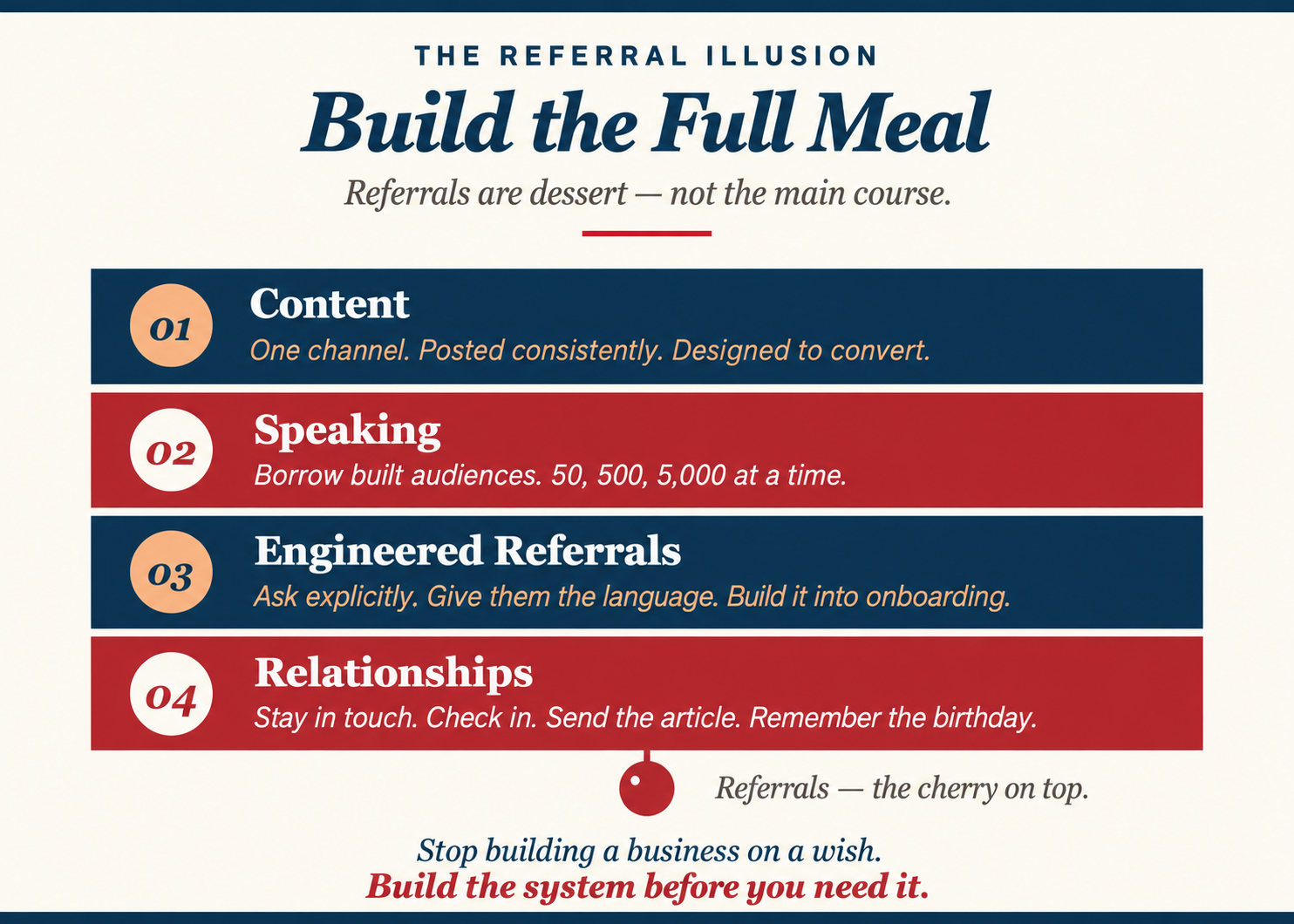
Let’s run the numbers on something most service-based business owners are quietly doing every single week: the referral coffee.

If you take two referral coffees a week (you know the ones, where someone “wants to learn more about what you do”) in a year, you’ve talked to 100 people. You’ve also probably gained 12 pounds from all the lattes. (No judgment. I’ve been there.)

Here’s the part that should make you pause: You’ve spent roughly 100 hours of your life saying “so tell me about your business” to strangers who may or may not ever hire you. That’s two and a half work weeks. Gone. Poof. Just oat milk and good vibes.

OR …

You could give one talk. Thirty minutes. Reach those same 100 people in half an hour instead of a full year. Same audience size, way less caffeine, and—plot twist—infinitely better margins on your time.

Stop Booking Coffee. Start Booking Stages. by Laura Berman FortgangThis is why I tell every service-based business owner I work with that speaking is the #1 way to grow your business. The onesie-twosie referral hustle, as lovely as it is, will keep you stuck in a loop of espresso and small talk.

Here are the four reasons why.

1. The One-to-Many Math

A referral conversation puts you in front of one person. A talk puts you in front of 20, 50, 200 prospects all at the same time.

These aren’t strangers you cornered at a networking event. These are people who showed up. They self-selected. They chose to be there. They’re already leaning in.

You can build a year’s worth of pipeline from one 30-minute talk, while your referral-loving friends are still scheduling their next “quick 15 minutes.”

2. Speaking Compresses the Know-Like-Trust Timeline

You know how referrals work. Someone has to meet you, like you, trust you, remember you exist three weeks later, and then hopefully hire you.

I’m tired just typing that sentence.

When you speak, you collapse all of that into 30 minutes. The audience sees your expertise, your point of view, and you doing your thing in real time. By the time you’re finished, they don’t feel like they’re hiring a stranger; they’re already much further down the sales funnel with you.

Sometimes there’s barely a sales conversation at all. Sometimes people walk up after a talk and ask, “How do I hire you?”

Music. To. My. Ears!

3. You’re the Only Authority in the Room

This one is sneaky-powerful.

When you have a referral meeting, that prospect might be talking to three other experts too. They’re comparing you. Checking you out. Maybe even Googling you mid-conversation.

But on a stage? You are the expert the host chose to bring in. You’re already vetted. The credibility and authority are baked into the moment you step up to that mic.

You’re no longer being evaluated. You’re being chosen.

That authority, my friends, pays the bills.

4. Every Talk Is a Renewable Asset

Here’s the part most people miss.

A coffee chat equals one possible client and a slightly elevated heart rate from caffeine. That’s it.

One talk equals the room you’re in PLUS the recording, the clips, the testimonials, the email signups, the host introducing you to their next event, and that one person in the audience who books you on their podcast and puts you in front of a whole new audience.

Referrals give you addition. Speaking gives you compounding.

__________________________________________________________

Your Challenge This Week

Stop booking coffee chats. Start booking stages.

It doesn’t have to be a TEDx Talk. (That comes later.) Start with a webinar. A podcast guest spot. A workshop. A 20-minute lunch-and-learn at someone else’s company. That’s how I started.

Just get in front of more than one person at a time.

The fastest path to a fully booked business isn’t in your inbox; it’s in front of a room.

Go book the stage, ditch the coffee circuit, and let me know how it goes.

Filed Under: Now What? Newsletter Articles Tagged With: Career coach, Career Coaching, Clarity, coaching, entrepreneurs, Now What Coaching, Opportunity

  • Page 1
  • Page 2
  • Page 3
  • Interim pages omitted …
  • Page 20
  • Go to Next Page »

Primary Sidebar

Pinpoint–and plan-a fulfilling "next chapter" of your career with the Now What?® Program

Start Today

Buy Now

Sign up for Laura’s mailing list so you don’t miss a thing!

[gravityform id=”3″ title=”false” description=”false” ajax=”true”]

Disclaimer |
Site Usage and Privacy Policy  |  Facilitator Zone

Copyright © 2026 Now What?® Coaching. All Rights Reserved.

Login

Lost Your Password?