• Skip to primary navigation
  • Skip to main content
  • Skip to primary sidebar
Now What?® Coaching

Now What?® Coaching

from Laura Berman Fortgang

  • Login
  • About
    • About Laura
    • Our Philosophy
    • Praise
  • Hire a Facilitator
    • Hire Laura
  • Become a Facilitator
  • Online Courses
    • Career Clarity & Direction
    • Career Clarity & Direction: Self-Guided Course
    • Job Search Academy
  • Products
  • Blog
  • Contact

Laura Berman Fortgang

The Referral Illusion: A Wish Wearing a Strategy Costume

By Laura Berman Fortgang on October 18, 2026

The Referral Illusion: Why Waiting for Word-of-Mouth Is Killing Your Business

When someone asks where your clients come from, do you say — oh, referrals mostly. Word of mouth?

It sounds great. It sounds humble. It sounds like a flex. It sounds like a real answer.

But today I’m going to tell you an uncomfortable truth.
Saying
“I get mostly referrals” is code for I have no marketing system.
Referrals
are my system, and I’m at the mercy of other people’s memory.

That’s why I call it the Referral Illusion.
We’re going to look at why it might be quietly killing your business.

What Most People Get Wrong About Referrals

Most coaches, consultants, and experts think a referral-based business is great, and for a while, it really does seem magical.
You don’t have to market. You don’t have to do anything. Clients just show up.
The Referral Illusion: A Wish Wearing a Strategy Costume by Laura Berman FortgangBut . . . the referral-based business has a dirty little secret. Referrals plateau. Sometimes they dip.
And then you go into a panic — you’ve got to do LinkedIn posts, find somebody who’ll be your next client, and you have no idea where the next one is coming from.

Why? Because you’ve built a business entirely dependent on other people remembering you. That’s a lot to ask.
That’s not a business strategy. That’s a wish wearing a strategy costume.

Referrals are wonderful. I love referrals. Everyone should get referrals. But they’re the bonus; they can’t be the plan.
If your entire client acquisition process is hoping someone brings up your name at a cocktail party, you don’t have a client acquisition process – you have a wish.

Why Passive Referrals Plateau

Let me name what’s actually happening when you rely on referrals.

Your referral sources forget about you.
They may love you, but they’re busy, they’ve got lives, they’ve got things going on. How many times a year does someone ask them,
“Do you know a good coach? An expert in X, Y, or Z?” Maybe once a year. Even your biggest fans aren’t thinking about you most days; that’s human.

Referrals send you clients they like — not necessarily your ideal client.
Here’s a personal example. In the twenty-five years I spent doing career coaching almost exclusively, I loved the part about helping people figure out what to do with their lives. I didn’t love doing resumes and job search strategy — that wasn’t my jam, that wasn’t what I was great at. But people constantly sent me referrals for exactly that, because they thought career coach, that’s what she wants. No. Your referral sources don’t always know who your ideal client is.

It’s wildly unpredictable.
There are real downsides to being referral-based only. You can’t scale on a wish, invest in a team, build systems, or carry overhead when everything is so random.

Three Practices to Fix It

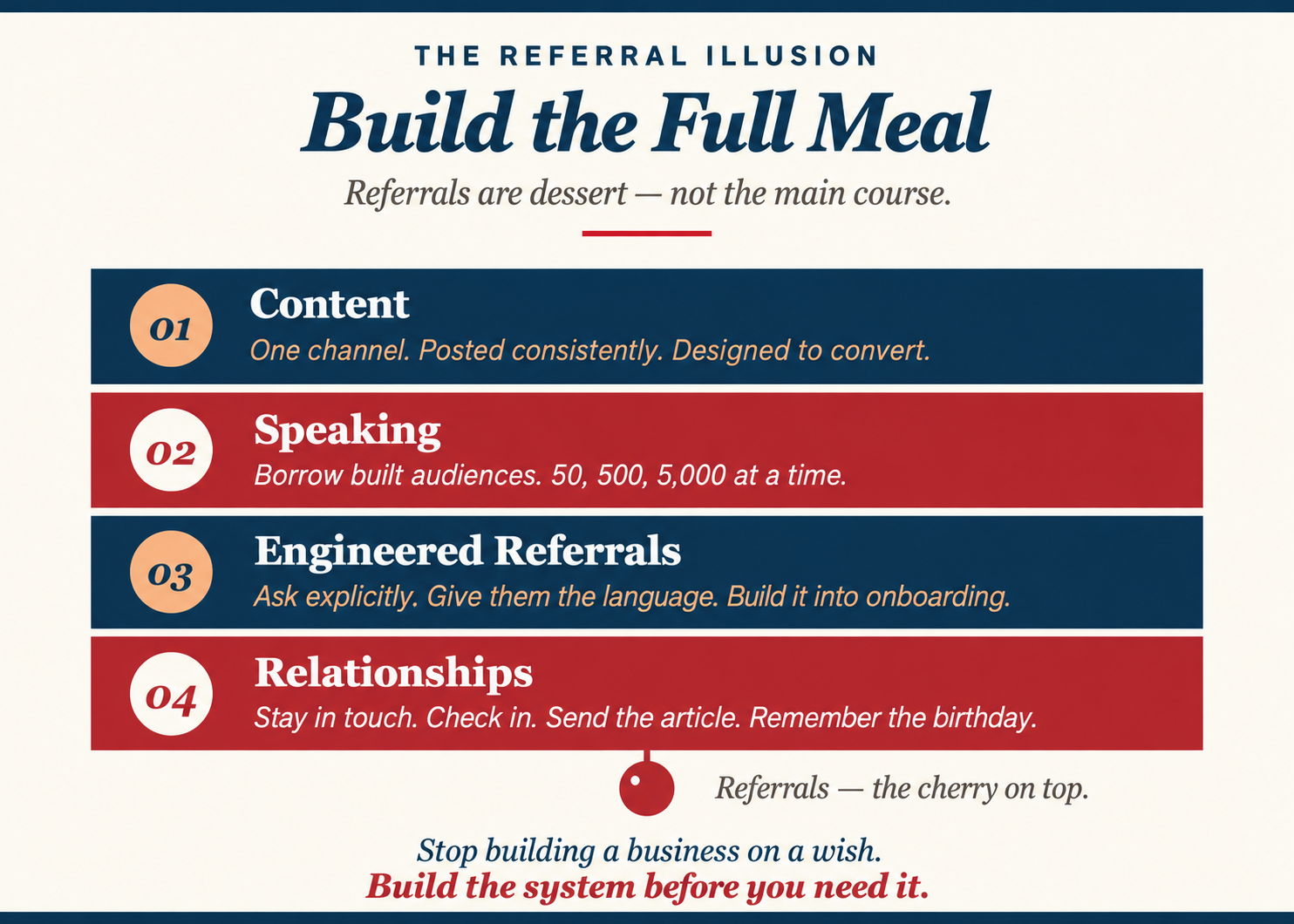
1. Build an actual marketing system alongside the referrals, not instead of them. This has two legs: content and speaking.

On the content side, pick one consistent channel — your newsletter, LinkedIn, a podcast — and show up regularly with content designed to convert, not just to be seen. (Go back and look at our Content Treadmill episode if you missed it. This is where that comes in.)

Here’s the piece most solopreneurs underuse — speaking. Getting in front of other people’s audiences is one of the most powerful ways to build a real pipeline. When you speak — on a stage, in a webinar, on a podcast, on an industry panel, inside a corporate event — you borrow audiences that someone else has already built. Instead of trying to collect one follower at a time, you’re in front of fifty people, five hundred people, five thousand if you’re lucky. These are people paying attention and getting to know you. They’re spending time with your voice and with your energy. They’re the people who will want to work with you.

We’re talking about volume here — not just the onesie-twosies that happen with referrals. Speaking generates referrals at scale. Every person in that room becomes someone who can hire you or introduce you.

2. Actively engineer referrals instead of waiting for them. Most of your clients would happily refer you — but they don’t know how and they don’t know when. So teach them. At the end of a successful engagement, say explicitly: If you know one person who’s dealing with X, I’d love an introduction. Give them the language they can use. Make an introduction request a normal part of off-boarding your clients. The best referrers aren’t the most generous. They’re the ones who’ve been given a clear directive on how to help you.

3. Stay in touch with your past clients and champions. Really build those relationships. Check in with people. Send birthday cards. Send an article. Tell them you were thinking about them. That’s relationship maintenance, and it’s a high-leverage activity for your business.

The Mindset That Makes It Stick

Here’s what I want you to really let sink in:
Referrals are dessert. They are not the main meal.

A sustainable business is built on a real marketing system — content that attracts the right people, speaking that puts you in front of them, offers that convert, and relationships you actively tend to. Referrals sit on top as a beautiful cherry on the sundae.

If you’re currently relying only on referrals as your primary strategy, you’re not humble, not low-key, not above the marketing game. You’re just one dry quarter away from a crisis. Anyone who’s been through one of those crises knows exactly what they say afterward: I wish I’d built the system sooner.

Build the system now — before you need it.

Your Homework This Week

Ask yourself one honest question:
If every referral source I have dried up tomorrow, how would I generate my next three clients?

If you have a clear answer — awesome! You have a system. Keep tending to it.

If you don’t — that’s your data point. This week, pick one thing. One piece of content to publish. One speaking opportunity to go after — a podcast, a webinar, a group, a conference. One past client to reach out to. One active referral ask to make at your next off-boarding meeting.

Just one step toward building something that doesn’t depend on luck.

Stop waiting for word of mouth to carry you.
Build real systems — content, speaking, intentional relationships.
And then, when the referrals
do come, they’ll just be the icing on an already very stable cake.

Yes — go get a referral. But better yet, build a marketing system.
Filed Under: Now What? Newsletter Articles Tagged With: Career coach, Career Coaching, entrepreneurs, Laura Berman Fortgang, marketing system, new direction, Now What Coaching, passive referrals, referrals

The Boundary Blur: Why Your Clients Are Treating You Like an Employee (And Why It’s Your Fault)

By Laura Berman Fortgang on October 11, 2026

When was the last time you got a client text, email, or message outside of regular business hours — and answered it right away?

Maybe it was a Saturday morning.
Maybe it was 10 PM on a Tuesday.
Maybe it was that
quick question in the DMs that turned into thirty minutes of back-and-forth.

If you just winced — welcome.

We’re talking about what I call the Boundary Blur: Why your clients have started treating you like an employee, and the uncomfortable truth about who actually trained them to do it.

What Most People Get Wrong About Client Boundaries

Most coaches, consultants, and experts think the problem is their clients.
They’re needy. They’re disrespectful. They’re demanding. They’re entitled.

That’s not the case.

The uncomfortable truth: You trained them, and only you can retrain them.

You trained them when you answered that after business hours text.
You trained them when you said yes to the extra ask.
You trained them when you didn’t put clear scope in your contract.
You trained them when you kept the Zoom running thirty minutes after the session should have ended.
You trained them when you let the discovery call turn into a free coaching session.

Every one of those moments taught them:
This is how it works. This is what I can expect. This is who she is to me — available at all hours of the day.

Now, mind you — some of you like giving that level of service, and that’s fine. I’m not talking to you. I’m talking to the people who are feeling burned out, crispy around the edges, and ready to do something about it.

The good news? You can retrain them. The bad news? Only you can do it.
Nobody else is going to walk into your business and set the boundaries for you because you are the business.

The Boundary Blur: Why Your Clients Are Treating You Like an Employee (And Why It's Your Fault) by Laura Berman Fortgang

The Three Most Common Boundary Blurs

Scope creep. You agree to one set of work, one project, one thing. Then they ask you about something adjacent. Then something tangential. Then something that has nothing to do with what you were hired for. You keep helping because it feels awkward in the moment to renegotiate. But six months in, you’re basically running their business for them and burning out doing it.

Time creep. You said the session was sixty minutes. It went ninety. You said the engagement was weekly. Now it’s daily texts and DMs. The 60-minute call that happened once at 90 minutes is now 90 minutes every time. You keep telling yourself it’s just this once. It isn’t.

Role creep. This is the sneakiest. Somewhere along the way, you stopped being the coach, consultant, or expert and started being the friend/the therapist/the on-call emotional support. It’s not a terrible thing on its own, but when you’ve become their 24/7 safety net, you’ve blurred your authority. You’ve blurred what you were hired to do.

These three blurs aren’t just an energy drain. They quietly erode the very thing clients hired you for — your authority. The more you blur, the less they treat you like the expert. The less they treat you like the expert, the less your work actually produces results for them.

Three Practices to Reclaim Your Boundaries

Put it in the contract. Everything that’s gone unspoken gets written down. Response times. Session length. What’s included. What’s extra. What happens when they miss a session. The clearer the contract, the fewer awkward conversations later. If you’re embarrassed to put something in writing — that’s exactly why you need to.

Use scripts to hold the line. When scope creep shows up mid-engagement, you need language ready to go. Try: “That’s a great question; it’s outside the scope of what we’re working on, but I’d love to talk about adding that to our engagement.” Or: “I want to give that the attention it deserves, so let’s talk about it on Monday.” The script is the boundary. Without one, you’ll default to over giving. With one, you have an exit ramp.

Charge for the extras — or stop giving them away. When a client wants more than what they bought, you have two options: Add an upsell – create an extra access package, or build in an hourly rate for out-of-scope work (that one’s more for consultants than coaches). The one option that’s not on the table anymore is giving it away for free and quietly resenting it. Because resentment is the final cost of a blurred boundary. It’s what leads to burnout, and it’s always more expensive than the money you were trying to avoid asking for.

The Mindset That Makes It Stick

Here’s what I want you to internalize:
Your clients are not your bosses, but they will be if you don’t hold the line.

Boundaries aren’t rude. They aren’t unfriendly. They aren’t bad for business. They are how you stay in business, and how you serve your clients well. They’re what prevents the burnout.

Every boundary you hold is a vote for your longevity, your energy, your results — and ultimately for your clients’ results too.

Your Homework This Week

Pick one boundary you’ve let slide — the late-night texts, the sessions that run long, the free advice between calls — and put it back in place this week. You don’t need to write a dramatic email. Just retrain them, quietly and clearly. Have a little script. Hold the line.

Coaches, consultants, and experts who’ve built the most sustainable businesses stopped blaming their clients, and they retrained them. Better yet — many of them never had to retrain anyone because they had clear boundaries written into their contracts and clear agreements from the beginning. That’s the best way to deal with it. But if you have to correct — you can correct and retrain.

Here’s the secret nobody tells you:
Clear boundaries don’t lose you clients. They’re how you get to keep doing the business you love.

Filed Under: Now What? Newsletter Articles Tagged With: boundaries, boundary blur, Career coach, Career Coaching, Clarity, coaching, entrepreneurs, Laura Berman Fortgang, take action

Showing Up: I almost hid in my room

By Laura Berman Fortgang on October 4, 2026

Showing Up: What Happened When I Stopped Hiding at a Conference

I’m writing to you fresh off a trip to Des Moines, Iowa, where I attended the International Coaching Federation’s Midwest Conference. I went to speak, but I came home with a lesson I’ve been teaching for years and lived out loud for myself. It’s about showing up, and it turned into two exciting business opportunities in a single day.

A Confession About Conferences

Have you ever gone to a conference or event and just wanted to hide?

You know the pattern. There’s a buzz of anticipation before you go. You’ve studied the agenda and picked the sessions you want to attend. Then, in-between those sessions, when everyone else is milling around the lobby, chatting over coffee, and swapping stories, you find yourself slipping back to your hotel room to recharge.

If that sounds familiar, you’re in good company because I’m describing myself.

When I’m at an event to speak, my habit is to conserve my energy. I tell myself I need to save it for the stage. I don’t want to talk to too many people. I’m polite, I’m present for my session, and then I quietly disappear.

This time, I decided to take my own advice.
I chose not to do my usual hiding.
I really showed up, participated fully, and did my thing.
The results surprised even me.

Two Opportunities in One Day

By the end of a single day, I had two tremendous opportunities on the table.

The first could possibly take me to Tokyo. The second is a chance to work with a large coach training organization, bringing the business side of coaching (the actual business of coaching) to their people.

Two business opportunities in one day. Not bad, right?

None of that would have happened if I’d spent my breaks hiding in my room. Opportunity doesn’t knock on your hotel room door. It lives in the hallways, in the lobby, at the lunch table, and in the conversation you almost didn’t start.

Showing Up: What Happened When I Stopped Hiding at a Conference by Laura Berman Fortgang

What “Showing Up” Really Means

Let me be clear about what I’m not talking about. Showing up doesn’t mean pressing your business card into every hand that passes by, or pitching everyone you meet with a free offer before you’ve even learned their name. That approach turns people off, and it’s exactly the image many of us have in mind when we cringe at the words “networking” or “schmoozing.”

What I’m talking about is genuine connection.

The people who are successful tend to be the ones who know how to work a room, and they do it not from a sleazy, transactional place but from real curiosity and openness. They ask themselves questions like these:
Is there someone here I’d love to be introduced to?
Is there someone I’ve been meaning to meet for a long time?
Did someone just step off that stage whom I’d like a minute with?

Then they go for it.

Three Practices to Help You in Showing Up

How do you actually do it, especially if (like me) your instinct is to retreat?

Here are three practices you can put into play at your next conference, event, or gathering.

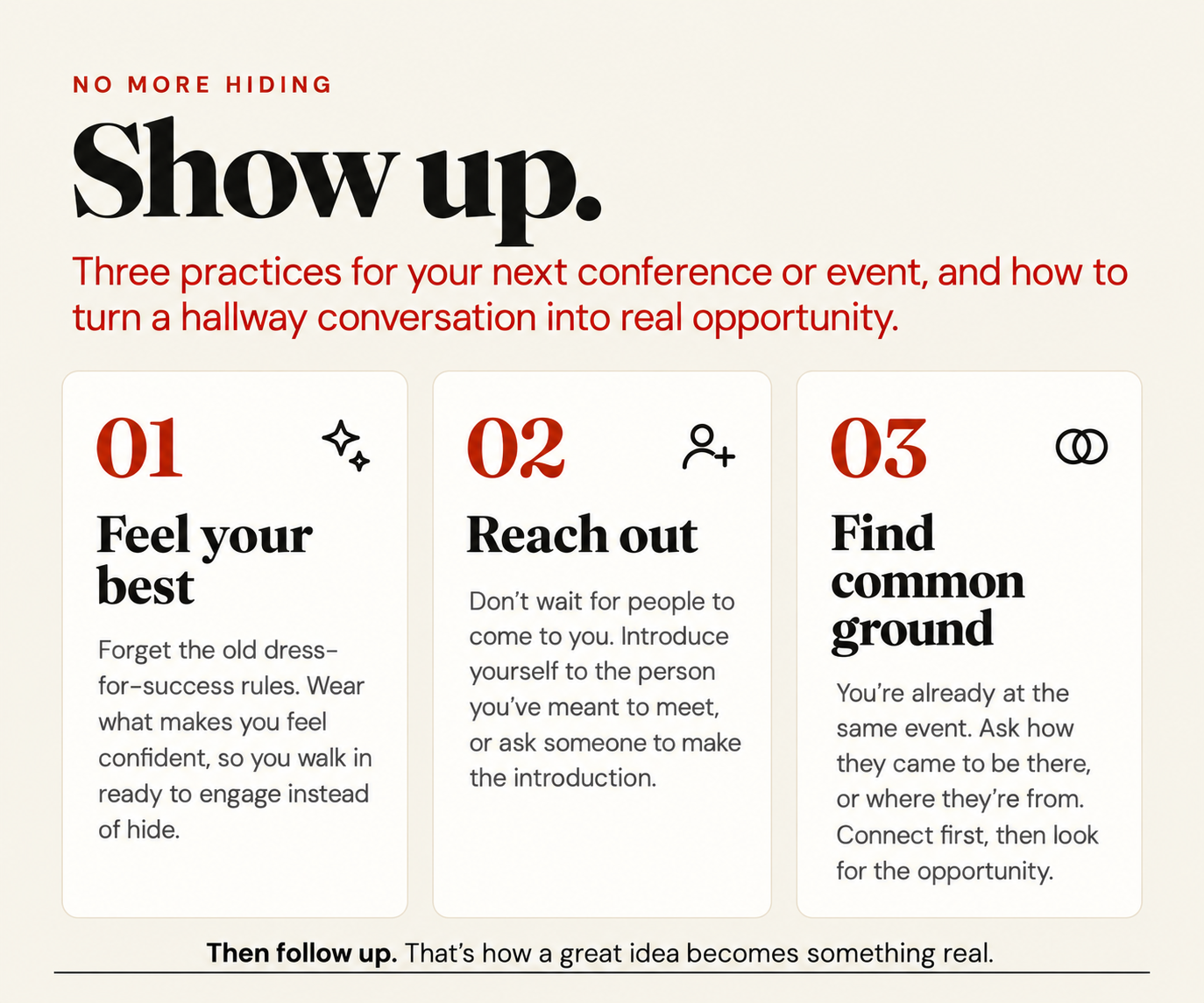
1. Feel your best.
The old “dress for success” rule book, with its mandatory suits and rigid expectations, is long gone. What still matters is how you feel in what you’re wearing. Choose clothes that make you feel good, confident, and like yourself. When you feel your best, you carry yourself differently. You’re less likely to shrink into a corner and more likely to walk into the room ready to engage.

2. Reach out.
Don’t wait for people to come to you. If there’s someone you’ve been meaning to meet, walk over and introduce yourself. If you don’t feel comfortable approaching them cold, find someone who knows them and ask for an introduction. Most people are happy to connect others. It feels good to be the bridge. The only thing standing between you and that conversation is the decision to initiate it.

3. Find common ground.
This is where most people get stuck. You’ve worked up the courage to approach someone, and then your mind goes blank:
What do I say? The good news is that at any event, common ground is built in. You’re both there for the same reason – start there. Ask how they came to be at this event. Ask whether they’re from the city you’re in, or what brought them there. Ask which session has been their favorite so far. There’s no shortage of natural openers, and each one creates a small moment of connection before you ever get to the business part.

Once that connection is established, don’t be shy about looking for the opportunity. If there’s a way you might work together, help each other, or stay in touch, say so. People appreciate directness when it comes after genuine rapport.

Beyond Showing Up: Following Up

Here’s the piece that separates a nice conversation from a real opportunity: Follow-up.

It’s easy to leave an event buzzing with ideas and promises: “We should definitely work together!” or “Let’s talk next month!” But without proper follow-up, those exciting exchanges remain heat-of-the-moment enthusiasm that fades by the time you’ve unpacked your suitcase.

When you follow up well, you turn “That was a great idea” into “This is actually happening.” It’s so important that I’ll be devoting an entire future broadcast to it, covering how to follow up, when, and what to say. Stay tuned for that one.

Giving Myself Some Credit

I want to share one more small moment of showing up. When it came time to go live from Des Moines for my weekly broadcast, I couldn’t get a reliable internet connection in my hotel room. I ended up broadcasting from the lobby after jumping through quite a few hoops just to be there.

I’m giving myself credit for that, and I encourage you to do the same whenever you choose to show up even when it’s inconvenient or uncomfortable.

Those small acts of commitment add up.

Your Invitation This Week

Here’s my challenge to you:
At your next conference, networking event, or even a neighborhood gathering, notice the urge to hide, and then choose to show up anyway.

Feel your best.
Reach out or ask for an introduction.
Find common ground.
Then follow up.
Show up one hundred percent and stay open, because that’s where the opportunity is.

No more hiding. Go forth and prosper!

Filed Under: Now What? Newsletter Articles Tagged With: Career coach, Career Coaching, entrepreneurs, follow up, Laura Berman Fortgang, Now What Coaching, Opportunity, showing up

The Authenticity Advantage: Three ways to stop looking like everybody else

By Laura Berman Fortgang on September 27, 2026

The Authenticity Advantage: Why Bringing More of Yourself Is Your Best Branding Strategy

If someone landed on your website, your Instagram, or your LinkedIn right now — would they know it was you?
Or would it look like every other coach, consultant, expert, or leader in your space?

Same colors. Same fonts. Same headshots against the white brick wall. Same three-word taglines. Same buzzwords. Same everything.

Let’s talk about the Authenticity Advantage — how it’s your best branding strategy, and why bringing more of yourself into your business is not a distraction from your brand; it is your brand.

What Most People Get Wrong About Branding

Most entrepreneurs think branding is your colors, your logo, your website, your fonts, the Canva template you spent three days making.

Those things are important; I’m not knocking them. But they’re the packaging, not the product.

Real branding is how your work makes people feel. What is the ethos of it? It’s that specific flavor of you that comes through in your content, your delivery, your voice, your way of being, your point of view.

It’s what makes someone say: I don’t just want a coach. I want that coach, that consultant, that employee.

The Authenticity Advantage: Three ways to stop looking like everybody else by Laura Berman FortgangThat flavor doesn’t come from getting more polished. It comes from letting more of your actual self show.
Your passions. Your hobbies. Your gifts. The things you love. The season of life you’re in.
The stuff you normally leave out because you think it’s not professional enough.

Because in a world where every coach and every internet expert is starting to sound alike, the most strategic thing you can do is refuse to blend in. Bring more of yourself to the picture.

What This Looks Like In Real Life

I have a client who’s a coach and also loves to knit. Instead of leaving that as just a hobby, she brought together a knitting circle — a group coaching container where women knit together and get coached at the same time. It’s completely differentiated. Nobody else is doing that. And it fills up because her people don’t just want coaching; they want the community, the hobby, the togetherness. Her passion became her hook.

I have another client, a retiree, who was trying to get a life coaching business off the ground and told me, I don’t want to work so hard. I don’t want to grind through all this marketing. This isn’t fun. So we found what was fun. She loves helping people write their memoirs — not full books, just stories about their memories. We saw quickly how that could become her coaching. Not that she’s a writing coach — she uses the past that people surface in their memoirs to inform the future they want to create. Same coaching skills. Completely new brand. Instantly recognizable in a crowded market.

On a personal note — you might notice if you see me online, I’m going for a Cruella de Vil look. I’ve decided to grow out my silver after much struggle and consternation. Will it be professional? Will it make me look older or younger? Will there be ageism? Prejudice? You know what — maybe there will be. But I’m at a stage of life where I’m ready to let it show. Stop coloring. Stop performing. Start being. That’s the lesson I’m teaching my clients, and I’ll let you know how it goes. (By the way — authentic also means changing your mind. So if you see me go back to all-dark, you’ll know why.)

Your knitting. Your memoir writing. My silver hair.
These aren’t distractions from your brand; they
are your brand.

The Authenticity Advantage – Three Practices to Bring More of You Into Your Business

Take inventory of what you’ve been hiding.
Sit down and make a list of things about yourself you’ve kept out of your professional life. Maybe you don’t think they’re cool, but write them anyway. Your interests. Your unusual background. The book obsession, the sport, the second language, the weird collection, the personal story, the phase of life you’re in. Anything you’ve decided isn’t
professional enough. If you’ve followed me long enough, you know I was a musical theater performer in a past life, and every now and then, I’ll do a Broadway-inspired newsletter. That’s me bringing my hobby in.

Look for the intersection.
Where does one of your passions intersect with what your clients actually need? Not everything on the list will become an offer. But sometimes there’s a beautiful overlap that everyone else has been missing, like my knitting-circle client or the memoir client. Here’s another one: I know a gentleman who worked on a NASCAR pit crew. He turned that into a leadership and teamwork experience for corporations. He takes them out on the track and teaches them to work as a team doing pit crew work. Nobody else does this to teach leadership. That’s the intersection.

Let the messy be seen.
We always think we have to be perfect, polished, tightened up. But sometimes the truth is you’re going through something — a new season, a body change, a health journey, a creative pivot, a late-life reinvention — and letting people see that process is what makes them trust you. Authenticity isn’t just about hobbies; it’s about honesty.

Authenticity Advantage – The Mindset That Makes It Stick

Here’s what I want you to internalize:
Branding is not what you put on top of your business.
Branding is what leaks out of you when you stop trying to look like everybody else.

Your colors, your logo, your website — those are the wrapper and the container. But the reason someone picks you over the ten other people they looked at? That’s you. Your voice, your point of view, your knitting, your memoir obsession, your silver hair, your dog, your pit crew knowledge, your late-life reinvention.

You’re not too much. You’re not too weird. You’re not too niche. You’re just under-integrated.
Integrating who you actually are into what you actually do is the most powerful branding move you’ll ever make.

Your Homework This Week

Take the inventory. Make the list.
Then pick one thing you’ve been keeping out of your business — one hobby, one passion, one part of who you are right now — and let it into your content this week just once. A post. A story. A newsletter mention. A photo.

Notice the world doesn’t end. People don’t judge you as much as you think they will.
Most of the time, the right ones lean in and get
more interested.

Stop trying to look like the industry template.
Be messy. Be real. Be specific. Be you.

Filed Under: Now What? Newsletter Articles, Lessons Learned, Marketing and Visibility Tagged With: branding, Career coach, Career Coaching, entrepreneurs, Laura Berman Fortgang, marketing, Now What Coaching, take action, visibility

Priced to Feel Safe – Three Signs It’s Time to Raise Your Rates (or ask for that raise)

By Laura Berman Fortgang on September 20, 2026

Priced to Feel Safe: Why What You Charge Has Nothing to Do With What You’re Worth

When was the last time you thought about raising your prices — and then chickened out? You talked yourself right out of it!

Maybe you rehearsed the new number in your head.
Maybe you went so far as to write the email to your clients.
Maybe you told a friend you were
going to do it.
But then somewhere between the plan and the actual asking, your stomach dropped, your nervous system went haywire, and you quietly kept charging what you were charging, or if you’re in a corporate setting, stayed at the salary you were at.

Here’s what actually happened: You priced to feel safe.
I want to tell you why
safe pricing is one of the most expensive habits you have in your business.

What Most People Get Wrong About Pricing

Most coaches, consultants, and experts think what they charge is a reflection of their self-worth. So every time you set a price — or go to raise a price — you’re not making a business decision. You’re taking a personal referendum on your value as a human being.

That’s why it feels so terrifying.
That’s why people round
down instead of rounding up.
That’s why you offer discounts nobody asked for.
That’s why, when a prospect flinches at your fee, you cave — or worse – you apologize.

I’ve seen this over and over and over.

But the truth is: pricing is a business decision, not a self-worth decision. Your rate has nothing to do with whether you’re a good person, valuable as a coach, or valuable as an employee. It doesn’t indicate whether you’re worthy of taking up space in the world. It’s about the value the marketplace receives, the market you’re in, and the business you’re actually trying to build.

Most solopreneurs have never been taught to separate their worth from this business decision.
Therefore, every pricing conversation becomes an identity conversation.
When your identity is on the line — of course you price to feel safe. Who wouldn’t?

The Expensive Truth About Safe Pricing

Cheap pricing isn’t humility. It isn’t accessibility. It isn’t kindness.
Most of the time, it’s just fear in a generosity costume.
(Pause on that for a minute.)

The version of you that’s afraid to charge more is also the version of you that stays exhausted, stays small, and stays stuck. That safe number in your head isn’t protecting you; it’s keeping you exactly where you don’t want to be.

Priced to Feel Safe: Three Signs It's Time to Raise Your Rates (or ask for that raise)

Three Signs It’s Time to Raise Your Rates

You’re booked or close to it.
If your calendar is just about full and you can’t take anybody else on, it tells me you’ve probably been undercharging for a while. Demand has to exceed supply for you to raise your fees. If you’re already at capacity, the market has been telling you for months that your price is too low. Every full calendar is a message from the market.

Your results have gotten better, but your pricing hasn’t.
Let’s say you set your prices three years ago. Since then, you’ve completed more certifications. You have deeper expertise. You have better outcomes with your clients. But you’re still pricing based on who you
were. Solopreneurs and entrepreneurs evolve. If your value has doubled and your prices haven’t gone up? That’s not humility; that’s a math problem – charge more.

Your ideal clients are saying yes too easily.
I know this one is surprising, but when people don’t flinch, don’t argue, don’t take a moment to think about it – no one’s negotiating with you — your price is likely too low. When they say yes really quickly, you probably can charge more.

I don’t want to sound totally mercenary, but there’s nothing wrong with making money. The marketplace will bear it in a lot of instances. When everyone says yes without blinking, you’re probably leaving money on the table.

Corporate leaders — this is where it applies to you too. For salary negotiations, budgets, and internal work, the same emotional patterns show up in salary conversations that show up in fee-setting. Same trap, different setting.

The Mindset That Makes It Stick

Here’s what I really want you to embrace: You are not your price.

Your price is a number attached to a service in a market. It can go up, it can go down, it can be tested and adjusted. And it has nothing to do with your worth as a person, your value as a coach, or your right to be in business.

Set a number. Test it. Watch how the market responds. Then adjust.
You’re not going to die. Everything’s going to be okay.

Your Homework This Week

Look at your pricing and ask yourself one honest question:
If a colleague I respected charges what I charge, would I think they were charging enough?

If the answer is no, you have your data. Now the only question is whether you’re brave enough to act on it.

Pick one offer. Raise the price. Not by five percent; that’s still safe pricing. Raise it by an amount that would make you slightly uncomfortable. Say it out loud and just once — and notice, you’re not going to die. Most of the time, the client says yes.

Stop pricing to feel safe. Price to grow!

Let your worth exist somewhere outside what the market can touch.
Let your worth live in the rest of your life — not in your fees, not in your salary.

Filed Under: Now What? Newsletter Articles, Lessons Learned, Taking Action Tagged With: Career coach, Career Coaching, entrepreneurs, Laura Berman Fortgang, priced to feel safe, raise your prices, saef pricing, self-worth decision, take action

The Content Treadmill: You Can’t Deposit Follows Into Your Bank Account

By Laura Berman Fortgang on September 13, 2026

The Content Treadmill: Why “Just Post More” Isn’t a Strategy

How many of you are sitting there right now thinking, I should be posting more on social media?

If that’s you — and it’s most business owners I know — welcome to the Content Treadmill. That feeling of never publishing enough.
Could you do more?
Could you show up live?
Could you make more reels?
Send more newsletters?
Be on LinkedIn every day?
Then
your business will finally take off.

I want to tell you the uncomfortable truth: running faster on that treadmill isn’t going to get you where you want to go.

What Most Business Owners Get Wrong About Content

You’ve been told over and over, by every marketing guru with an audience to sell to, that visibility equals content. Post more. Show up daily. Feed the algorithm. Be everywhere.

I totally believe in visibility. Feeding the algorithm matters, but it doesn’t have to be a grind.

Right now, you’re posting, you’re batching, you’re scheduling.
You spend every Sunday writing captions.
You’re filming reels in your bathroom.
You wake up thinking about your content calendar.

However, the sales aren’t matching the effort.
Nobody’s talking to you in the DMs.
People aren’t getting on your schedule to talk about working with you.
Your revenue isn’t reflecting the hours you’re pouring in.

Here’s why – Content is not the goal. Trust is the goal.

The Content Treadmill: You Can't Deposit Follows Into Your Bank Account by Laura Berman FortgangPosting more doesn’t automatically build trust. Sometimes it actually erodes trust because you’re producing content that doesn’t really speak to anything. Being visible just for the sake of being visible isn’t what grows a business.

The people you watch converting followers into people who pay them? They aren’t posting more than you. In a lot of cases, they’re posting less. But everything they post does a specific job. And that’s the difference between a content strategy and a content treadmill.

Visibility Content vs. Conversion Content

Let me draw a distinction most solopreneurs have never been taught. There are two kinds of content, and they do very different jobs.

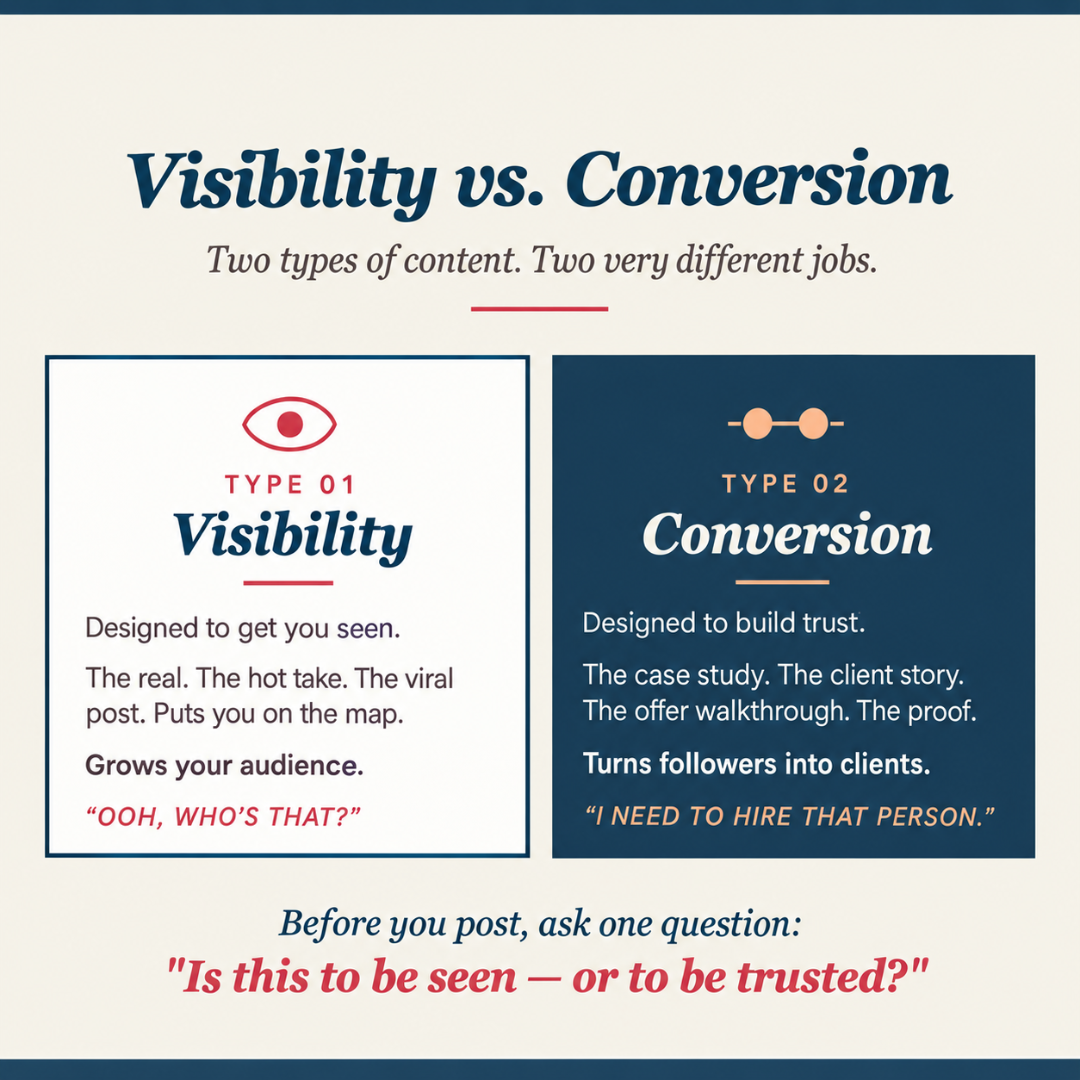
Visibility Content is designed to get you seen. It’s the reel that goes viral. The post that gets shared. The hot take that racks up comments. You get the dopamine hit of watching the followers tick up, the likes roll in, new people saying, Ooh, who’s that? Visibility content puts you on the map.

Conversion Content is designed to build trust with the audience you already have. It can be a smaller audience, and that’s okay. It’s the case study. The behind-the-scenes look at how you work. The client transformation. The specific way you solve a specific problem. The walkthrough of your offer. Conversion content turns followers into leads, and leads into clients.

Most solopreneurs live almost entirely in visibility content. They’re chasing views and likes and follower counts, but you can’t deposit follows into your bank account. Followers who don’t trust you don’t buy from you.

Here’s the twist: you can have a huge audience and still be broke, or a tiny audience and be booked out.
It’s not about the number of people watching.
It’s about whether the right people trust you enough to hire you.

It’s okay to live in the visibility world sometimes, but we want to do it for a reason, not just to be a placeholder.
Skew your content mix heavily toward conversion.

Three Practices to Get Off the Content Treadmill

Audit your last thirty days of posts. Go back and look at what you’ve been putting out for the past month. Mark each one: visibility, conversion, or neither. I’ll bet you’ll find that about eighty percent of what you did was visibility. That’s okay; that’s what we’ve been told we have to do. But now you know exactly why the content isn’t affecting your revenue.

Build a lean content system, not a content fire hose. You don’t need to post every single day; you need to post intentionally. Pick a rhythm you can actually sustain — maybe three times a week — and post with purpose. Before you hit publish on anything, ask one question: Is this to be seen, or is this to be trusted? That’s your new distinction.

Treat content like breadcrumbs, not billboards. Let everything you post lead to something else. What do they do next? Do they get a free download? Sign up for your newsletter? Follow you? Book a discovery call? Read your next post? Have a call to action. Let people know Here’s where to go next; here’s how to work with me. When you’re strategic like this, your content stops being decoration and starts being a system.

The Mindset That Makes It Stick

Here’s what I really want you to get: Being seen is not the same as being hired.

Chasing visibility feels like doing business. You can watch the numbers go up, get those little dopamine hits. But you can’t measure any of it in real revenue unless you’ve gone viral and you have millions of followers, which would be great in itself. For most of us, that’s not the game.

The game is trust. Trust comes from posting specifically — from letting the right people see exactly who you are, exactly what you do, and exactly how you can help them.

You don’t need a bigger audience. You need a convinced one.

Your Homework This Week

Do the thirty-day audit.
Was it visibility content? Conversion content? Or neither?
And if it was neither — learn from that. Don’t post like that anymore.

Post strategically. Stop confusing a lot of activity for progress.
Get off the treadmill and start building content that actually converts — not content that just adds to the noise.

Because the solopreneurs, consultants, and experts building the boldest, most sustainable businesses in the world stopped mistaking motion for progress. They got off the treadmill and built something that actually converts.

Filed Under: Now What? Newsletter Articles Tagged With: Career coach, Career Coaching, Clarity, content treadmill, entrepreneurs, Laura Berman Fortgang, Now What Coaching, posting content on social media, strategy on posting to social media, trust vs. visibility on social media

  • Page 1
  • Page 2
  • Page 3
  • Interim pages omitted …
  • Page 34
  • Go to Next Page »

Primary Sidebar

Pinpoint–and plan-a fulfilling "next chapter" of your career with the Now What?® Program

Start Today

Buy Now

Sign up for Laura’s mailing list so you don’t miss a thing!

[gravityform id=”3″ title=”false” description=”false” ajax=”true”]

Disclaimer |
Site Usage and Privacy Policy  |  Facilitator Zone

Copyright © 2026 Now What?® Coaching. All Rights Reserved.

Login

Lost Your Password?