“It’s never too late to be what you might have been.” George Elliot
Blog
-
Now What? Q &A: Franchise with a family member?
 A caller from Spokane, Washington presented this question on a recent Community Call; answered by: Laura Berman Fortgang.
 Question:
I am a registered nurse and fitness trainer and recovering from knee surgery. I don’t want to leave the industry but I know it’s taken a toll on my body, so I’m trying to figure out what’s next. There is the possibility of opening a franchise with my brother. Even though he’s been successful with other franchises, I’m feeling a bit fearful. Do you have any thoughts that might help me assess this opportunity?
Answer:
As a post-op patient, you now have something in common with your clients and patients. It’s clear from what you’ve described that you don’t want to leave the industry. While I’m not an expert in franchises, there are some issues to consider regarding money and risk and going into business with a family member. You’ll want to talk about things such as: your expectations, roles, escape clauses if it doesn’t work out, and how this with affect your relationship with each other. It’s essential to have that conversation first, yet many don’t. Research is also important. It’s great that he has a track record, however you want to weigh the risks and not necessarily mortgage your whole future. In other words, think about how much you want to invest. Is it all your dime or could you have a small ownership piece and be one of his managers? Perhaps you could pay as you go and buy him out over time, so that your initial risk is lower.
Also, I find that a lot of people will have a theme throughout their lives. I encourage you to do some of the exercises from Now What? (especially chapters 4 and 5) and see what your purpose is and what these themes are. Your purpose may have transmuted over time and changed vehicles, i.e., nursing was first and now there is another vehicle emerging. You want your discoveries in this exercise to be your guide for this franchise opportunity. Does it really match who you are or is it an ungrounded move? The bottom line is look before you leap both financially and emotionally.
-
Today’s Quote: Great Things
“Great things are done by a series of small things brought together.” Vincent van Gogh
-
Now What? Q &A: Doubts, Fears, & Big Undertakings
Today’s question is an excerpt from Ginny’s interview with lawyer-turned-chef, Andy Broder, highlighted in yesterday’s article.
GINNY: Once you decided to build your own studio, was there any point where you had doubts or fears arise? And if so, how did you deal with them?
ANDY: Well, I think there are always doubts. I don’t think I had doubts about specifically wanting to do it. I knew that it was for me going to be a big undertaking. I think that when you’re in the mode of saying, “I like this prospect and I think it’s going to be good,” and you’re being creative about it and you’re practical at the same time, and you’re applying tools to take ideas and turn them into something that’s a real thing, that if you are excited about it, you have concerns or those fears but you deal with them and you keep moving towards your goal.
-
Cooking Up a Change: Lessons from a Lawyer Turned Chef
by Ginny Kravitz, Deputy Editor
Pre-Cooking
As a kid, Andy Broder spent his Saturday mornings watching Julia Child on TV, but a career in cooking wasn’t even on the radar. It’s hard to imagine now but this was before celebrity chefs and Food Network. Viewing cooking as a hobby, Andy chose the field of law for his career and became a litigator.
Change Brewing
After five or six years, Andy had the vague sense that he would not be practicing law for the rest of his life. His dissatisfaction grew and he began to entertain the idea that by age 40 or so, he would transition to a new career, whatever that might be. A few years ahead of schedule and after 12 years practicing law, a potential change in his firm’s partnership arose and it became a natural time to leave. With no specific destination in mind, Andy sold his interest in his firm and decided to take some time off. “Because sometimes not doing anything is really doing something.”
He thumbed through books in the library and contemplated various professions. “But I always kept going back to the food section.” Andy’s decision to enroll in Scottsdale Culinary Institute was made with the rationale that even if he ultimately chose not to have a food career, he would be happy to have the knowledge. In that case, he would call it a sabbatical and could always go back to practicing law.
He followed his instincts and, rather than take a kitchen assignment at a hotel or restaurant, Andy obtained an internship on his own, writing for the Food Section of the Los Angeles Times. There he felt he would learn the most and be able to do what he loved: develop recipes and test them. Stating that he studied as hard for the culinary exam as the bar exam, Andy graduated with a 4.0 GPA and was a graduation speaker. “I wanted to get 100%.”
A Career That Cooks
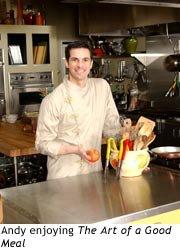
Andy describes his process after graduation as part Zen in approach. “I continued to do what I liked and test the waters of what I thought I was going to like.” After five years of teaching around town, he decided to pursue the vision that was taking shape: his own “culinary studio” — a term he has registered as a trade name. To do this, he added some very practical disciplines into the Zen mix, namely a 20-page business plan and precise design specifications that would transform a former Pilates space to the kitchen and studio he envisioned.
AndyFood opened in 2003 and today offers cooking classes to the public, team building for organizations, client appreciation events, and private parties. Operating with the mantra of “the art of a good meal”, Andy has observed that people like being part of a creative process. Classes culminate with a buffet of the students’ collective culinary creations which Andy says produces the feeling of being part of “something bigger than you”.
Commenting on how house parties usually end up with everybody in the kitchen, Andy says that part of his own enjoyment with AndyFood is that on a daily basis he gets to be “in the kitchen where people are having a party”.
When I asked Andy what he would say to someone who is contemplating a career change, he offered: “I think people should do something they really care about.” He then added that it’s important to be wary of “ruining your hobby” because not every hobby is meant to be turned into a profession.
“So, you haven’t ruined it for yourself?” I asked, “You still love to cook?” Andy’s answer: “I do.”
“I didn’t find a place where my peg fit into that shape hole.
I sort of created my own space to do what I want to do.”
—Andy BroderSee Also: How Careers Are Made, 8 lessons we can take from Andy’s story.
Complete interview posted here.