
The Owner’s Trap: Why Your Business Is Only as Big as You Are
When was the last time you tried to take a real vacation? Not a working vacation where you checked your email and had your phone going the whole time — a real vacation, where nobody needed you.
If the answer is Ha, that hasn’t happened in years — or worse, The last time I tried, my business almost fell apart — then you’re stuck in what I call the Owner’s Trap. Today I want to help you climb out.
What Solopreneurs Get Wrong About Their Business
Most solopreneurs, coaches, consultants, and experts think they’re building a business.
What they’re really building is a job.
A job you can’t sell.
A job you can’t quit.
A job you can’t leave for two weeks without the whole thing falling apart.
There’s a huge difference between being self-employed and owning a business.
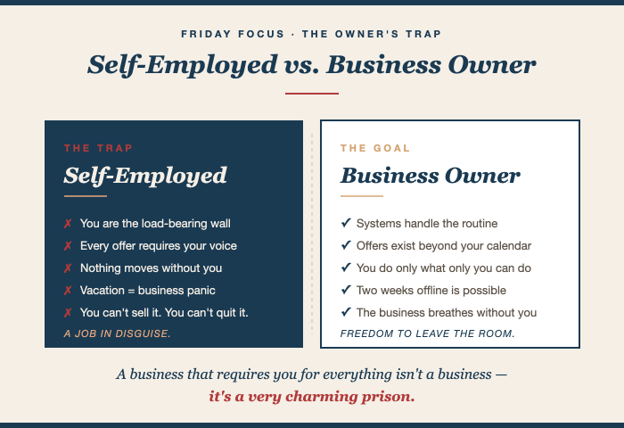
Self-employment means everything relies on you. You are the load-bearing wall. Nothing happens unless you’re there.
Owning a business — even a one-person business — means you have systems, structures, and offers that don’t require you to be present at every single moment.
Here’s the kicker: this isn’t about getting bigger. You can be beautifully profitable as a one-person shop and still not be in the Owner’s Trap. The trap isn’t about size — it’s about dependency. It’s about whether everything relies on you being switched on.
How You Got Here
You built it this way on purpose, even if you didn’t realize it.
In the beginning, everything was about you. You were the brand. You were the offer. You were the sales team, the admin, the delivery team, the marketing department. And it worked; your presence was the value. Clients hired you because they wanted you.
Here’s what nobody tells you: this model has a ceiling. It could be a dollar amount. It could be a number of clients. Whatever it is, at some point you stop growing. You start suffering. You get resentful. You start getting the Sunday scaries about the business you built. Not your job — the business you built!
Whether you’re a coach with a full one-on-one practice, a consultant charging by the hour, or a corporate leader who’s become the bottleneck on your own team — same trap, different costume. If everything runs through you, everything stops when you do.
Three Practices to Climb Out
Do the “only me” audit.
Sit down and write every single thing you do in your business in a typical week. Every task. Every email. Every meeting. Every proposal. Then ask one question of each item: Is this something only I can do? Not should only I do. Only I can do.
Most of what’s on your list — the scheduling, the invoicing, the admin, the follow-ups, the formatting — is not you. That can be done by someone else, or systematized, or eliminated. Even as a one-person shop, getting yourself out from under everything that isn’t only you changes everything.
Separate your delivery from access.
Right now, most of your offers require you to be there. You’re the teacher, the coach, the deliverer, the everything. So think about other ways to generate revenue that don’t rely on you being in the chair. A membership. A small group. A course. A cohort. Something that delivers more value to more people without demanding more of your time. You don’t need to overhaul everything, but add at least one offer that isn’t dependent on you being live in the room.
Build a business that could survive you being offline for two weeks.
Pick a date six months out. Whether you actually take the time off or not (I won’t be watching) design toward it. What would need to be in place? Automated payments. A support inbox someone else can answer. Client onboarding that doesn’t require you.
When I was writing for Redbook Magazine years ago, I told them I was taking the whole month of August off. Nobody wanted to respect that. They were looking for me. I didn’t return calls. I didn’t answer the phone. I literally took a month off. And it took me a year and a half to get ready for that month. So I know how hard this is, but you can do it.
The Mindset That Makes It Stick
Here’s what I want you to internalize:
You are not your business; you have a business.
The healthiest thing you can do for it — and for you — is to stop being the only load-bearing wall.
Most people wear their over-involvement in the business like a badge of honor. Nothing can happen without me. No one can do it like me. I have to be the one. Some of that is true. Most of it is ego dressed up as devotion. And it’s the exact story that’s keeping you trapped inside a business that can’t grow.
A business that requires you for everything isn’t a business. It’s a very charming prison.
Your Homework This Week
Do the “only me” audit. Take twenty minutes, list what you actually do in a week, and mark each item — only me, or could be systematized, delegated, or deleted. Then pick one thing off that second list, just one, and build a system for it, get it off your plate, or stop doing it entirely.
Because the solopreneurs, consultants, and experts building the most sustainable businesses stopped making their presence the value. They built businesses that could breathe without them. They gave themselves the one thing every stuck owner secretly wants — the freedom to actually leave the room every now and then.
While we’re still in August and it’s still vacation season — go take one. Or plan for a better one next year.