
The Delegation Lie: Why You Can’t Hand Anything Off (And It’s Not Because They’d Mess It Up)
What’s the one thing in your business you know you should be delegating, but every time you think about handing it off, you hear yourself say, nobody can do it as well as I can?
Let’s talk about the Delegation Lie. Because that sentence — nobody can do it as well as I can — is almost never the real reason you’re doing everything yourself.
This one is especially for folks in their own business, but it also applies to anyone who holds down a job and has the ability to delegate — meaning you’re not the person everyone’s delegating to.
What Most People Get Wrong About Delegation
You think the reason you’re not handing things off is because you’re a perfectionist. You have high standards. You care about the quality of your work. And nobody would do it the way you would.
Some of that is true. You do have high standards. You do care.
But that’s not actually why you haven’t delegated.
The real reason is something deeper. Most people don’t let themselves see it because it’s much more flattering to say nobody can do it like me than to admit the actual thing that’s keeping you stuck.
Here’s the brutal truth: your business cannot scale past you if everything has to go through you. You’ve become a bottleneck. Every time you tell yourself nobody can do it as well as I can, you’re also telling yourself that your business cannot grow. That’s just a fact.
I want to pull back the curtain on the four hidden reasons you’re not delegating and what to do about it.
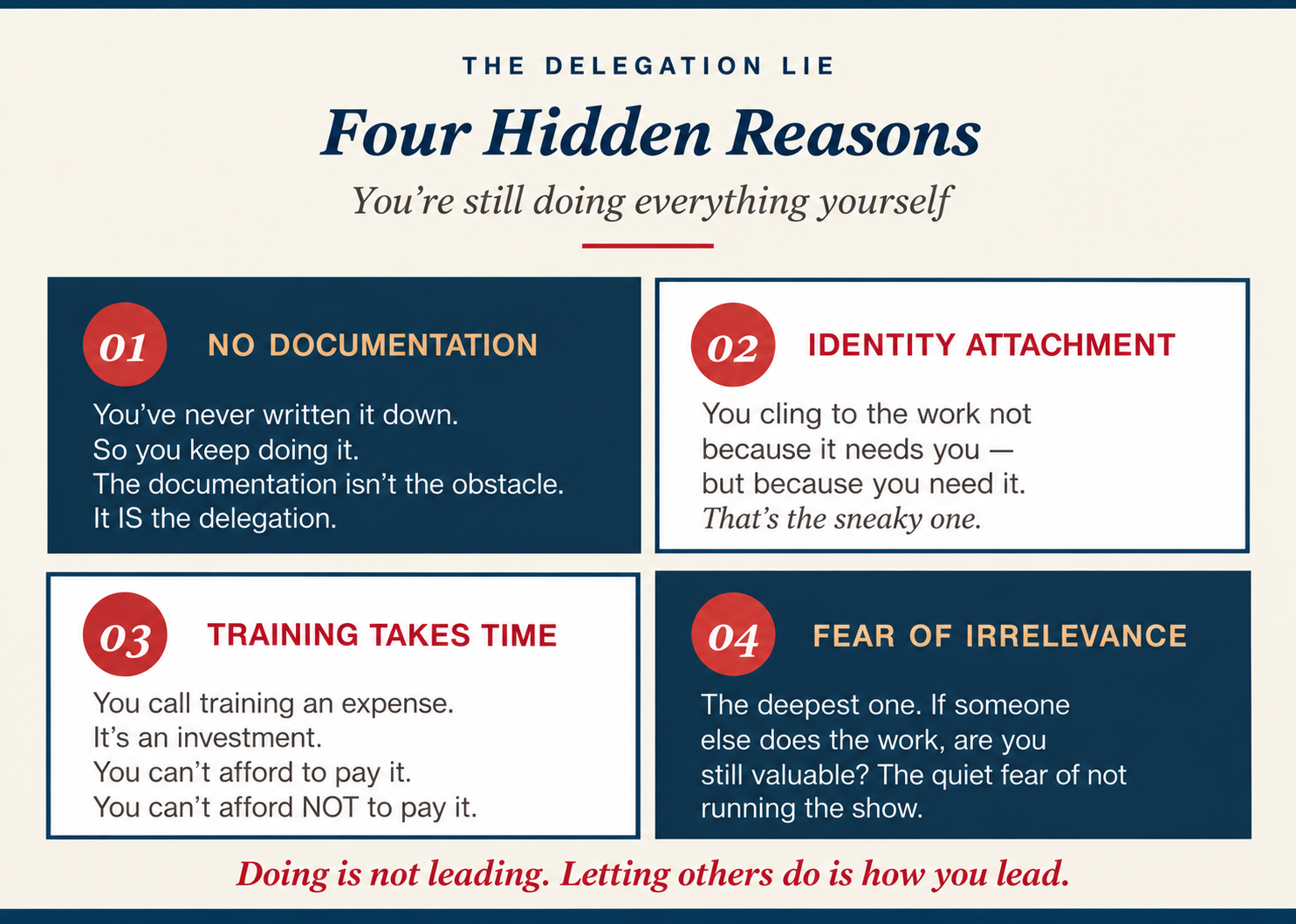 The Four Hidden Reasons You Won’t Delegate
You’ve never documented what you do.
SOPs — Standard Operating Procedures. You can’t hand something off if you’ve never written it down. Instead of taking the time to document it, you just keep doing it yourself. It feels faster in the moment. But six months later, you’re still doing it, and you still haven’t documented it. You’ve become the obstacle to the delegation. The documentation is the delegation.
You’re attached to being the one who does it.
This one’s sneaky. Somewhere along the way, your identity got wrapped up in being the person who personally writes the emails, who runs the calls, who handles everything. If you hand it off, you’re not sure who you are without it. So you cling to it — not because it needs you, but because you need it. Let me say that again: Not because all this activity needs you, but because you need it.
You don’t want to spend the time training someone.
Does it take longer to train somebody than to do it yourself? Yes — but only in the beginning. And the ten hours you’d get back every week once they’re trained? That’s time you can spend on the things only you can really do. So it’s not an expense; it’s an investment. Stop saying you can’t afford the help. You can’t afford not to have the help.
You secretly believe your value comes from doing it yourself.
This is the deepest one. If you delegate, who are you? If someone else writes the content, delivers the service, or handles the client, is it still you? Underneath that question is a quiet fear: if I’m not the one doing the work, maybe I’m not actually valuable. That’s not true, but it’s the belief running the show for a lot of people who don’t delegate.
Three Practices to Break the Cycle
Pick the smallest, lowest-stakes thing first.
You’re not going to delegate the big project right away. Start with something small — something your business won’t collapse over if it gets done a little wrong. The point of the first delegation isn’t to save massive time. It’s to prove to yourself that the sky doesn’t fall.
Document as you do.
The next time you do the thing you’ve been meaning to hand off, make a Loom video. Narrate what you’re doing. It doesn’t have to be a sixty-page manual — a 10-15 minute video is enough to let someone else conduct that task for your business. Perfectionism with this is just another way of dabbling. Don’t do it.
Let it be imperfect.
If someone can do the task at 80 percent of your capacity, that’s better than you doing it 100 percent because it buys you back a lot of time. You’ve got to get used to good enough. I’m not saying accept terrible work – I’m saying take a new standard. When you’re suffering, it means your standards are too high. If you’re suffering doing everything yourself, it’s time to lower the standards a little. Let other people find their way. It will buy you back your time and energy. I promise it’s a massive win. Stop grading people against the impossible standard you’ve set.
The Mindset That Makes It Stick
Here’s what I want you to internalize:
You are not the work. You are the strategist of the work.
The most successful people aren’t the ones doing everything themselves. They’re the ones who figured out that their highest value isn’t in the doing — it’s in the deciding. What gets built. What gets prioritized. Who gets served. Where the business goes next.
Every hour you spend doing something that someone else could do at 80 percent is an hour you’re not spending on the things only you can do. No one else is going to come along and free up your time for you. You have to do this yourself.
Your Homework This Week
Pick one small thing you can delegate, and hand it off to someone this week — not next week, not next quarter, not next year.
Notice what happens.
Notice how uncomfortable it feels to let go.
Notice the little voice that says they’ll mess it up and do it anyway.
The people most successful at sustaining a business stopped making the mistake of thinking that doing is leading.
Doing is not leading. Letting others do is how you lead.
Stop making yourself the bottleneck of your business, and discover the secret nobody tells you — that the moment you stop being the only one who can do everything is the moment your business can actually grow.