• Skip to primary navigation
  • Skip to main content
  • Skip to primary sidebar
Now What?® Coaching

Now What?® Coaching

from Laura Berman Fortgang

  • Login
  • About
    • About Laura
    • Our Philosophy
    • Praise
  • Hire a Facilitator
    • Hire Laura
  • Become a Facilitator
  • Online Courses
    • Career Clarity & Direction
    • Career Clarity & Direction: Self-Guided Course
    • Job Search Academy
  • Products
  • Blog
  • Contact

Opportunity

Waiting isn’t humility; it’s a stall tactic

By Laura Berman Fortgang on July 5, 2026

The Confidence Loop: Why Waiting to Feel Ready Is Keeping You Stuck

What’s the thing you’ve been putting off until you feel ready?

The business you’ve been waiting to launch.
The promotion you’ve been thinking about asking for.
The hard conversation you’ve been rehearsing for months.
The book, the podcast, the pivot, the pitch.

Here’s the follow-up questions:
How’s it working for you?
Are you any closer to feeling ready after this whole year of waiting?
Are you still hoping for that magic moment when something clicks and the confidence finally shows up?

Spoiler Alert: It’s not coming. And I want to explain why.

What Most People Get Wrong About Confidence

Most people think they have to feel ready before they take the action. They believe confidence is a feeling you achieve first, and only then do you launch, ask, post, pitch, or push back.

But that’s backwards.
Confidence isn’t the cause of action. Confidence is the result of action.

You don’t think your way into confidence. You act your way into it.

This is hard whatever camp you’re in. If you’re an entrepreneur, you’re probably waiting to feel ready before you raise your prices, launch the offer, or post the thing on LinkedIn. If you’re in corporate, you’re waiting to feel ready before you talk to your boss about the promotion, speak up in the meeting, or push back on a decision. Different settings, same trap. You’re waiting for a feeling that only shows up after you do the thing you’re waiting to feel ready to do.

Why Waiting Makes It Worse

Here’s the brutal part — waiting actively erodes your confidence. The longer you wait, the more you’re quietly teaching your brain that you can’t, you shouldn’t, you’re not ready. The waiting itself becomes evidence.

Meanwhile, the people you watch flying past you? They’re not more talented. They’re not smarter. They’re not more prepared than you are. They’ve just figured out what you haven’t yet — that confidence is built on the other side of action, not on this side of it.

Think about anything you’re confident about right now. Driving a car. Running a meeting. Having a hard conversation with your teenager. You’re not confident at those things because you sat around until you felt ready. You’re confident because you did them (maybe badly at first) and then less badly, and then with ease.

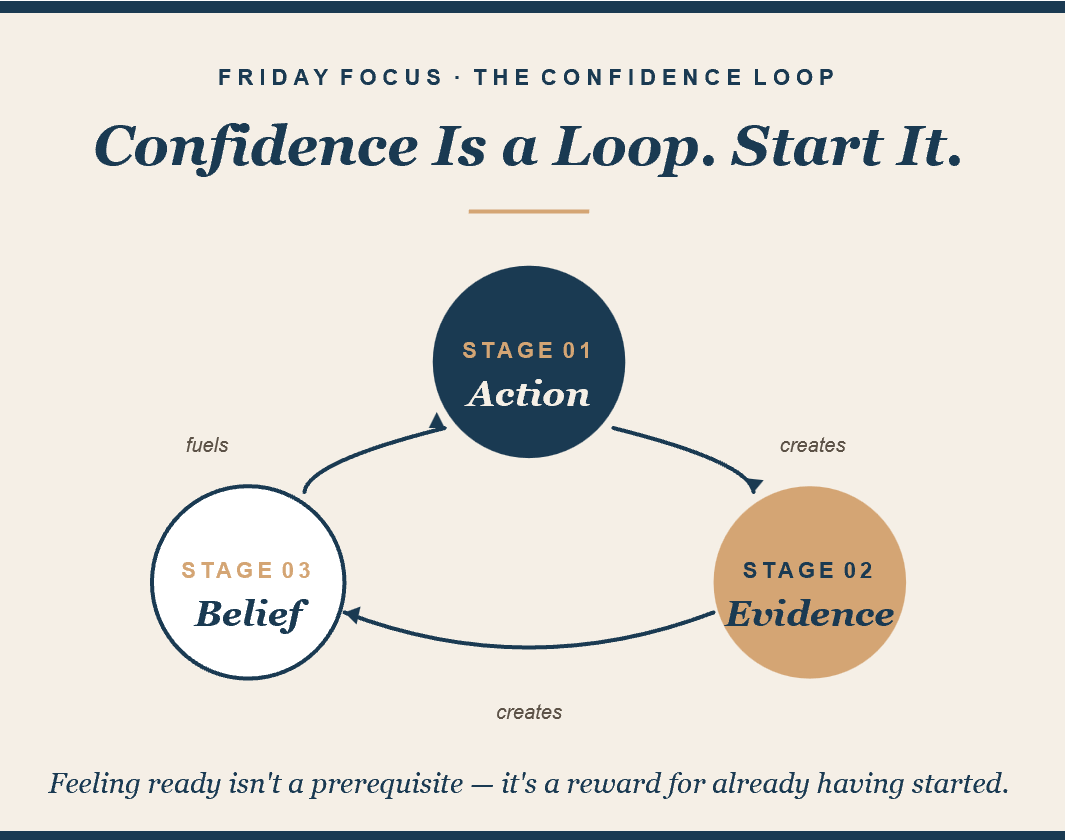
That’s the loop. Action creates evidence. Evidence creates belief. Belief makes the next action easier.
And the loop keeps spinning, but only if you’re willing to take that first imperfect step to get it started.

The Confidence Loop: Why Waiting to Feel Ready Is Keeping You Stuck

Three Practices to Start the Confidence Loop

Shrink the action. You’re not writing a whole book; you’re writing five hundred words. You’re not running in to demand a promotion; you’re asking your boss for fifteen minutes to talk about your trajectory. You’re not launching the whole big product; you’re writing the sales page first. Make the action smaller. Make it doable. The lower the resistance, the faster you start.

Do it badly on purpose. You just have to get started. You’re not going to be perfect the first time out. The first pitch is going to be awkward. The first draft isn’t going to be written right. It doesn’t matter. Action beats inaction every single time. Let the action inform you, teach you, show you what to fix next time, but do it imperfectly.

Collect the evidence. Most people take the action and then move on without noticing. Don’t. Look at the email you sent. Look at the price you quoted. Look at the meeting you ran. Look at the post you published. You’re building a case file for yourself because the next time you run out of confidence and forget that you’re good at something, you can go back and say, “Hey, I did that.”

The Mindset That Makes Confidence Stick

Here’s what I want you to internalize:
Feeling ready is not a prerequisite for being ready. It’s a reward for already having started.

Total opposite thinking, right?

The most successful people I know don’t feel more confident than you do. They’ve just stopped requiring confidence as a permission slip. They take action while uncertain. They speak up while nervous. They launch while imperfect. The confidence catches up with them.

Waiting to feel ready isn’t humility, wisdom, or strategy. It’s a stall tactic dressed up as something respectable, but I don’t respect it. It’s costing you the life and the business you actually want.

Your Challenge Today

Forget the whole week. Here’s your homework today: Take something you’ve been waiting to feel ready to do, and do it.
Send the email. Make the call. Ask for the thing. Write the paragraph. Just do it.

Then notice what happens — not externally, but inside you. Because the confidence you’ve been waiting for has been on the other side of that one small action the entire time.

The people doing the boldest, most courageous work in the world aren’t more confident than you.
They just stopped waiting and started.

And starting today, so do you.

Filed Under: Now What? Newsletter Articles Tagged With: Career coach, Career Coaching, Clarity, entrepreneurs, Laura Berman Fortgang, life coach, new direction, Now What Coaching, Opportunity, take action

The Debt That Pays You Back

By Laura Berman Fortgang on May 17, 2026

Why borrowing to grow isn’t a dirty word

I want to tell you about a check I wrote that scared the heck out of me.

It was for a coaching program. Not cheap. The kind of number that makes your stomach drop, your chest pound, and your neck clench when you sign the bottom. I didn’t have the cash sitting around; I had to use my line of credit to borrow it.

Every voice in my head said this is irresponsible.
Every piece of conventional advice said wait until you can afford it.

I did it anyway, and it changed my business. It paid back in spades.

That experience taught me something I think most people get completely wrong about money:
The idea that all debt is bad – it’s not. And believing it is, is costing you.

Here’s the truth:
Some debt drains you. Some debt builds you.
Learn the difference and everything changes.

The Two Kinds of Debt

Bad debt funds the stuff that’s already gone by the time the bill arrives. The vacation you couldn’t really afford — you’ve got the photos, you’ve got a couple of tchotchkes you brought home, and you’re still paying for it eighteen months later. The buy-now-pay-later plans stacking up on gadgets, gizmos, and clothes that somehow always feel free until you add them up. Money going out. Nothing growing in return. That’s the trap.

Good debt is the opposite. Good debt is borrowed money that produces a return greater than what it costs you. The business loan that lets you hire so you can double your output. The mortgage on a property that pays you rent. The coaching program that doubles your revenue. Good debt is a tool.

Here’s the simple test: If the borrowed money will produce more than it costs you — in interest, in effort, in time — it’s working for you. If it won’t, it’s working against you.

The Debt That Pays You Back by Laura Berman FortgangThe Part Nobody Wants to Hear

Most real growth in a business and in life happens before you can afford it.

The program that could change your business costs twenty grand, and you don’t have it.
The equipment that lets you serve bigger and better clients costs twenty-five grand.
The hire that frees up twenty hours a week so you can stay in your zone of genius might cost sixty thousand a year — and you need them now, not eighteen months later.

Waiting until you can pay cash sounds responsible. In reality, it means watching the people who were willing to leverage smartly fly right past you.

The one thing you can’t borrow back is time.

Four Questions Before You Sign Anything

This isn’t a license to swipe the card on every shiny opportunity. Smart leverage requires honest math.
​
Before you take on any debt, ask yourself:

What’s the realistic return?
Not the dream scenario – the reasonable one.

What’s the payback period?
How much time do you have to pay it back, and is there a clear path to do it?

What’s your plan if it doesn’t work? ​
Smart borrowing always has a downside plan. Can you still make the payments if the investment under performs?

Is the interest rate reasonable for what you’re using it for?
A seven or nine percent loan for something that gives you back thirty percent – that’s excellent debt. A twenty-four percent credit card for the same thing? Problem – no good.

The Mindset Shift

The wealthy don’t avoid debt. They use it deliberately and leverage. The difference between them and someone drowning in credit card balances isn’t access to credit; it’s intention behind every dollar borrowed.

Your business and your skills are assets. Investing in them — through coaching, education, equipment, hiring, marketing — often produces the highest returns of any investment you’ll ever make. Sometimes that requires borrowing. Done thoughtfully, that’s not reckless. That’s how growth actually works.

The goal was never to live debt-free.
​The goal is to make sure every dollar you owe is making you richer, not poorer.

I’m asking you to bet on yourself. Bet smartly, and watch what happens.

Filed Under: Now What? Newsletter Articles Tagged With: Career Coaching, Clarity, entrepreneurs, Laura Berman Fortgang, Opportunity, take action

Stop Booking Coffee. Start Booking Stages.

By Laura Berman Fortgang on May 10, 2026

Grab your coffee my friend because today we’re doing math.
Specifically,
speaker math.

I’m going to save you a lot of money on lattes by the time we’re done.

The Coffee Chat Math Nobody Wants to Do

Let’s run the numbers on something most service-based business owners are quietly doing every single week: the referral coffee.

If you take two referral coffees a week (you know the ones, where someone “wants to learn more about what you do”) in a year, you’ve talked to 100 people. You’ve also probably gained 12 pounds from all the lattes. (No judgment. I’ve been there.)

Here’s the part that should make you pause: You’ve spent roughly 100 hours of your life saying “so tell me about your business” to strangers who may or may not ever hire you. That’s two and a half work weeks. Gone. Poof. Just oat milk and good vibes.

OR …

You could give one talk. Thirty minutes. Reach those same 100 people in half an hour instead of a full year. Same audience size, way less caffeine, and—plot twist—infinitely better margins on your time.

Stop Booking Coffee. Start Booking Stages. by Laura Berman FortgangThis is why I tell every service-based business owner I work with that speaking is the #1 way to grow your business. The onesie-twosie referral hustle, as lovely as it is, will keep you stuck in a loop of espresso and small talk.

Here are the four reasons why.

1. The One-to-Many Math

A referral conversation puts you in front of one person. A talk puts you in front of 20, 50, 200 prospects all at the same time.

These aren’t strangers you cornered at a networking event. These are people who showed up. They self-selected. They chose to be there. They’re already leaning in.

You can build a year’s worth of pipeline from one 30-minute talk, while your referral-loving friends are still scheduling their next “quick 15 minutes.”

2. Speaking Compresses the Know-Like-Trust Timeline

You know how referrals work. Someone has to meet you, like you, trust you, remember you exist three weeks later, and then hopefully hire you.

I’m tired just typing that sentence.

When you speak, you collapse all of that into 30 minutes. The audience sees your expertise, your point of view, and you doing your thing in real time. By the time you’re finished, they don’t feel like they’re hiring a stranger; they’re already much further down the sales funnel with you.

Sometimes there’s barely a sales conversation at all. Sometimes people walk up after a talk and ask, “How do I hire you?”

Music. To. My. Ears!

3. You’re the Only Authority in the Room

This one is sneaky-powerful.

When you have a referral meeting, that prospect might be talking to three other experts too. They’re comparing you. Checking you out. Maybe even Googling you mid-conversation.

But on a stage? You are the expert the host chose to bring in. You’re already vetted. The credibility and authority are baked into the moment you step up to that mic.

You’re no longer being evaluated. You’re being chosen.

That authority, my friends, pays the bills.

4. Every Talk Is a Renewable Asset

Here’s the part most people miss.

A coffee chat equals one possible client and a slightly elevated heart rate from caffeine. That’s it.

One talk equals the room you’re in PLUS the recording, the clips, the testimonials, the email signups, the host introducing you to their next event, and that one person in the audience who books you on their podcast and puts you in front of a whole new audience.

Referrals give you addition. Speaking gives you compounding.

__________________________________________________________

Your Challenge This Week

Stop booking coffee chats. Start booking stages.

It doesn’t have to be a TEDx Talk. (That comes later.) Start with a webinar. A podcast guest spot. A workshop. A 20-minute lunch-and-learn at someone else’s company. That’s how I started.

Just get in front of more than one person at a time.

The fastest path to a fully booked business isn’t in your inbox; it’s in front of a room.

Go book the stage, ditch the coffee circuit, and let me know how it goes.

Filed Under: Now What? Newsletter Articles Tagged With: Career coach, Career Coaching, Clarity, coaching, entrepreneurs, Now What Coaching, Opportunity

The Entrepreneur You Need to Be (So You Can Be the Coach You Want to Be)

By Laura Berman Fortgang on April 19, 2026

Let me ask you something. Are you a great coach (or service business owner) who’s struggling to build a great business?

If so, you’re not alone – and it’s not your fault. Coaching school teaches you how to coach; it does not teach you how to run a business. And those are two completely different skill sets.

Here’s a number that should stop you in your tracks: 82% of coaches fail within two years of starting their business. Eighty-two percent! That’s not a coaching problem. That’s an entrepreneur problem.

The Entrepreneur You Need to Be (So You Can Be the Coach You Want to Be) by Laura Berman FortgangThe coaches who are earning six figures or more, designing their own schedules, working with clients they love — they didn’t get there by being better coaches than everyone else. They got there by making a decision. The decision was: I am the CEO of my business. It doesn’t matter how small your business is. When you start thinking like a CEO, everything changes.

What do entrepreneurially-minded coaches do differently? Three things.


1. They Build a Lead Machine, Not a Hope Strategy

A full practice doesn’t happen by accident. It doesn’t happen by waiting for word of mouth to kick in, or for referrals to magically fill your pipeline, or for the right moment when you finally feel ready.

It happens because you have a system — a consistent, repeatable way to attract your ideal clients. Whether that’s doing live broadcasts, speaking (which is arguably the most powerful way), podcasting, or building an email list, the key is to pick your lane and show up in it every single week.

Not when you feel like it. Not when inspiration strikes. Every week.

Consistency is your competitive advantage. The market rewards coaches who keep showing up because most don’t.


2. They Price Like a Business Owner, Not an Employee

This one is where so many coaches leave money on the table, and burn themselves out in the process.

Fear is usually at the root of it. Fear that people will say no. Fear of not being “worth it” yet. But here’s what actually happens when you undercharge: You attract clients who undervalue you, you exhaust yourself trying to make up in volume what you’re not making in revenue, and you start to resent the very work you used to love.

Here’s the reframe that changes everything: You are not charging for your time. You are charging for the transformation you create and the results you deliver. That is not an hourly wage; it’s an investment your clients are making in themselves, so price accordingly.

One more thing worth noting — scarcity signals value. When you’re not endlessly available, when people have to get on a waiting list to work with you, that communicates something powerful. It says: This person is in demand and is worth it.


3. They Design Their Business Around Their Life

This might be the most important mindset shift of all.

Too many coaches are afraid to build a big business because they think it will take over their life. Therefore, instead of designing the life and business they actually want, they play small and stay stuck.

Here’s the truth: You are in control. You don’t have to show up on someone else’s schedule anymore. You decide when you work, how many clients you take on, and what your days look like. Want Fridays off? Take Fridays off. Don’t want to work evenings? Don’t. Want to work fewer hours overall? Charge more and take fewer clients.

Your business should be built to serve your life — not the other way around. Design the life you want first, then build the business to match it.


The Foundation That Makes It All Work

Your coaching skills are real, and the value you create is real. But without an entrepreneurial foundation underneath those skills — the systems, the pricing strategy, the visibility, the mindset — you will stay stuck, undervalued, and underpaid.

The good news is that entrepreneurship is a learnable skill, just like coaching is. You weren’t born knowing how to coach — you learned it. The same is true here.

The question is: Are you ready to learn it?

Because the clients who need you most haven’t found you yet – and they’re waiting.

Filed Under: Now What? Newsletter Articles Tagged With: Career coach, Career Coaching, Clarity, coaching, entrepreneurs, Laura Berman Fortgang, Opportunity, take action

The Entrepreneurial Roller Coaster: How to Ride It (And Actually Survive)

By Laura Berman Fortgang on February 8, 2026

If you’ve ever been on a roller coaster, you know that moment right before the first drop – you grip the bar, your stomach tightens, you take a deep breath, and you wonder what the heck you just got yourself into.

Welcome to entrepreneurship.

Except this ride lasts years instead of minutes. There’s no operator doing safety checks. You can’t see the track ahead. And the drops? They’re steeper than anything at Six Flags.

After 32 years of running my own business, I can tell you this: The roller coaster never really smooths out. You just get better at riding it. That’s what I want to share with you today – how to not just survive the ride, but actually thrive on it.

Build Your Reserves (Both Kinds)

First things first: You need cushions for the falls. I’m talking about two types of reserves that most entrepreneurs overlook.

Financial reserves are the obvious one, but let me be specific. You need at least six months of operating expenses, plus personal savings. Not the optimistic spreadsheet version where everything goes perfectly. You need the realistic version where your biggest client ghosts you or that investor pulls out at the last minute.

I run my business on a ten-month year. Not because I take two months off, but because I know things will fluctuate and some months will be lean. Building in that buffer keeps me from making decisions out of desperation.

Here’s what most people miss: Emotional reserves. This is your hobbies, your relationships, exercise, meditation, therapy – whatever fills your tank. The entrepreneurs who burn out aren’t the ones who work hard; they’re the ones who work hard with an empty emotional tank. When you have people you can talk to, activities that restore you, and a life outside your business, you create an emotional cushion that lets you weather the storms.

You can’t pour from an empty cup, so protect both reserves like your business depends on it because it does.

On Low Days: Do ONE Thing That Moves the Needle

There will be days when you wake up convinced you’ll never get another client.
When the weight of it all feels crushing.
When you question everything.

person on roller coasterOn those days, forget your massive to-do list.
Pick ONE thing that will actually move the needle and do that.

Not busy work. Not cleaning your desk or organizing files. One meaningful action: Make that scary sales call, have that critical conversation you’ve been avoiding, fix that tech bug that’s been haunting you, send that partnership proposal.

Here’s the magic: Mood follows action. We’re often waiting for the mood to hit us before we take action. But it works the opposite way. You don’t need to feel motivated to act; you act and the motivation follows. Take the action first, and watch your mood improve.

After a Win: Attack, Don’t Relax

This might be the most counterintuitive advice, but it’s critical. Your most dangerous moment isn’t after a failure; it’s after a success.

You just closed a major client. You just hit your revenue target. Every instinct tells you to take your foot off the gas, to relax a little, to enjoy the moment.

Don’t.

Celebrate that evening, absolutely. But the very next day? Double down. Already in a good mood? Take more action. Make another call. Close another client. Do something that makes a difference while you’re riding that high.

Here’s why: Wins create momentum, open doors, and boost confidence. You’re never more attractive to potential clients, partners, or investors than right after a visible success. Use that fuel. Don’t let it evaporate.

Know the Difference: Dip or Dead End?

Not every low point is worth pushing through. Seth Godin talks about “The Dip,” that valley between starting something and mastering it where most people quit. Winners push through strategic dips because there’s something valuable on the other side.

But dead ends are different. A dead end is when the market fundamentally doesn’t want what you’re selling, when the economics will never work, when there’s nothing pointing to it coming back.

The hard part? They feel the same in the moment.

That’s why you need trusted advisors – friends, coaches, mentors – who can help you see clearly. People who will tell you the truth when you need to hear it because it’s really hard for us to know the difference between a dip and a dead end when we’re the ones on the ride.

Hold On Tight

The ride is terrifying.
The ride is exhilarating.
For those of us crazy enough to strap in, it leads to something incredible: freedom.

You get better at riding it.
You build your reserves.
You take action when you’re low.
You attack when you’re high.
You surround yourself with people who help you know when to push through and when to pivot.

Buckle up, buttercup.
This is what you signed up for, and it’s worth every twist and turn.

Filed Under: Now What? Newsletter Articles Tagged With: Career coach, Career Coaching, career path, coaching, entrepreneurs, Laura Berman Fortgang, Now What Coaching, Opportunity, take action

Old Lessons Made New to Finish 2023 Strong

By Laura Berman Fortgang on September 24, 2023

It’s hard to believe we’re already heading into the fourth quarter of 2023, but it’s coming right up.

So … how’s it going?

Would your September 2022 self be proud?
Are you on track to reach your goals?
Did you blow by your wildest expectations?
Have you made some wrong turns or hit detours?

No matter where you are now, you still have time to finish even stronger and better. You have time to focus on what you want to get done by the end of this year.

I’ve been thinking about this a lot this week. As you may know, not only am I a Master Certified Credentialed Coach, but I’m also an ordained interfaith minister, incorporating wisdom and inspiration from ancient traditions around the world, into my work and every day.

This past weekend was Rosh Hashanah, the Jewish New Year, followed by a 10-day period of Judaism’s High Holy Days, and this coming Sunday marks Yom Kippur, the Day of Atonement or holiest day of the year.

It’s a time for reflection and renewal, introspection and connection.

A time for shedding the old and celebrating new beginnings — wishing family and friends a year filled with happiness, health, and prosperity.

Old Lessons Made New to Finish 2023 Strong by Laura Berman FortgangAs well as a time for thinking back over the past year, facing your missteps, asking forgiveness, and considering how you may become a better person in the year ahead.

Whether you take part in these customs or not, you can consider this a reminder that life is full of opportunities to begin again and move forward with renewed energy.

This weekend also marks the official first day of fall. Just like the trees shed leaves, what do you want to let go of? What do you want to make room for?

If you haven’t done it by now, maybe you didn’t really want to — so dump it!

Or forgive yourself for putting it off this long — and get to it!

Whatever you’re looking to accomplish in your career or business, the year’s not over yet. Celebrate how far you’ve come, make peace with your setbacks, and reawaken your drive to succeed.

Filed Under: Following Your Passion, Life Goals, Life Lessons, Now What? Newsletter Articles, Reinventing Yourself, Taking Action Tagged With: Career Change, Career coach, Career Coaching, Laura Berman Fortgang, Now What Coaching, Now What Program, Opportunity, passion, take action, transition

  • Page 1
  • Page 2
  • Page 3
  • Interim pages omitted …
  • Page 23
  • Go to Next Page »

Primary Sidebar

Pinpoint–and plan-a fulfilling "next chapter" of your career with the Now What?® Program

Start Today

Buy Now

Sign up for Laura’s mailing list so you don’t miss a thing!

[gravityform id=”3″ title=”false” description=”false” ajax=”true”]

Disclaimer |
Site Usage and Privacy Policy  |  Facilitator Zone

Copyright © 2026 Now What?® Coaching. All Rights Reserved.

Login

Lost Your Password?