
• Skip to primary navigation
  • Skip to main content
  • Skip to primary sidebar
Now What?® Coaching

Now What?® Coaching

from Laura Berman Fortgang

  • Login
  • About
    • About Laura
    • Our Philosophy
    • Praise
  • Hire a Facilitator
    • Hire Laura
  • Become a Facilitator
  • Online Courses
    • Career Clarity & Direction
    • Career Clarity & Direction: Self-Guided Course
    • Job Search Academy
  • Products
  • Blog
  • Contact

career reinvention

Nobody can do it as well as you? That’s the Delegation Lie.

By Laura Berman Fortgang on November 1, 2026

The Delegation Lie: Why You Can’t Hand Anything Off (And It’s Not Because They’d Mess It Up)

What’s the one thing in your business you know you should be delegating, but every time you think about handing it off, you hear yourself say, nobody can do it as well as I can?

Let’s talk about the Delegation Lie. Because that sentence — nobody can do it as well as I can — is almost never the real reason you’re doing everything yourself.

This one is especially for folks in their own business, but it also applies to anyone who holds down a job and has the ability to delegate — meaning you’re not the person everyone’s delegating to.

What Most People Get Wrong About Delegation

You think the reason you’re not handing things off is because you’re a perfectionist. You have high standards. You care about the quality of your work. And nobody would do it the way you would.

Some of that is true. You do have high standards. You do care.

But that’s not actually why you haven’t delegated.

The real reason is something deeper. Most people don’t let themselves see it because it’s much more flattering to say nobody can do it like me than to admit the actual thing that’s keeping you stuck.

Here’s the brutal truth: your business cannot scale past you if everything has to go through you. You’ve become a bottleneck. Every time you tell yourself nobody can do it as well as I can, you’re also telling yourself that your business cannot grow. That’s just a fact.

I want to pull back the curtain on the four hidden reasons you’re not delegating and what to do about it.
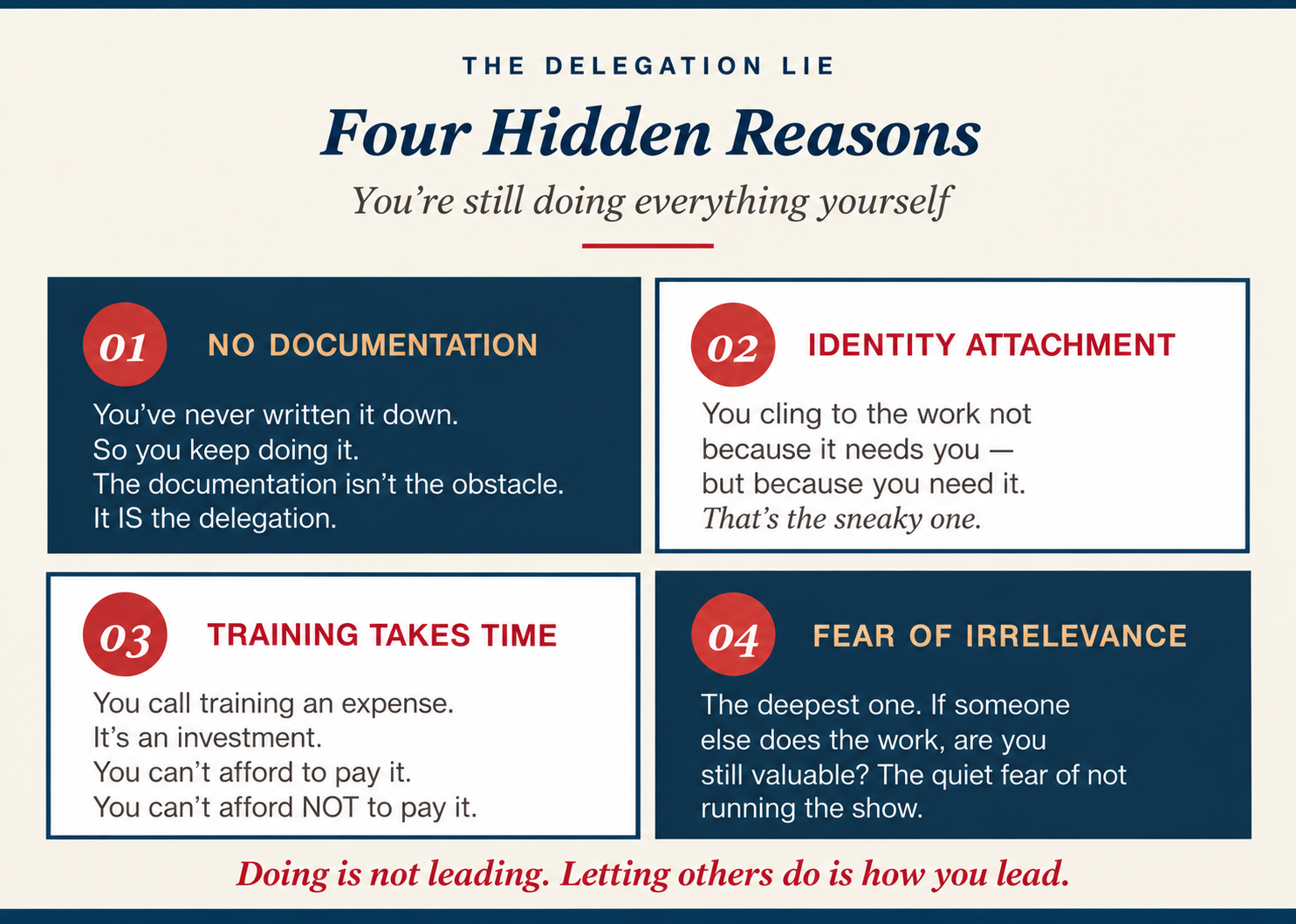
Nobody can do it as well as you? That's the Delegation Lie. by Laura Berman FortgangThe Four Hidden Reasons You Won’t Delegate

You’ve never documented what you do.
SOPs — Standard Operating Procedures. You can’t hand something off if you’ve never written it down. Instead of taking the time to document it, you just keep doing it yourself. It feels faster in the moment. But six months later, you’re still doing it, and you still haven’t documented it. You’ve become the obstacle to the delegation. The documentation is the delegation.

You’re attached to being the one who does it.
This one’s sneaky. Somewhere along the way, your identity got wrapped up in being the person who personally writes the emails, who runs the calls, who handles everything. If you hand it off, you’re not sure who you are without it. So you cling to it — not because
it needs you, but because you need it. Let me say that again: Not because all this activity needs you, but because you need it.

You don’t want to spend the time training someone.
Does it take longer to train somebody than to do it yourself? Yes — but only in the beginning. And the ten hours you’d get back every week once they’re trained? That’s time you can spend on the things only you can really do. So it’s not an expense; it’s an investment. Stop saying you can’t afford the help. You can’t afford
not to have the help.

You secretly believe your value comes from doing it yourself.
This is the deepest one. If you delegate, who are you? If someone else writes the content, delivers the service, or handles the client, is it still
you? Underneath that question is a quiet fear: if I’m not the one doing the work, maybe I’m not actually valuable. That’s not true, but it’s the belief running the show for a lot of people who don’t delegate.

Three Practices to Break the Cycle

Pick the smallest, lowest-stakes thing first.
You’re not going to delegate the big project right away. Start with something small — something your business won’t collapse over if it gets done a little wrong. The point of the first delegation isn’t to save massive time. It’s to prove to yourself that the sky doesn’t fall.

Document as you do.
The next time you do the thing you’ve been meaning to hand off, make a Loom video. Narrate what you’re doing. It doesn’t have to be a sixty-page manual — a 10-15 minute video is enough to let someone else conduct that task for your business. Perfectionism with this is just another way of dabbling. Don’t do it.

Let it be imperfect.
If someone can do the task at 80 percent of your capacity, that’s better than you doing it 100 percent because it buys you back a lot of time. You’ve got to get used to
good enough. I’m not saying accept terrible work – I’m saying take a new standard. When you’re suffering, it means your standards are too high. If you’re suffering doing everything yourself, it’s time to lower the standards a little. Let other people find their way. It will buy you back your time and energy. I promise it’s a massive win. Stop grading people against the impossible standard you’ve set.

The Mindset That Makes It Stick

Here’s what I want you to internalize:
You are not the work. You are the strategist of the work.

The most successful people aren’t the ones doing everything themselves. They’re the ones who figured out that their highest value isn’t in the doing — it’s in the deciding. What gets built. What gets prioritized. Who gets served. Where the business goes next.

Every hour you spend doing something that someone else could do at 80 percent is an hour you’re not spending on the things only you can do. No one else is going to come along and free up your time for you. You have to do this yourself.

Your Homework This Week

Pick one small thing you can delegate, and hand it off to someone this week — not next week, not next quarter, not next year.

Notice what happens.
Notice how uncomfortable it feels to let go.
Notice the little voice that says
they’ll mess it up and do it anyway.

The people most successful at sustaining a business stopped making the mistake of thinking that doing is leading.
Doing is not leading. Letting others do is how you lead.

Stop making yourself the bottleneck of your business, and discover the secret nobody tells you — that the moment you stop being the only one who can do everything is the moment your business can actually grow.
Filed Under: Now What? Newsletter Articles Tagged With: Career coach, Career Coaching, career reinvention, Career transitions, delegation, delegation lie, Laura Berman Fortgang, Now What Coaching, Opportunity

The Dabbler’s Dilemma: Boredom is Not a Business Strategy

By Laura Berman Fortgang on October 25, 2026

The Dabbler’s Dilemma: Why You Keep Starting Over

How many times have you reinvented your business in the last three years?

New niche. New offer. Maybe a new website. A new program name. Maybe you went for another certification. A new everything.

I know you think that’s good. I know you think that’s productive. But you may have what I call the Dabbler’s Dilemma — and I want to talk about why it’s quietly costing you.

What Most Business Owners Get Wrong About Reinvention

Most solopreneurs, coaches, consultants, and experts think reinvention is progress. They think it’s refinement. They believe each new version of their business is them finally getting clearer about who they are and what they do.

And I get it feels that way.

But often, the opposite is true because every reinvention is a reset.

It takes you away from your audience knowing who you are and what you’re about because you keep changing it. You lose the compounding effect of building expertise and credibility over time. You lose the moment where people catch on, understand what you do, and start following you for that one thing.

The brutal truth is the people whose businesses you admire — the ones who got the book deal, the ones who became the go-to for their topic, the ones who are booked out — didn’t get there because they were more talented than you. They got there because they stayed in one lane long enough for the market to recognize them.

The Dabbler’s Dilemma: Boredom is Not a Business StrategyMeanwhile, if you’ve been reinventing every six months, your audience has whiplash. They can’t recommend you because they’re not sure what you do this week. They can’t trust you yet because they’re still catching up to who you were last year.

You have to stay in your lane long enough to become known and recognized.

Why We Dabble

So why do we do this? Because dabbling feels productive. Every reinvention gives you a dopamine hit. New branding, new excitement, new possibility. You feel like you’re moving forward because you’re doing something.

But let me name what’s actually underneath it.

Boredom. You’ve been doing the same thing for a while and it got less exciting. So instead of going deeper, you go sideways.

Avoidance of the real work. The work of building a business is boring once you’re past the fun, creation phase. It’s follow-ups, sales calls, outreach, visibility. Reinventing lets you look busy without doing the uncomfortable work that actually grows the business.

Perfectionism. The current version isn’t quite right. So instead of launching and iterating, you keep tweaking. New angle. New niche. New messaging. You never give any version of your business a real chance.

Fear of success. The sneakiest one. Because if you actually commit to one thing and it works, you’re on the hook to deliver, to scale, to be visible. Reinventing keeps you safe. It keeps you in the chrysalis stage forever.

Dabbling vs. Pivoting

I want to be clear — not every reinvention is dabbling.
Sometimes you really do need a strategic pivot.
So how do you tell the difference?

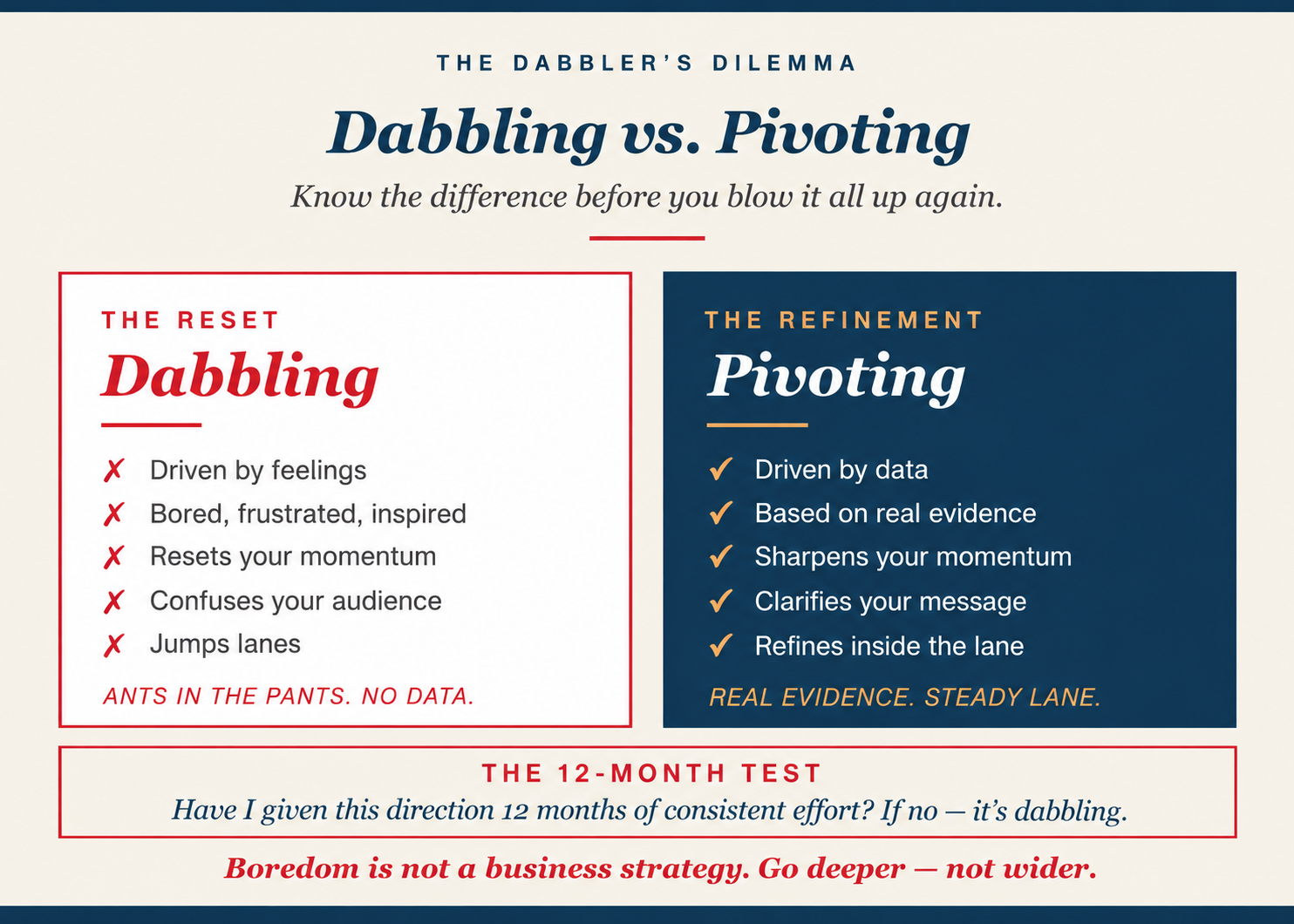
A real pivot comes from data. You’ve been in your lane long enough to know what’s working and what isn’t. You sharpen, you refine, and you base the change on evidence.

Dabbling comes from feeling. You’re bored. You’re frustrated. You read a new book and said this is exciting, I’m going to change my whole business to do this. But you haven’t been in your lane long enough to know for sure. You just decided to skip lanes and change lanes.

Here’s a simple test:
Have I given this current direction at least twelve months of consistent effort before deciding it isn’t working?
If the answer is no, you’re probably not pivoting; you’re dabbling.

Three Practices to Stop Dabbling

Commit to a twelve-month runway.
Pick your current direction. Not the next one, not the one you’re already daydreaming about. The current one. Commit to it long enough to gather real data about what’s working, what isn’t, and whether the market is responding.

Refine the lane you’re in — don’t jump lanes.
You can absolutely improve, iterate, and sharpen within your chosen direction. Better copy, tighter messaging, a stronger offer — all of that is fine. But resist the urge to blow the whole thing up every time something feels stuck. Fix
inside the lane.

Write out your “why.”
Before you reinvent anything, write out why. Figure out — are you doing this because you have data, or are you doing it because you have ants in your pants and just want to do something different? If you can’t name the data, pause. That’s dabbling.

Here’s what I want you to internalize:
Boredom is not a business strategy. It’s a signal to go deeper, not wider.

You want to compound. You want people to be able to follow you, know what you’re about, and recognize you. That doesn’t happen in six-month cycles. It happens through repetition, consistency, and the patient willingness to show up as the same person for the same thing — long enough for it to actually mean something.

The person who’s bored of your business isn’t your audience; it’s you. And that’s the exact moment to double down, not jump ship.

Your Homework This Week

If you’ve reinvented your business three or more times in the last three years, ask yourself one honest question:
If I had taken that same reinvention energy and gone deeper instead of jumping lanes, where would my business be right now?

That’s your answer and your assignment.

Pick one thing.
Stick with it for a longer time.
Let your audience catch up with you.
Let your credibility compound.
Stop reinventing and start repeating.

Because the entrepreneurs, consultants, and experts building the businesses you admire stopped mistaking motion for progress.
They picked a lane, stayed in it, and let the slow, boring, extraordinary work of compounding do its thing.

Filed Under: Now What? Newsletter Articles Tagged With: business strategy, Career coach, Career Coaching, career reinvention, Dabbler’s Dilemma, Dabbling vs. Pivoting, entrepreneurs, Laura Berman Fortgang, Now What Coaching

You Don’t Have to Be a Celebrity to Join the A-List

By Laura Berman Fortgang on March 29, 2026

You Don’t Have to Be a Celebrity to Join the A-List
​
But you do have to act like one.

Here’s what I see coaches and entrepreneurs doing every single day. They’re talented. They create genuine transformations in people’s lives. Yet they’re out there hustling, discounting their prices, watering down their message, trying to reach everybody. They’re treating their business like an open audition that never ends.

I want to ask them one question: What are you auditioning for?

Meryl Streep doesn’t send in audition tapes. Denzel Washington doesn’t line up in hope. At a certain level of this game, we’ve got to stop asking, “Will they pick me?” and start asking, “Do I want to work with them?” That shift — right there — is the A-List mentality.

You don’t get on the A-List by earning it.
You get there by deciding you’re on it, and then bringing it into fruition.

THE PROOF

I’ve had some incredible opportunities in my career, and none of them came the way you might expect. I got to be on the Oprah Winfrey Show. I have a TEDx talk with over two million views. My first book? They asked me to write it. I didn’t send a single query letter.

None of it came from spending all my time trying to engineer my way to the next level. It came from one thing: Showing up one hundred percent, every single time.

Not 90% because I was tired. Not 80% because the fee wasn’t what I wanted. A hundred percent, consistently, and without questioning whether I belonged. Look — I’m human. There are moments of doubt. There are moments of “Who am I to be doing this?” But you’ve got to put those thoughts out of your head as fast as possible. Certainty isn’t a feeling that arrives. It’s a decision you make.

THE 6 RULES OF THE A-LIST

The A-List isn’t something other people deem you worthy of. It’s something you deem yourself worthy of. Here’s how A-List coaches and entrepreneurs actually operate:

  1. They own their niche without apology.

Trying to serve everybody is a hiding strategy. When you’re vague, you’re hiding. Pick your lane; plant your flag. The more specific you are, the more magnetic you become, and the easier it is for the right people to find you.

  1. They set their own terms.

A-Listers aren’t auditioning. They ask for money with the same energy they’d order coffee at Starbucks — no doubt, no hype – just matter of fact. The ideal client doesn’t want the cheapest deal; they want the best.

  1. They protect their energy like it’s a contract clause.

Every yes to the wrong thing is a no to the right thing. A-Listers have learned to create a certain amount of scarcity in the market; not because they’re playing games, but because their time genuinely costs something. That’s the signal.

  1. They never question the room.

They don’t walk into a space wondering if they belong. Their energy precedes them. Certainty — and I’ve said this before — is not a feeling that comes to you. It’s a decision you make. You decide you belong. The energy in a room shifts around that belongingness. It is the most underrated business strategy alive.

  1. They build visibility on purpose.

Being excellent in private gives you a hobby business. Being excellent in public gives you a real one. Write the thing. Take the stage. Post the idea. The world can’t ask for you by name if it doesn’t know your name.

  1. They raise their standard of proximity.

You can’t think A-List thoughts in B-List rooms. It’s who you hang out with, who you’re in conversation with, who you mentor with. Put yourself in the environment that matches where you’re going, not just where you’ve been.

THE DECISION

Here’s what all six of those rules have in common: None of them require a publicist. None require a huge following. None require you to wait until you feel ready because the feeling of ready is often the story fear tells you to stay comfortable.

All they require is a decision. A decision that you’re done shrinking. Done discounting. Done explaining yourself to people who weren’t going to get it anyway. Done auditioning for opportunities that should be auditioning for you.

The A-List begins with you deciding you’re on it. It’s not waiting for you. It’s a decision you make.

Here’s the question I want to leave you with:

What would you do differently today if you already knew you were the person people ask for by name?

Go do that. Start now!

Filed Under: Now What? Newsletter Articles Tagged With: career, Career coach, Career Coaching, career reinvention, Clarity, entrepreneurs, life coach, Now What Coaching

How to Stop Imposter Syndrome in Its Tracks

By Laura Berman Fortgang on October 1, 2023

Do you ever feel like an imposter?

Are you sometimes afraid that someone’s going to discover you have no idea what you’re doing — that you’re not the expert you proclaim to be, you’re not as skilled as you’ve made yourself out to be, and you’re not quite qualified to be in the position you’ve found yourself in?

Maybe you’re worried that you don’t measure up somehow, so it makes you feel like you’re pretending to be someone you’re not.

Here’s what this looks like.

Them: We’d like to interview you [for a dream job]!
You: Maybe they didn’t notice I don’t have enough experience.

Them: Congratulations! We’d like to offer you the [dream] job.
You: I’ll surely be fired by Tuesday, once they figure out I’m a fraud.

Them: We’ve selected your proposal to speak at the next conference.
You: Oh no! I’m probably going to make a fool out of myself.

Them: I’m looking for a coach, and I’d love to work with you.
You: But what if I can’t help you get results, and you tell everyone I’m a con?

I’m not a doctor, but as a Master Certified Credentialed Coach with 30 years of experience, I can confidently assess what’s happening here.

Imposter Syndrome

Don’t worry; it’s not fatal to your career or success.

Most people struggle with it from time to time, and it’s entirely “treatable.”

If you feel like your Imposter Syndrome is flaring up, here’s what I suggest you do —

  1. How to Stop Imposter Syndrome in its Tracks by Laura Berman FortgangPause and accept what’s happening. No sense in ignoring the symptoms. Denying it only makes things worse by trying to overcompensate.

  2. Learn to recognize your triggers (comparisons, someone else’s recent success) and how you respond, so you can head it off at the pass. Before you go into a full-on panic, tell yourself, “This is just imposter syndrome flaring up again. Nothing alarming. You can do this.”
  3. Notice your self-talk. As soon as you start beating yourself up, STOP. It may sound easier said than done, but you can tell yourself “no.” No more negative self-talk; you’re not listening.
  4. Ask yourself what success looks like. Are you trying to measure up to a perfect ideal? Scratch that and aim for progress instead.
  5. Keep learning. The best way to keep Imposter Syndrome at bay is to continue seeking out new knowledge and ways of doing things, evolving, and growing your skill set.
  6. Celebrate wins! I can’t say enough about this. Remind your brain that you’re doing good things.

Do this again and again, every time Imposter Syndrome starts to creep up, and you’ll start experiencing it less and less.

Don’t get caught up in calling yourself an expert. Instead of thinking of yourself as someone who’s supposed to know everything, think of yourself as someone who makes it your business to learn everything you can about your particular topic of choice.

You’re not an imposter, so keep showing up as the best of who you are. You’ve got this!

Filed Under: Lessons Learned, Life Goals, Life Lessons, Now What? Newsletter Articles, Personality Development, Reinventing Yourself, Taking Action Tagged With: career, Career coach, Career Coaching, career path, career reinvention, career transition, Change, Clarity, coaching, entrepreneurs, Following your passion, Laura Berman Fortgang, life coach, Now What Coaching, Now What Program, Now What?® Program, take action, transition

The Power of Pumpkin Spice

By Laura Berman Fortgang on September 17, 2023

Fall is just around the corner again, and you know what that means — it’s pumpkin spice season!

I know … you’re either rolling your eyes, giddy with excitement, or couldn’t care less. But stick with me here, because we should all be paying attention.

Love it or hate it, there’s no denying the POWER of pumpkin spice.

I kid you not — studies have found that Americans are spending over half a BILLION dollars on pumpkin spice stuff every year. Buying up everything from Starbucks lattes to scented trash bags, industry insiders call it the “pumpkin spice economy.”

Sure, it may seem like things have gotten out of hand, and seeing the hype start in mid-August is a pet peeve of mine. Personally, I’m a fan of pumpkin spice, and I’m an even bigger fan of pumpkin spice as a marketing phenomenon.

Marketers have NAILED this. Here’s how —
    1. The Power of Pumpkin Spice by Laura Berman FortgangBuilding anticipation: Those of us who are fans of the rich, fragrant flavor and scent crave our first annual sip or whiff.
    2. Creating emotional connection: It’s become interwoven with the coziness of the season, like a warm sweater, crackling fires, and family holiday gatherings.
    3. Making a limited-time offer: Not being able to order it year-round makes it special. Consumers hurry to buy while they can, as much as they can.
    4. Establishing consistency: We know this thing is coming down the pike every year and have come to rely on it.

How can you translate these lessons into your business or career?

Anticipation: Talk about what you’re brewing up; create intrigue. Developing a new program? Offer hints along the way. Working on an exciting project? Let others know you can’t wait to share. Before long, people will be on the lookout for whatever you have going on and want in on it.

Emotional connection: Make sure people associate your work with something deeper than a commodity. You don’t just offer accounting services, but peace of mind. Not just coaching, but clarity and inspiration.

Limited access: Scarcity encourages people to take action. Offer a limited number of one-on-one coaching opportunities. Focus on projects that make the greatest impact rather than spreading yourself thin.

Consistency: Let people know what to expect from you, so they can look forward to your upcoming podcast episode, newsletter, program launch, or presentation at the next industry conference — and depend on you showing up.

I’d love to know how you’re going to spice things up this fall. Hit reply and share.

Filed Under: Life Goals, Life Lessons, Now What? Newsletter Articles, Personality Development, Reinventing Yourself, Taking Action, Uncategorized Tagged With: beat the odds, career, Career Change, Career Coaching, career path, career reinvention, career transition, Career transitions, Change, entrepreneurs, Laura Berman Fortgang, new direction, Now What Coaching, Now What?® Program, take action, transition

If Work is Your Identity

By Laura Berman Fortgang on September 3, 2023

For some people, work is their identity. It’s how they measure their worth, and that works for them. It gets a bad rap, but there’s nothing inherently wrong with deriving meaning from the work you’re called to do.

Being driven by your goals can serve you quite well … until it doesn’t!

Let’s face it —

You’re never going to succeed by sitting on your laurels.

Establishing yourself is going to come with some late nights, missed birthday parties, and sacrifice.

But there’s a limit to how much good it does you to burn the WiFi at both ends and stay glued to your phone.

Making your identity all about work is likely costing you, even more than you know.

If you’re thinking of yourself as “Ms. CPA Extraordinaire” or “The best SAHM Return to Work Career Coach” or “my company’s next SVP of Marketing” 24/7/365, you might want to take a breather every now and then.

If your family and friends are constantly teasing you or complaining about your job, it can be frustrating … but they might have a point.

If Work is Your Identity by Laura Berman Fortgang“All you ever do is work.”

“You always cancel on us.”

“When are you ever gonna take a vacation?”

There’s a good chance you’ve let workaholism creep in and take over.

Here’s the thing —

Even if you love what you do…

Even if you think doing more of it is your ticket to ride…

What got you here won’t necessarily get you to the next level.

Instead, you may hit a brick wall of disappointment.

Ignoring the voices – both internal and external – that say you’re working too much is a sure way to burnout.

Ignoring your personal desires and the people around you, putting everything off to a later date, means something is missing.

Maybe it’s time to reexamine what’s driving you.

Why are you making your identity about work? Look for the origin.

Did you make a vow to yourself to succeed at all costs?
Is being rewarded at work fulfilling a personal need?
Is work your source for love, acceptance, and self-worth?

What happens is work gives us all something good, but if something’s missing, that hit can become an addiction like anything else.

Once you’re aware of this, the hard part starts — lowering your standards. Yikes!

Once you know what’s lacking, you can start practicing acceptance of yourself without adhering to the highest standards.

If your identity is all about work and it’s COSTING you, this is what you need to do. It won’t be easy, but it’ll be worth it.

Because here’s the kicker: Eventually, you will achieve MORE by doing LESS.

Filed Under: Job Satisfaction, Life Lessons, Now What? Newsletter Articles, Reinventing Yourself, Taking Action Tagged With: Career Change, Career coach, Career Coaching, career path, career reinvention, career transition, Career transitions, Following your passion, Laura Berman Fortgang, Now What Coaching, Now What Program, Now What? 90 Days to a New Life Direction, take action, transition

  • Page 1
  • Page 2
  • Page 3
  • Interim pages omitted …
  • Page 9
  • Go to Next Page »

Primary Sidebar

Pinpoint–and plan-a fulfilling "next chapter" of your career with the Now What?® Program

Start Today

Buy Now

Sign up for Laura’s mailing list so you don’t miss a thing!

[gravityform id=”3″ title=”false” description=”false” ajax=”true”]

Disclaimer |
Site Usage and Privacy Policy  |  Facilitator Zone

Copyright © 2026 Now What?® Coaching. All Rights Reserved.

Login

Lost Your Password?