by Ginny Kravitz, Deputy Editor
Pre-Cooking
As a kid, Andy Broder spent his Saturday mornings watching Julia Child on TV, but a career in cooking wasn’t even on the radar. It’s hard to imagine now but this was before celebrity chefs and Food Network. Viewing cooking as a hobby, Andy chose the field of law for his career and became a litigator.
Change Brewing
After five or six years, Andy had the vague sense that he would not be practicing law for the rest of his life. His dissatisfaction grew and he began to entertain the idea that by age 40 or so, he would transition to a new career, whatever that might be. A few years ahead of schedule and after 12 years practicing law, a potential change in his firm’s partnership arose and it became a natural time to leave. With no specific destination in mind, Andy sold his interest in his firm and decided to take some time off. “Because sometimes not doing anything is really doing something.”
He thumbed through books in the library and contemplated various professions. “But I always kept going back to the food section.” Andy’s decision to enroll in Scottsdale Culinary Institute was made with the rationale that even if he ultimately chose not to have a food career, he would be happy to have the knowledge. In that case, he would call it a sabbatical and could always go back to practicing law.
He followed his instincts and, rather than take a kitchen assignment at a hotel or restaurant, Andy obtained an internship on his own, writing for the Food Section of the Los Angeles Times. There he felt he would learn the most and be able to do what he loved: develop recipes and test them. Stating that he studied as hard for the culinary exam as the bar exam, Andy graduated with a 4.0 GPA and was a graduation speaker. “I wanted to get 100%.”
A Career That Cooks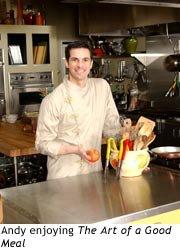
Andy describes his process after graduation as part Zen in approach. “I continued to do what I liked and test the waters of what I thought I was going to like.” After five years of teaching around town, he decided to pursue the vision that was taking shape: his own “culinary studio” — a term he has registered as a trade name. To do this, he added some very practical disciplines into the Zen mix, namely a 20-page business plan and precise design specifications that would transform a former Pilates space to the kitchen and studio he envisioned.
AndyFood opened in 2003 and today offers cooking classes to the public, team building for organizations, client appreciation events, and private parties. Operating with the mantra of “the art of a good meal”, Andy has observed that people like being part of a creative process. Classes culminate with a buffet of the students’ collective culinary creations which Andy says produces the feeling of being part of “something bigger than you”.
Commenting on how house parties usually end up with everybody in the kitchen, Andy says that part of his own enjoyment with AndyFood is that on a daily basis he gets to be “in the kitchen where people are having a party”.
When I asked Andy what he would say to someone who is contemplating a career change, he offered: “I think people should do something they really care about.” He then added that it’s important to be wary of “ruining your hobby” because not every hobby is meant to be turned into a profession.
“So, you haven’t ruined it for yourself?” I asked, “You still love to cook?” Andy’s answer: “I do.”
“I didn’t find a place where my peg fit into that shape hole.
I sort of created my own space to do what I want to do.”
—Andy Broder
See Also: How Careers Are Made, 8 lessons we can take from Andy’s story.
Complete interview posted here.