
• Skip to primary navigation
  • Skip to main content
  • Skip to primary sidebar
Now What?® Coaching

Now What?® Coaching

from Laura Berman Fortgang

  • Login
  • About
    • About Laura
    • Our Philosophy
    • Praise
  • Hire a Facilitator
    • Hire Laura
  • Become a Facilitator
  • Online Courses
    • Career Clarity & Direction
    • Career Clarity & Direction: Self-Guided Course
    • Job Search Academy
  • Products
  • Blog
  • Contact

transition

You Are Not Your Story — But Your Story Is Running Your Life

By Laura Berman Fortgang on April 5, 2026

Most of us hear the word “storytelling” and think of campfires, children’s books, or maybe a TEDx Talk. But veteran coach and one of my early mentors, Jay Perry, has spent decades thinking about something far more fundamental: the stories that are already running inside you, whether you chose them or not.

Perry calls it the “story sphere,” a term he coined to describe the invisible atmosphere of narratives surrounding us at all times: interior stories, media stories, family stories, political stories. According to Perry, AI estimates there may be as many as a trillion stories operating at any given moment. “Like the atmosphere,” he says, “we don’t necessarily see everything that’s going on, but we know if we didn’t have oxygen and hydrogen and all those things, we couldn’t survive. We don’t survive without story. Story actually is what human is.”

This isn’t a metaphor; it’s neuroscience. Our brains are literally wired to function through story — seeking patterns, confirming what they already believe, and above all, protecting us from perceived threat.

The Squatter Stories

That protective function is where things get complicated. Over the course of our lives, we accumulate what Perry calls “squatter stories,” which are narratives that took up residence in the brain and refuse to leave. Things like I’ll never finish anything; I’m always behind; or Just when things get going, everything falls apart. Many people Perry works with are neurodivergent, and for them these stories often coalesce into a single punishing belief: There’s something wrong with me.

The brain doesn’t mean harm. It’s doing exactly what it was designed to do — protecting you based on patterns it has recognized. But the problem is confirmation bias. “Every time something shows up that confirms that I’m stupid, or whatever that story is,” Perry explains, “the brain digs deeper and deeper into it.” The story becomes identity. It becomes the lens through which you see everything.

Simply telling yourself to “change your story” doesn’t work. As Perry puts it: “Easy conceptually, but to actually do that requires lessening the power of those foundational stories and increasing our narrative intelligence.” Trying to override a deep story with sheer logic, he says, is like bringing a knife to a gunfight.

You Are Not Your Story — But Your Story Is Running Your Life by Laura Berman FortgangThe Intelligence We’ve Been Ignoring

Here’s where Perry’s work gets truly provocative. He distinguishes between two modes of thinking. Logical thinking works on data, and AI does that better than any human ever will. But there’s another kind of thinking, what he calls Narrative Intelligence, that operates on something entirely different: imagination, intuition, emotion, wonder, common sense.

“Narrative intelligence works on no data,” Perry says. “Logic works really well when the future is likely to be like the present and the past.” In a world changing as rapidly as ours, that’s a liability. The people who will navigate what’s ahead are those who can think in story and can imagine outcomes not yet in evidence, hold multiple possibilities at once, and pivot when the plan stops working.

We’ve been rewarded our whole lives for getting the right answer. That rewired us toward the logical, computational mode of thinking. Now that machines are taking over that function, the undervalued skill — narrative intelligence — suddenly becomes essential.

How Fascinating

What do you actually do when a squatter story shows up? Perry was inspired by conductor and author Benjamin Zander, who teaches a deceptively simple practice: When something goes wrong, say “how fascinating,” and mean it fully, physically, emotionally.

It sounds almost too simple, but the point is precise. You can’t fight a foundational story with a cognitive argument, because the story has far more emotional force than any counterargument you can muster. What you can do is interrupt the pattern with enough energy and presence to actually stop the loop. “How fascinating” isn’t just words. It’s a full-bodied shift in stance that says: I see you, story. And I’m curious about you, not imprisoned by you.

Perry calls this approach “playful story catching.” The goal isn’t to eliminate the stories or shame yourself for having them. It’s to notice them, to create distance from them, and remember that you are the author, not the character.

One powerful technique is shifting your narrative perspective. Our brains are conditioned to protect “I.” But if you can catch yourself in an “I story” and reframe it, such as Laura is having trouble with this instead of I am having trouble with this — the brain relaxes its grip. The protective mechanism doesn’t guard “Laura” the same way it guards “I.”

The Power of We

Perhaps the most striking idea Perry offers is the shift from “I stories” to “we stories.” No one has ever done anything entirely alone, yet we insist on framing our lives as solo narratives. When you expand your story to include others — a community, a collaborator, an idea, even a place — possibilities open that the I story simply cannot access. “The I story is chained by that protective mechanism,” Perry says. “When we start thinking in we stories, things become possible that aren’t possible for the I story.”

He built his community, Story Sphere Central, around exactly this principle. For $22 a month, members from Thailand to Europe gather for group coaching, co-working sessions, creative workshops, and a course called Heroes of the Story Sphere — a name Perry chose deliberately. “I think it takes bravery,” he says. “It takes heroism to show up and actually look for the truth about what the stories are.”

Be Open to the Plot Twist

Perry closes with what may be his most powerful invitation. In a study by researcher Angus Fletcher, veterans with PTSD were given access to every conventional healing modality available including massage, meditation, and yoga. Only one person in the group made a full recovery. What set them apart? They had experienced a plot twist.

A plot twist isn’t something you manufacture. It’s something you receive — a bankruptcy, a loss, an unexpected phone call, an idea that comes from nowhere. What you can do is stay open to one. “If we can open our consciousness to seeing the gifts that are given to us,” Perry says, “that’s why it’s so important to have we stories — because that multiplies the number of opportunities we have for plot twists.”

You are swimming in a story sphere right now.
The question is whether you’re authoring the story or being authored by it.


Jay Perry’s community, Story Sphere Central, can be found at StorySphereCentral.com.
This article is a synthesis of an interview conducted on March 27, 2026
Filed Under: Now What? Newsletter Articles Tagged With: Career Coaching, entrepreneurs, Laura Berman Fortgang, new direction, Now What Coaching, take action, transitionLeave a Comment

When the Storm Hits: Your Guide to Weathering What Comes and Emerging Stronger

By Laura Berman Fortgang on February 1, 2026

The meteorologists saw it coming days in advance. The grocery stores emptied of bread and milk. Batteries flew off the shelves. Everyone knew the storm was approaching, yet when it finally arrived, many still found themselves unprepared for its full force.

Life’s storms work the same way. Sometimes we see them gathering on the horizon – a organizational restructuring, a relationship reaching its breaking point, a business model that’s clearly running out of road. Other times, they hit without warning, leaving us scrambling to find our footing while everything we counted on gets rearranged.

The question isn’t whether storms will come. They will.
The question is:
How will you prepare, how will you weather them, and how will you use what they teach you?

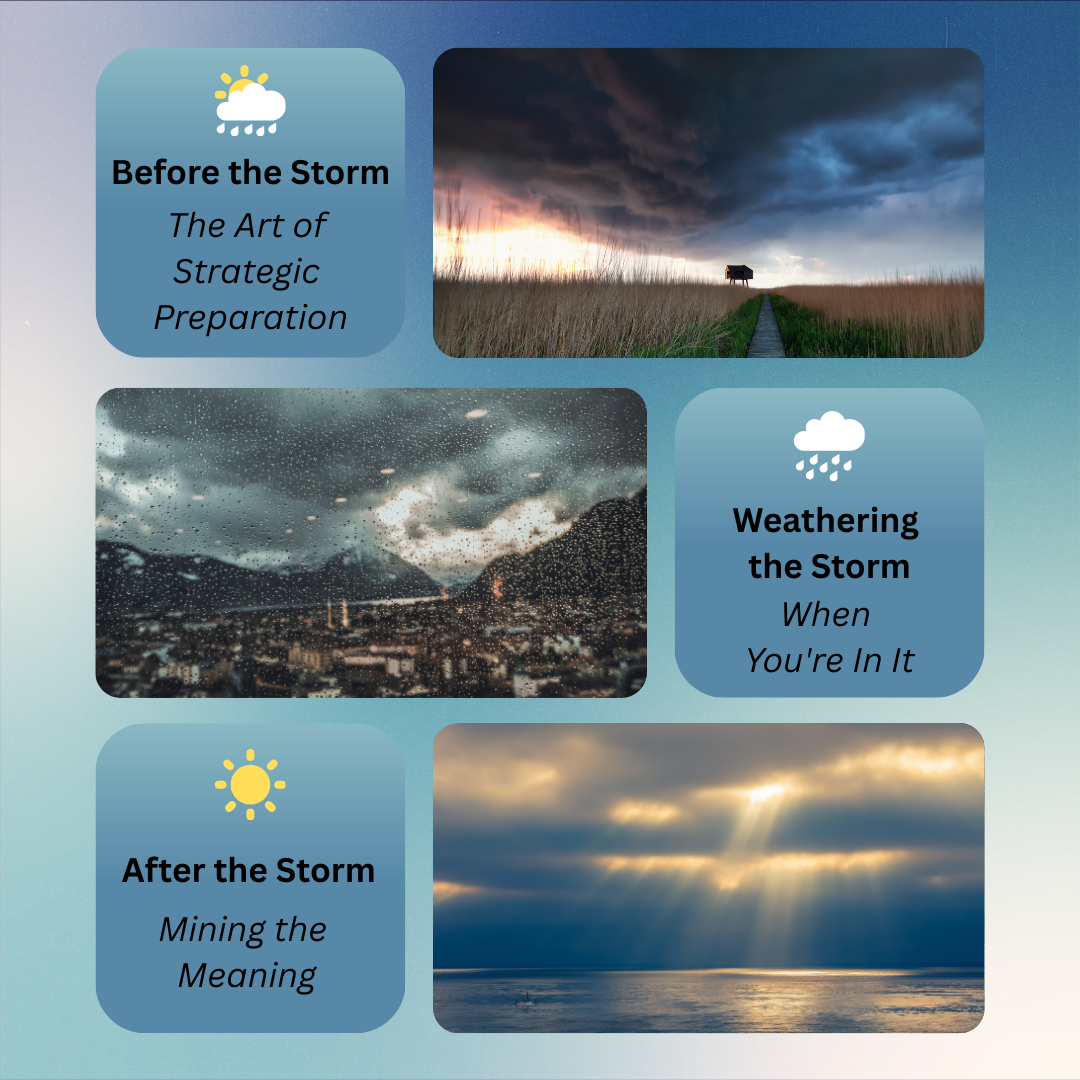
Before the Storm: The Art of Strategic Preparation

Here’s what most people get wrong about preparation:
They stockpile supplies, but they forget to strengthen their foundation.

When I work with leaders and entrepreneurs facing major transitions, I ask them a simple question: “What are you anchoring to?” When everything else is moving, you need something solid to hold onto. For some, it’s their core values. For others, it’s their sense of purpose or their commitment to the people they serve.

The coaches I work with who navigate industry changes most successfully aren’t the ones with the biggest emergency funds (though those help). They’re the ones who’ve built what I call “foundational flexibility,” which is a clear sense of who they are and what they stand for, combined with the agility to adapt their methods without compromising their mission.

Practical preparation looks like this:

Know your non-negotiables.
What absolutely must be protected?
What defines you at your core?
When you’re clear on this, you can let go of everything else with much less anxiety.

Build your support system before you need it.
The middle of a crisis is not the time to start looking for allies.
Invest in relationships during the calm, so you have people to call when the winds pick up.

Create options, not just plans.
Plans assume a predictable future.
Options give you choices when the unexpected arrives.
What are three different ways you could respond if X happens?
What resources could you access if Y occurs?

When You’re In It: Weathering the Storm

There’s a moment in every storm when you realize – this is happening.
The preparation phase is over.
Now you’re just trying to stay upright.

This is when your previous work pays off, or when you discover what you missed.

When the Storm Hits: Your Guide to Weathering What Comes and Emerging StrongerThe most important skill for weathering a storm isn’t strength; it’s presence.

The ability to stay aware, stay responsive, and resist the temptation to panic-react your way into worse problems.

I’ve watched brilliant people make terrible decisions in the middle of storms because they were so desperate to make the discomfort stop that they grabbed at the first solution that presented itself.
They pivoted their entire business model after one bad quarter.
They blew up a relationship because they couldn’t tolerate the tension of uncertainty.
They abandoned their vision because it got hard.

Weathering a storm means accepting that some things are out of your control while staying active in the things that aren’t.

You can’t stop the storm, but you can:

Protect your energy.
This is not the time to take on new commitments or push yourself to maintain “business as usual.”
Give yourself permission to focus on essentials.

Stay connected.
Isolation is the enemy of resilience. Reach out. Ask for help. Let people know you’re struggling.
The vulnerability you show now will deepen your relationships later.

Look for the small wins.
You don’t need to solve everything today.
You need to take one right action, then another, then another.
Progress compounds.

After the Storm: Mining the Meaning

Every storm deposits something. Sometimes it’s wreckage that needs clearing. Sometimes it’s nutrients that will feed next season’s growth. Your job is to examine what’s been left behind.

The entrepreneurs I know who’ve built the strongest businesses didn’t do it by avoiding failure. They did it by getting exceptionally good at learning from it. Each setback became data. Each crisis revealed something they didn’t know about themselves, their market, or their model.

The question isn’t “Why did this happen to me?”
The question is “What does this make possible that wasn’t possible before?”

Maybe the storm cleared out deadwood – projects that were draining energy without producing results, relationships that had run their course, assumptions that were holding you back. Maybe it revealed strengths you didn’t know you had. Maybe it showed you who really has your back.

Coming out positive doesn’t mean pretending the storm didn’t hurt.
It means refusing to let the hurt be the only thing that defines what happened.

The storms will come. They always do.

The only real question is: When the next one arrives, who will you be?
Someone who merely survives it, or someone who uses it to become more of who you’re meant to be?

Start preparing now. Not because you’re pessimistic, but because you’re committed to staying in the game no matter what the weather brings.

Filed Under: Lessons Learned, Life Lessons, Now What? Newsletter Articles, Reinventing Yourself, Taking Action Tagged With: Change, Clarity, coaching, Laura Berman Fortgang, life coach, new direction, Now What Coaching, take action, transitionLeave a Comment

Before You Do, Remember Who You’re Becoming

By Laura Berman Fortgang on January 25, 2026

Every January, millions of people launch into action. They join gyms, open blank documents for that novel they’ve been meaning to write, or register their LLC for the side hustle that’s going to change everything.

By February, most have stopped.

The problem isn’t lack of willpower or poor planning. It’s that they’re trying to change their actions without first transforming their identity.

The Identity-Action Gap

Here’s what typically happens: You decide you want to lose 30 pounds, so you buy meal prep containers and download a fitness app. You want to write a novel, so you block out time on your calendar and create the perfect workspace. You’re ready to launch that consulting business, so you design business cards and build a website.

These are all smart actions.
But they’re built on a foundation of sand.

When you take action without first shifting who you believe yourself to be, every choice becomes an internal negotiation. The alarm goes off at 5:30 AM for your workout, and you have to convince yourself – again – that you’re the kind of person who does this. You sit down to write, but that blank page mocks you because you don’t yet believe you’re actually a writer. You need to make sales calls for your new business, but impostor syndrome screams that you’re just pretending to be an entrepreneur.

This exhausting internal debate is why most ambitious goals fail. You’re constantly fighting against your own self-concept.

The Power of Identity-First Change

Consider weight loss. Most people approach it as a behavior problem: “I need to eat less and move more.” But sustainable transformation happens when you shift from “I’m trying to lose weight” to “I’m someone who takes care of my body.”

That subtle shift changes everything. When you’re someone who takes care of your body, choosing the salad isn’t deprivation; it’s consistency with who you are. Missing a workout creates genuine discomfort because it conflicts with your identity, not because you’re failing at a resolution.

The same principle applies to writing your novel. You don’t need to wait until you’re published to be a writer. You become a writer the moment you decide that’s who you are. Real writers write on days they don’t feel inspired. They protect their writing time. They study this craft. Once you embody that identity, sitting down to write becomes natural rather than forced.

And for your side hustle? Stop “trying to start a business” and start being an entrepreneur. Entrepreneurs solve problems. They learn from failure. They show up consistently even when results are slow. When that’s who you are – not what you’re attempting – the difficult actions become expressions of identity rather than items on a to-do list.

Before You Do, Remember Who You're BecomingHow to Shift Your Beingness

This isn’t about positive thinking or affirmations. It’s about genuine identity transformation.

1. Define the identity clearly.
Don’t just say “I want to be healthy.” Get specific: “I’m someone who honors my body’s needs, makes conscious food choices, and moves daily because it feels good.”

2. Find your evidence.
Your brain needs proof. Identify any moment (no matter how small) when you’ve already been this person. That time you took the stairs? That counts. The paragraph you wrote last Tuesday? Evidence. The helpful advice you gave a friend? Entrepreneurial.

3. Make identity-consistent choices.
Ask yourself throughout the day: “What would the person I’m becoming do right now?” Then do that thing, even when it’s small,
especially when it’s small.

4. Speak it into existence.
Change your language. Not “I’m trying to lose weight,” but “I take care of my body.” Not “I want to write a book,” but “I’m writing a book.” Not “I’m thinking about starting a business,” but “I’m an entrepreneur building my business.”

The Truth About Tough Actions

Yes, losing weight requires tough choices. Writing a novel demands discipline and vulnerability. Building a business means facing rejection and uncertainty.

Here’s what makes those tough actions infinitely easier: Alignment.

When your actions flow from a clear sense of who you are, they stop feeling like obligations and start feeling like integrity. You’re not forcing yourself to do hard things; you’re simply being consistent with who you’ve become.

The action is still challenging, but it’s no longer a battle with yourself.

Before you revise your goals or create your action plan, pause.
Get clear on who you’re becoming.
Let that identity settle into your bones.

Then watch how naturally the right actions follow.

Filed Under: Now What? Newsletter Articles Tagged With: Change, Clarity, coaching, Identity Action Gap, Identity First Change, internal negotiation, Laura Berman Fortgang, new direction, Shift Your Beingness, take action, transforming identity, transitionLeave a Comment

How to Stop Imposter Syndrome in Its Tracks

By Laura Berman Fortgang on October 1, 2023

Do you ever feel like an imposter?

Are you sometimes afraid that someone’s going to discover you have no idea what you’re doing — that you’re not the expert you proclaim to be, you’re not as skilled as you’ve made yourself out to be, and you’re not quite qualified to be in the position you’ve found yourself in?

Maybe you’re worried that you don’t measure up somehow, so it makes you feel like you’re pretending to be someone you’re not.

Here’s what this looks like.

Them: We’d like to interview you [for a dream job]!
You: Maybe they didn’t notice I don’t have enough experience.

Them: Congratulations! We’d like to offer you the [dream] job.
You: I’ll surely be fired by Tuesday, once they figure out I’m a fraud.

Them: We’ve selected your proposal to speak at the next conference.
You: Oh no! I’m probably going to make a fool out of myself.

Them: I’m looking for a coach, and I’d love to work with you.
You: But what if I can’t help you get results, and you tell everyone I’m a con?

I’m not a doctor, but as a Master Certified Credentialed Coach with 30 years of experience, I can confidently assess what’s happening here.

Imposter Syndrome

Don’t worry; it’s not fatal to your career or success.

Most people struggle with it from time to time, and it’s entirely “treatable.”

If you feel like your Imposter Syndrome is flaring up, here’s what I suggest you do —

  1. How to Stop Imposter Syndrome in its Tracks by Laura Berman FortgangPause and accept what’s happening. No sense in ignoring the symptoms. Denying it only makes things worse by trying to overcompensate.

  2. Learn to recognize your triggers (comparisons, someone else’s recent success) and how you respond, so you can head it off at the pass. Before you go into a full-on panic, tell yourself, “This is just imposter syndrome flaring up again. Nothing alarming. You can do this.”
  3. Notice your self-talk. As soon as you start beating yourself up, STOP. It may sound easier said than done, but you can tell yourself “no.” No more negative self-talk; you’re not listening.
  4. Ask yourself what success looks like. Are you trying to measure up to a perfect ideal? Scratch that and aim for progress instead.
  5. Keep learning. The best way to keep Imposter Syndrome at bay is to continue seeking out new knowledge and ways of doing things, evolving, and growing your skill set.
  6. Celebrate wins! I can’t say enough about this. Remind your brain that you’re doing good things.

Do this again and again, every time Imposter Syndrome starts to creep up, and you’ll start experiencing it less and less.

Don’t get caught up in calling yourself an expert. Instead of thinking of yourself as someone who’s supposed to know everything, think of yourself as someone who makes it your business to learn everything you can about your particular topic of choice.

You’re not an imposter, so keep showing up as the best of who you are. You’ve got this!

Filed Under: Lessons Learned, Life Goals, Life Lessons, Now What? Newsletter Articles, Personality Development, Reinventing Yourself, Taking Action Tagged With: career, Career coach, Career Coaching, career path, career reinvention, career transition, Change, Clarity, coaching, entrepreneurs, Following your passion, Laura Berman Fortgang, life coach, Now What Coaching, Now What Program, Now What?® Program, take action, transitionLeave a Comment

Old Lessons Made New to Finish 2023 Strong

By Laura Berman Fortgang on September 24, 2023

It’s hard to believe we’re already heading into the fourth quarter of 2023, but it’s coming right up.

So … how’s it going?

Would your September 2022 self be proud?
Are you on track to reach your goals?
Did you blow by your wildest expectations?
Have you made some wrong turns or hit detours?

No matter where you are now, you still have time to finish even stronger and better. You have time to focus on what you want to get done by the end of this year.

I’ve been thinking about this a lot this week. As you may know, not only am I a Master Certified Credentialed Coach, but I’m also an ordained interfaith minister, incorporating wisdom and inspiration from ancient traditions around the world, into my work and every day.

This past weekend was Rosh Hashanah, the Jewish New Year, followed by a 10-day period of Judaism’s High Holy Days, and this coming Sunday marks Yom Kippur, the Day of Atonement or holiest day of the year.

It’s a time for reflection and renewal, introspection and connection.

A time for shedding the old and celebrating new beginnings — wishing family and friends a year filled with happiness, health, and prosperity.

Old Lessons Made New to Finish 2023 Strong by Laura Berman FortgangAs well as a time for thinking back over the past year, facing your missteps, asking forgiveness, and considering how you may become a better person in the year ahead.
Whether you take part in these customs or not, you can consider this a reminder that life is full of opportunities to begin again and move forward with renewed energy.

This weekend also marks the official first day of fall. Just like the trees shed leaves, what do you want to let go of? What do you want to make room for?

If you haven’t done it by now, maybe you didn’t really want to — so dump it!

Or forgive yourself for putting it off this long — and get to it!

Whatever you’re looking to accomplish in your career or business, the year’s not over yet. Celebrate how far you’ve come, make peace with your setbacks, and reawaken your drive to succeed.

Filed Under: Following Your Passion, Life Goals, Life Lessons, Now What? Newsletter Articles, Reinventing Yourself, Taking Action Tagged With: Career Change, Career coach, Career Coaching, Laura Berman Fortgang, Now What Coaching, Now What Program, Now What® Facilitator, Opportunity, passion, take action, transitionLeave a Comment

The Power of Pumpkin Spice

By Laura Berman Fortgang on September 17, 2023

Fall is just around the corner again, and you know what that means — it’s pumpkin spice season!

I know … you’re either rolling your eyes, giddy with excitement, or couldn’t care less. But stick with me here, because we should all be paying attention.

Love it or hate it, there’s no denying the POWER of pumpkin spice.

I kid you not — studies have found that Americans are spending over half a BILLION dollars on pumpkin spice stuff every year. Buying up everything from Starbucks lattes to scented trash bags, industry insiders call it the “pumpkin spice economy.”

Sure, it may seem like things have gotten out of hand, and seeing the hype start in mid-August is a pet peeve of mine. Personally, I’m a fan of pumpkin spice, and I’m an even bigger fan of pumpkin spice as a marketing phenomenon.

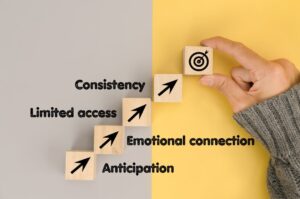
Marketers have NAILED this. Here’s how —
    1. The Power of Pumpkin Spice by Laura Berman FortgangBuilding anticipation: Those of us who are fans of the rich, fragrant flavor and scent crave our first annual sip or whiff.
    2. Creating emotional connection: It’s become interwoven with the coziness of the season, like a warm sweater, crackling fires, and family holiday gatherings.
    3. Making a limited-time offer: Not being able to order it year-round makes it special. Consumers hurry to buy while they can, as much as they can.
    4. Establishing consistency: We know this thing is coming down the pike every year and have come to rely on it.

How can you translate these lessons into your business or career?

Anticipation: Talk about what you’re brewing up; create intrigue. Developing a new program? Offer hints along the way. Working on an exciting project? Let others know you can’t wait to share. Before long, people will be on the lookout for whatever you have going on and want in on it.

Emotional connection: Make sure people associate your work with something deeper than a commodity. You don’t just offer accounting services, but peace of mind. Not just coaching, but clarity and inspiration.

Limited access: Scarcity encourages people to take action. Offer a limited number of one-on-one coaching opportunities. Focus on projects that make the greatest impact rather than spreading yourself thin.

Consistency: Let people know what to expect from you, so they can look forward to your upcoming podcast episode, newsletter, program launch, or presentation at the next industry conference — and depend on you showing up.

I’d love to know how you’re going to spice things up this fall. Hit reply and share.

Filed Under: Life Goals, Life Lessons, Now What? Newsletter Articles, Personality Development, Reinventing Yourself, Taking Action, Uncategorized Tagged With: beat the odds, career, Career Change, Career Coaching, career path, career reinvention, career transition, Career transitions, Change, entrepreneurs, Laura Berman Fortgang, new direction, Now What Coaching, Now What?® Program, take action, transitionLeave a Comment

  • Page 1
  • Page 2
  • Page 3
  • Interim pages omitted …
  • Page 12
  • Go to Next Page »

Primary Sidebar

Pinpoint–and plan-a fulfilling "next chapter" of your career with the Now What?® Program

Start Today

Buy Now

Sign up for Laura’s mailing list so you don’t miss a thing!

Disclaimer |
Site Usage and Privacy Policy  |  Facilitator Zone

Copyright © 2026 Now What?® Coaching. All Rights Reserved.