
When was the last time you said yes to something when every cell in your body was screaming no — and then spent days quietly resenting it?
If that question hit a nerve, you’re not alone. Today I want to make a case that’s going to make some of you uncomfortable: the most successful people you know are also, by most people’s definition, a little bit selfish. And you need to be too.
The Difference That Changes Everything
There’s a critical distinction we need to make right up front.
Selfish means taking at other people’s expense.
Self-prioritizing means protecting what allows you to give your best.
Those are not the same thing, but most of us have been taught to treat them as identical.
We’ve been told that selfish is the worst thing you can be, especially if you’re in a leadership role, a family role, or a helping role. But here’s what I notice: Every Fortune 500 CEO has a calendar guarded like Fort Knox. Nobody calls them selfish; they call them successful.
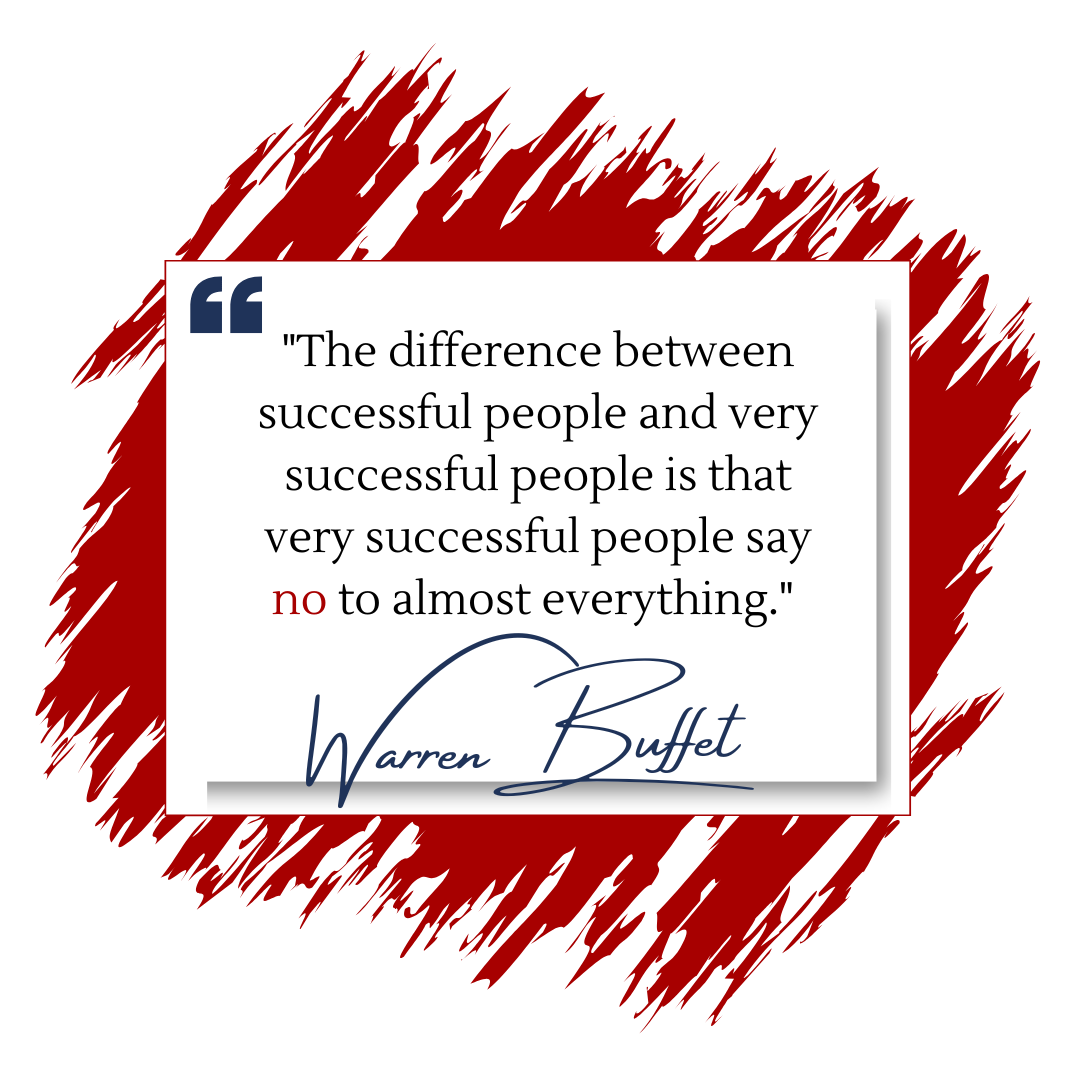
Warren Buffett said it best: “The difference between successful people and very successful people is that very successful people say no to almost everything.” Totally counterintuitive — and totally true.
The question isn’t whether you’re allowed to protect your time.
The question is whether you’re willing to stop apologizing for it.
You are not a vending machine for other people’s convenience.
 The Three Taxes You’re Paying Right Now
Chronic yes-saying carries three hidden costs that most people never see until they’re depleted.
The Energy Tax.
Every yes you didn’t mean is energy you can’t get back. You don’t just lose the hour of the meeting. You lose the anticipation time, the recovery time, and the mental real estate it occupies in your head.
The Opportunity Tax.
Every yes is a no to something else. The book you didn’t finish. The workout you didn’t do. The conversation with your kid that you didn’t have. People don’t see what you give up to say yes to them, but you do, and it adds up.
The Resentment Tax.
This is the silent killer. Chronic yes-saying doesn’t make people like you more. It makes you quietly resent them. That resentment leaks out and poisons every relationship it touches — your marriage, your team, your friendships. The very relationships you’re trying to protect by saying yes are the ones most damaged by it.
Three Scripts to Put in Your Back Pocket
Knowing why you need to say no is one thing. Knowing what to actually say is another. Here are three phrases you can use this week.
For the meeting that should be an email: “I want to make sure I’m giving this the focus it deserves. Can you send me the key points in an email, and I’ll respond with a thoughtful answer?“
For the favor you don’t have capacity for: “I’d love to help, but I’m protecting my bandwidth this quarter for the commitments I’ve already made.”
For the boss or client who feels impossible to refuse: “I want to do this well. To take this on, I’d need to deprioritize X. Which would you like me to focus on?” This one is powerful because it puts the decision back where it belongs — with them.
The key with all of these is no apologies, no over-explaining, and no leaving the door open a crack. Just a clean, kind no. A wishy-washy maybe is cruelty disguised as politeness.
The Mindset Shift That Makes It Stick
Before you can use any of this, you need to internalize something:
You are not responsible for managing other people’s disappointment.
The people who truly respect you will respect your no. The ones who don’t were never respecting you in the first place; they were just enjoying your compliance. Let them be annoyed.
If you feel guilty when you start doing this? Good.
Feeling guilty doesn’t mean you’ve done something wrong. It means you did something new. Congratulations!
Your Homework This Week
Say no to one thing. Just one. Something you’d normally say yes to out of habit, guilt, or fear of disappointing somebody. Notice what happens — both inside you and in the relationship.
Because the people doing the biggest work in the world, building the biggest companies, raising the healthiest families, making the deepest impact — they’ve all made peace with the same truth. They can’t be everything to everyone. And neither can you.
Protecting your time isn’t selfish. It’s the most strategic thing you’ll ever do.