• Skip to primary navigation
  • Skip to main content
  • Skip to primary sidebar
Now What?® Coaching

Now What?® Coaching

from Laura Berman Fortgang

  • Login
  • About
    • About Laura
    • Our Philosophy
    • Praise
  • Hire a Facilitator
    • Hire Laura
  • Become a Facilitator
  • Online Courses
    • Career Clarity & Direction
    • Career Clarity & Direction: Self-Guided Course
    • Job Search Academy
  • Products
  • Blog
  • Contact

life coach

Waiting isn’t humility; it’s a stall tactic

By Laura Berman Fortgang on July 5, 2026

The Confidence Loop: Why Waiting to Feel Ready Is Keeping You Stuck

What’s the thing you’ve been putting off until you feel ready?

The business you’ve been waiting to launch.
The promotion you’ve been thinking about asking for.
The hard conversation you’ve been rehearsing for months.
The book, the podcast, the pivot, the pitch.

Here’s the follow-up questions:
How’s it working for you?
Are you any closer to feeling ready after this whole year of waiting?
Are you still hoping for that magic moment when something clicks and the confidence finally shows up?

Spoiler Alert: It’s not coming. And I want to explain why.

What Most People Get Wrong About Confidence

Most people think they have to feel ready before they take the action. They believe confidence is a feeling you achieve first, and only then do you launch, ask, post, pitch, or push back.

But that’s backwards.
Confidence isn’t the cause of action. Confidence is the result of action.

You don’t think your way into confidence. You act your way into it.

This is hard whatever camp you’re in. If you’re an entrepreneur, you’re probably waiting to feel ready before you raise your prices, launch the offer, or post the thing on LinkedIn. If you’re in corporate, you’re waiting to feel ready before you talk to your boss about the promotion, speak up in the meeting, or push back on a decision. Different settings, same trap. You’re waiting for a feeling that only shows up after you do the thing you’re waiting to feel ready to do.

Why Waiting Makes It Worse

Here’s the brutal part — waiting actively erodes your confidence. The longer you wait, the more you’re quietly teaching your brain that you can’t, you shouldn’t, you’re not ready. The waiting itself becomes evidence.

Meanwhile, the people you watch flying past you? They’re not more talented. They’re not smarter. They’re not more prepared than you are. They’ve just figured out what you haven’t yet — that confidence is built on the other side of action, not on this side of it.

Think about anything you’re confident about right now. Driving a car. Running a meeting. Having a hard conversation with your teenager. You’re not confident at those things because you sat around until you felt ready. You’re confident because you did them (maybe badly at first) and then less badly, and then with ease.

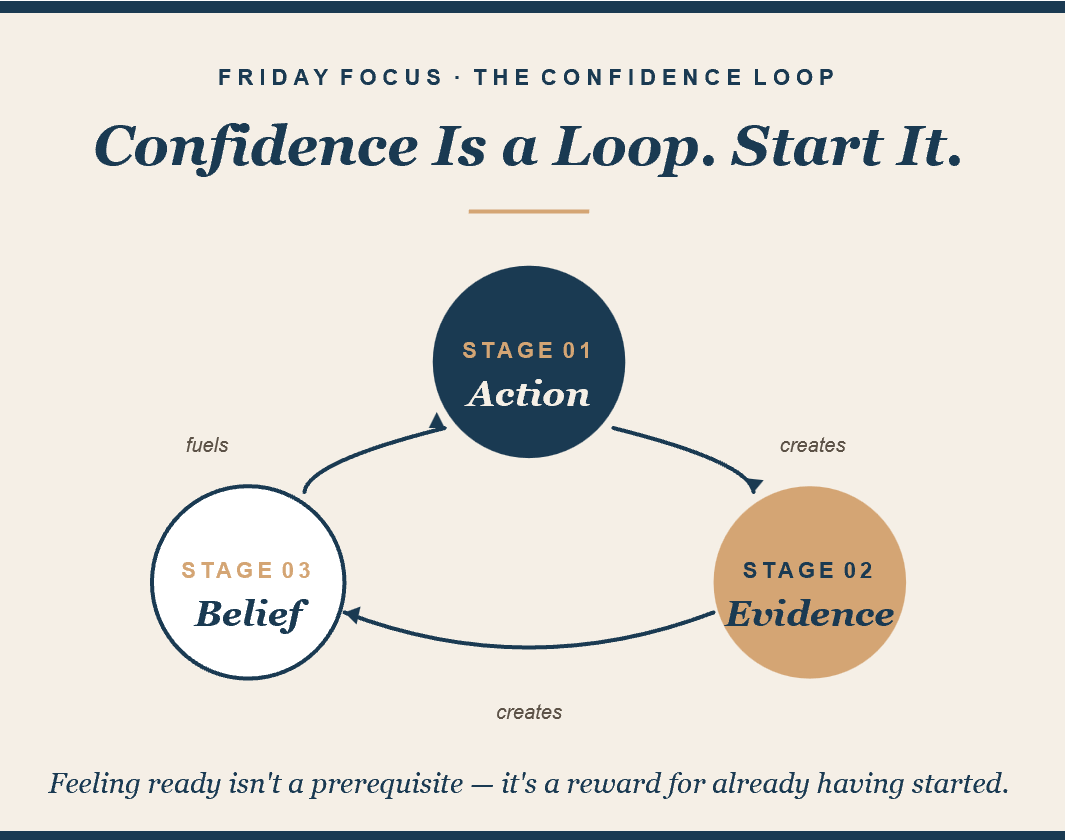
That’s the loop. Action creates evidence. Evidence creates belief. Belief makes the next action easier.
And the loop keeps spinning, but only if you’re willing to take that first imperfect step to get it started.

The Confidence Loop: Why Waiting to Feel Ready Is Keeping You Stuck

Three Practices to Start the Confidence Loop

Shrink the action. You’re not writing a whole book; you’re writing five hundred words. You’re not running in to demand a promotion; you’re asking your boss for fifteen minutes to talk about your trajectory. You’re not launching the whole big product; you’re writing the sales page first. Make the action smaller. Make it doable. The lower the resistance, the faster you start.

Do it badly on purpose. You just have to get started. You’re not going to be perfect the first time out. The first pitch is going to be awkward. The first draft isn’t going to be written right. It doesn’t matter. Action beats inaction every single time. Let the action inform you, teach you, show you what to fix next time, but do it imperfectly.

Collect the evidence. Most people take the action and then move on without noticing. Don’t. Look at the email you sent. Look at the price you quoted. Look at the meeting you ran. Look at the post you published. You’re building a case file for yourself because the next time you run out of confidence and forget that you’re good at something, you can go back and say, “Hey, I did that.”

The Mindset That Makes Confidence Stick

Here’s what I want you to internalize:
Feeling ready is not a prerequisite for being ready. It’s a reward for already having started.

Total opposite thinking, right?

The most successful people I know don’t feel more confident than you do. They’ve just stopped requiring confidence as a permission slip. They take action while uncertain. They speak up while nervous. They launch while imperfect. The confidence catches up with them.

Waiting to feel ready isn’t humility, wisdom, or strategy. It’s a stall tactic dressed up as something respectable, but I don’t respect it. It’s costing you the life and the business you actually want.

Your Challenge Today

Forget the whole week. Here’s your homework today: Take something you’ve been waiting to feel ready to do, and do it.
Send the email. Make the call. Ask for the thing. Write the paragraph. Just do it.

Then notice what happens — not externally, but inside you. Because the confidence you’ve been waiting for has been on the other side of that one small action the entire time.

The people doing the boldest, most courageous work in the world aren’t more confident than you.
They just stopped waiting and started.

And starting today, so do you.

Filed Under: Now What? Newsletter Articles Tagged With: Career coach, Career Coaching, Clarity, entrepreneurs, Laura Berman Fortgang, life coach, new direction, Now What Coaching, Opportunity, take action

You’re Not What They Said You Are

By Laura Berman Fortgang on June 28, 2026

The Feedback Filter: How to Hear Hard Truths Without Falling Apart (or Firing Back)

When was the last time you got feedback that stung?
A performance review that landed harder than expected.
A critical note from a client.
A comment from your spouse, a family member, or even your own kid that left you reeling.

What happened next:​
​Did you spiral? Did you get defensive? Did you replay it in your head for three days?
Or did you actually use it?

Today we’re talking about what I call the Feedback Filter —
how to take in hard truths without falling apart and without firing back.

What Most People Get Wrong

Most people treat feedback like an all-or-nothing situation. Either it’s totally true and they have to dump their entire strategy and start over, or it’s totally wrong and they have to ignore it. Truthfully, somewhere in the middle is where feedback is actually valuable.

This hits hard from two directions. If you’re in a corporate environment, you’re getting feedback constantly — from your boss, your peers, your direct reports, your 360 review process. If you’re an entrepreneur, it might be even harder because you’re getting feedback from every client you don’t close, every social media comment, every refund request. The feedback is nonstop, and there’s no HR department to soften the blow.

The most successful people I know — the ones who keep growing year after year — have figured out something different. They don’t take feedback personally, and they don’t dismiss it either; they filter it.

The Feedback Filter


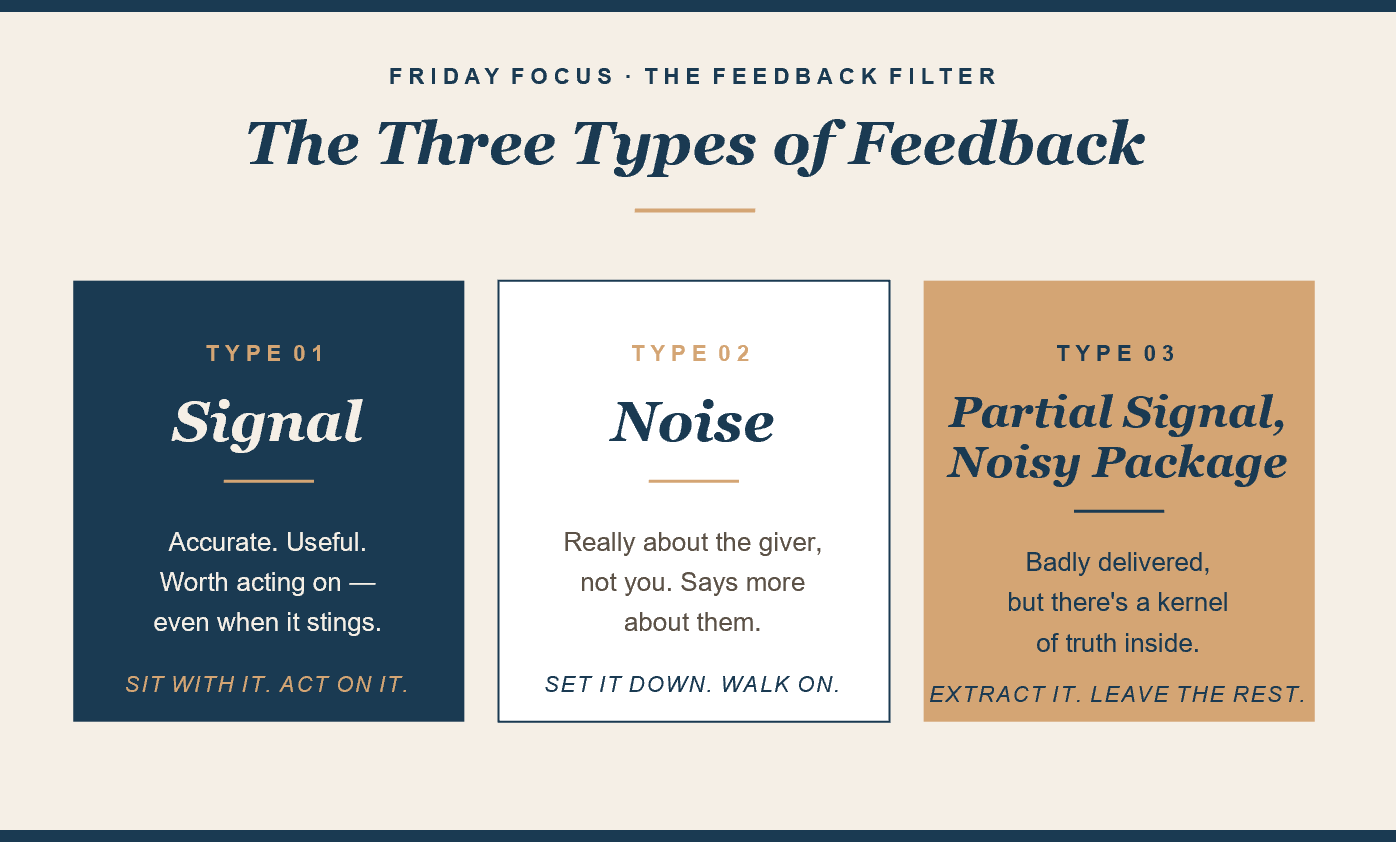
The Three Types of Feedback

Every piece of feedback that comes at you falls into one of three categories. Your job is to figure out which is which.

Signal. This is feedback that’s accurate, useful, and worth acting on, even if it stings. The boss who tells you your presentations are too long. The client who says your onboarding is confusing. The friend who points out you’ve been short-tempered lately. It hurts because it’s true. And the discomfort you feel? That’s just the cost of growth. Sit with it; act on it.

Noise. This is feedback that’s really about the giver, not about you. The client who’s lashing out because their own business is failing. The colleague who criticizes your work because they’re actually jealous of you. The parent who still talks to you like you’re sixteen years old. That feedback says more about them than it does about you. Acknowledge it, set it down, walk on.

Partial signal in a noisy package. This is the tricky one. The person who delivered the message badly — they were angry, they were mean, they had something going on — but there’s a kernel of truth in there that’s really valuable. Don’t throw the whole thing away because of how it was delivered. Extract the kernel. Leave the rest. Just because someone delivered the message poorly doesn’t mean the message is wrong.

Three Practices to Build the Filter

The 24-hour rule. ​
When feedback stings, don’t answer back, and don’t talk about it for twenty-four hours. Just say, “I hear you. Let me sit with this.” That pause trains your brain to move from reactive emotion into strategy. In that time, your emotional brain calms down and your strategic brain comes online. You’ll see clearly what was signal and what was noise.

Separate the message from the messenger.
​Ask yourself: If a person I deeply respected gave me the same feedback, would I take it more seriously? If the answer is yes, the issue isn’t the feedback; it’s who’s delivering it. That’s worth knowing because the truth is the truth that doesn’t care who says it.

Look for the pattern, not the single data point. ​
If one person tells you your pricing is too high, that’s an opinion. If three people in a row tell you your pricing is too high, that’s a pattern. Don’t overcorrect on one piece of feedback, but look for the patterns because that’s usually where there’s something you genuinely need to fix.

The Mindset That Makes It Stick

Here’s what I want you to internalize: feedback is information, not identity. When someone criticizes your work, your decisions, your business, your parenting — they’re not telling you who you are, and they’re not mandating anything. They’re just giving you data about how you’re being perceived in one particular moment.

You get to decide what to do with that data.
You can use it. You can question it. You can set it down.

But you don’t have to become it, and you don’t have to fight it. The strongest people I know hold their work to high standards without holding themselves hostage to every opinion about it.

Your Challenge This Week

Think about a piece of feedback you got recently — from a boss, a client, a family member, anyone — that’s still living rent-free in your head. Run it through the filter.

Was it signal? Was it just noise? Was it partial signal in a noisy package?
​What part of it deserves action, and what part deserves to be let go?

Because the people doing the biggest, boldest, most courageous work in the world have all figured out the same thing. They’re not people who never get hard feedback. They’re the people who learned to hear it without breaking, and to take what’s useful.

Filed Under: Now What? Newsletter Articles Tagged With: Career coach, Career Coaching, entrepreneurs, Laura Berman Fortgang, life coach, Now What Coaching

Why you’re fried by 2 PM (it’s not what you think)

By Laura Berman Fortgang on June 14, 2026

Decision Fatigue: How High Performers Are Quietly Burning Out by 2 PM

Have you ever sat down at your desk at 2 PM, looked at your to-do list, and felt completely fried — even though you haven’t really done anything that big that day?

Welcome to my world and to the world of decision fatigue.

You’re not lazy.
You’re not unmotivated.
​
​You’re not burned out in the way we usually talk about burnout. ​
​You’re paying what I call the Decision Fatigue Tax.

I want to show you how it’s quietly draining the best minds I know, and what to do about it.

What Most People Get Wrong About Burnout

Most people think burnout is about doing too much.
So the advice is always the same — take a vacation, take breaks, do less.

Listen, some of us are doing too much. But bear with me, because this reframe matters.

You’re not exhausted because you’re doing too much.
​You’re exhausted because you’re deciding too much.

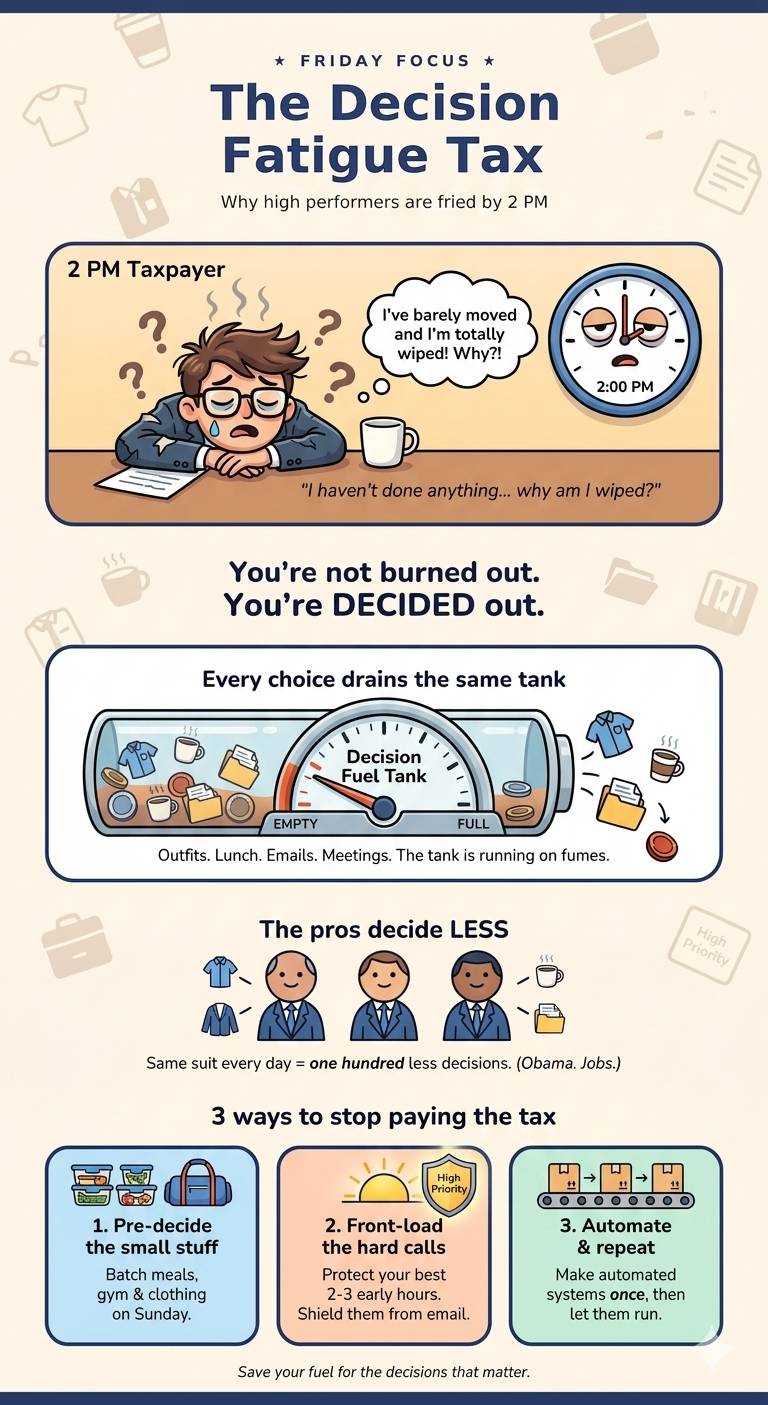
Every choice you make — what to wear, what to eat, which email to answer first, whether to take that meeting, how to phrase that text — pulls from the same mental fuel tank. And that tank is not as big as we think it is. By the time you get to the decisions that actually matter — the strategic ones, the creative ones, the ones about your family or your business — the tank is empty.

You’re not burned out; you’re decided out.

Decision Fatigue Tax


Why This Matters

Research on decision fatigue shows something brutal: As the day goes on, your judgment gets measurably worse.
You take shortcuts. You default to the easy answer. You say yes when you meant to say no.

That’s why the smartest, most successful people in the world have figured out a counterintuitive trick — they decide less. They automate.

Barack Obama wore only gray or blue suits as president. He said it out loud: “I don’t want to make decisions about what I’m eating or wearing because I have too many other decisions to make.”

Steve Jobs wore the same black turtleneck and jeans every day. Maybe it was his signature look, but it also eliminated a decision he’d otherwise have to make every morning.

You don’t need to wear a uniform, but you do need to understand the principle:
​Every decision you eliminate becomes fuel for the decisions that really matter.

Three Practices to Stop Decision Fatigue

Pre-decide the small stuff. ​
Sit down on Sunday and figure out what you’re going to eat for breakfast that week, what time you’ll go to the gym, what your first hour of the day looks like. Think of it as batching your decisions. Make them once and let them run on autopilot all week. Every decision you automate is more mental fuel available for what matters.

Front-load the hard decisions. ​
Your decision-making power is highest in the first two or three hours of the day. Most people waste those peak hours on email and to-do list cleanup. The strategic move is the opposite — schedule for the morning that hard call, that big creative work, or that important conversation. Pull the tiny choices to later in the day and put your one big important decision at the front.

Create defaults for recurring choices. ​
Have the same breakfast a few days a week. They wrote about how Jennifer Aniston used to eat the same salad every day on the set of Friends — maybe it was a weight loss thing, maybe it was just not wanting to make a decision. Have a default answer for new requests too. Don’t decide on the spot — tell people you’ll get back to them, and decide when you can actually be clear.

The Mindset That Makes It Stick

Here’s what I want you to internalize:
Your decision-making capacity is a finite resource; treat it like money.

You wouldn’t spend a hundred dollars on gum, and then wonder why you can’t afford dinner. Stop spending your best mental energy on what to wear and what to eat, and then wondering why you have nothing left for the decisions that actually shape your life.

Protect the tank. Spend it on purpose. Save it for what matters.

Your Challenge This Week

Pick three decisions you make every single day and eliminate them.
Pre-decide them on Sunday. Put them on autopilot.
Then notice what shows up in the mental space that opens up.

Because the people doing the biggest, clearest, most strategic, most creative work in the world have figured out the same secret.

They’re not deciding more.
They’re deciding less and deciding better.

Filed Under: Now What? Newsletter Articles Tagged With: Career Coaching, Clarity, Laura Berman Fortgang, life coach, Now What Coaching

Strategic Selfishness: Why Protecting Your Time Is the Most Powerful Move You’re Not Making

By Laura Berman Fortgang on June 7, 2026

When was the last time you said yes to something when every cell in your body was screaming no — and then spent days quietly resenting it?

If that question hit a nerve, you’re not alone. Today I want to make a case that’s going to make some of you uncomfortable: the most successful people you know are also, by most people’s definition, a little bit selfish. And you need to be too.

The Difference That Changes Everything

There’s a critical distinction we need to make right up front.
Selfish means taking at other people’s expense.
Self-prioritizing means protecting what allows you to give your best.
Those are not the same thing, but most of us have been taught to treat them as identical.

We’ve been told that selfish is the worst thing you can be, especially if you’re in a leadership role, a family role, or a helping role. But here’s what I notice: Every Fortune 500 CEO has a calendar guarded like Fort Knox. Nobody calls them selfish; they call them successful.

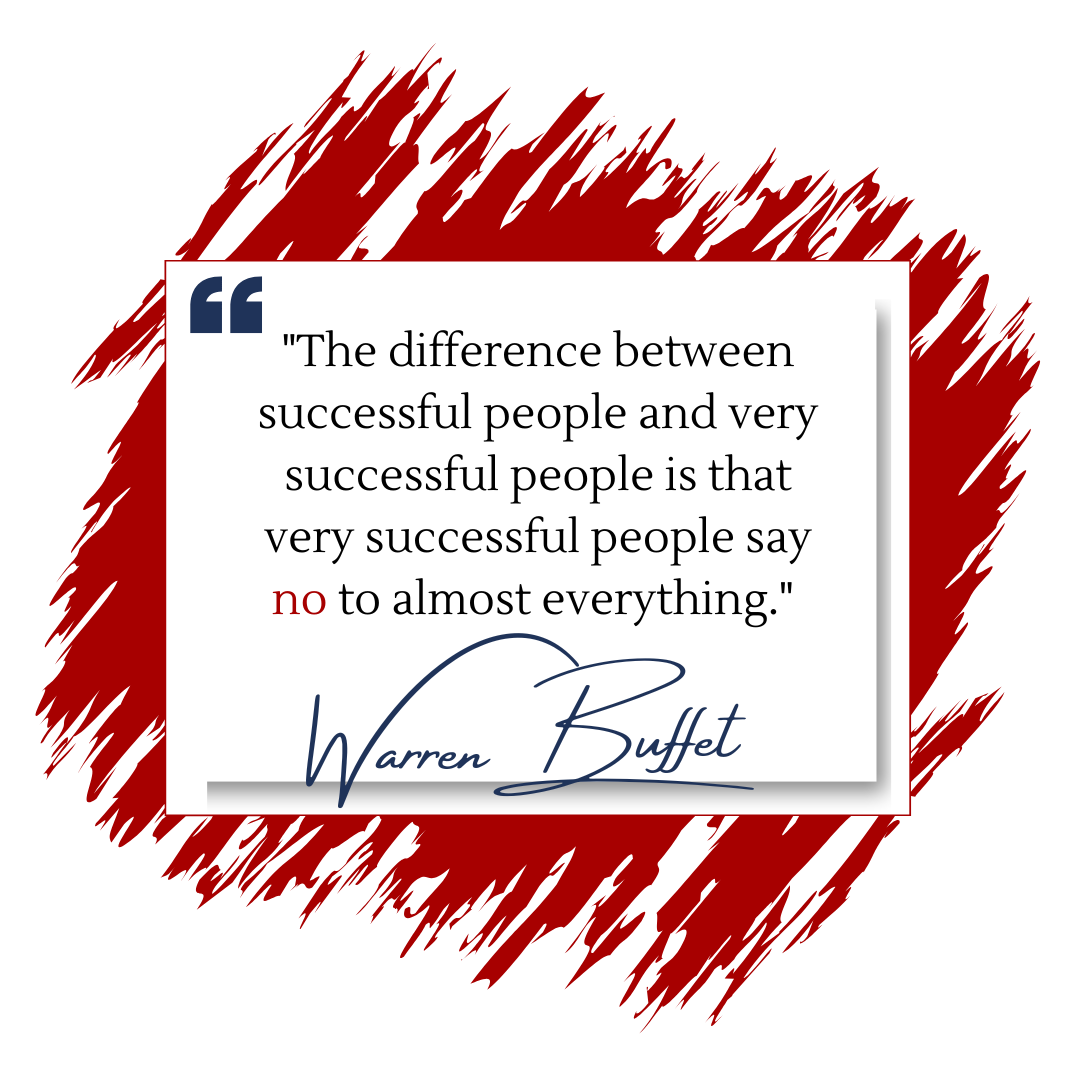
Warren Buffett said it best: “The difference between successful people and very successful people is that very successful people say no to almost everything.” Totally counterintuitive — and totally true.

The question isn’t whether you’re allowed to protect your time.
The question is whether you’re willing to stop apologizing for it.
You are not a vending machine for other people’s convenience.

Strategic Selfishness: Why Protecting Your Time Is the Most Powerful Move You're Not Making by Laura Berman FortgangThe Three Taxes You’re Paying Right Now

Chronic yes-saying carries three hidden costs that most people never see until they’re depleted.

The Energy Tax.
Every yes you didn’t mean is energy you can’t get back. You don’t just lose the hour of the meeting. You lose the anticipation time, the recovery time, and the mental real estate it occupies in your head.

The Opportunity Tax.
Every yes is a no to something else. The book you didn’t finish. The workout you didn’t do. The conversation with your kid that you didn’t have. People don’t see what you give up to say yes to them, but you do, and it adds up.

The Resentment Tax.
This is the silent killer. Chronic yes-saying doesn’t make people like you more. It makes you quietly resent them. That resentment leaks out and poisons every relationship it touches — your marriage, your team, your friendships. The very relationships you’re trying to protect by saying yes are the ones most damaged by it.

Three Scripts to Put in Your Back Pocket

Knowing why you need to say no is one thing. Knowing what to actually say is another. Here are three phrases you can use this week.

For the meeting that should be an email: “I want to make sure I’m giving this the focus it deserves. Can you send me the key points in an email, and I’ll respond with a thoughtful answer?“

For the favor you don’t have capacity for: “I’d love to help, but I’m protecting my bandwidth this quarter for the commitments I’ve already made.”

For the boss or client who feels impossible to refuse: “I want to do this well. To take this on, I’d need to deprioritize X. Which would you like me to focus on?” This one is powerful because it puts the decision back where it belongs — with them.

The key with all of these is no apologies, no over-explaining, and no leaving the door open a crack. Just a clean, kind no. A wishy-washy maybe is cruelty disguised as politeness.

The Mindset Shift That Makes It Stick

Before you can use any of this, you need to internalize something:
You are not responsible for managing other people’s disappointment.

The people who truly respect you will respect your no. The ones who don’t were never respecting you in the first place; they were just enjoying your compliance. Let them be annoyed.

If you feel guilty when you start doing this? Good.
Feeling guilty doesn’t mean you’ve done something wrong. It means you did something new. Congratulations!

Your Homework This Week

Say no to one thing. Just one. Something you’d normally say yes to out of habit, guilt, or fear of disappointing somebody. Notice what happens — both inside you and in the relationship.

Because the people doing the biggest work in the world, building the biggest companies, raising the healthiest families, making the deepest impact — they’ve all made peace with the same truth. They can’t be everything to everyone. And neither can you.

Protecting your time isn’t selfish. It’s the most strategic thing you’ll ever do.

Filed Under: Now What? Newsletter Articles Tagged With: Career coach, Career Coaching, Clarity, entrepreneurs, Laura Berman Fortgang, life coach, new direction, take action

You Don’t Have to Be a Celebrity to Join the A-List

By Laura Berman Fortgang on March 29, 2026

You Don’t Have to Be a Celebrity to Join the A-List
​
But you do have to act like one.

Here’s what I see coaches and entrepreneurs doing every single day. They’re talented. They create genuine transformations in people’s lives. Yet they’re out there hustling, discounting their prices, watering down their message, trying to reach everybody. They’re treating their business like an open audition that never ends.

I want to ask them one question: What are you auditioning for?

Meryl Streep doesn’t send in audition tapes. Denzel Washington doesn’t line up in hope. At a certain level of this game, we’ve got to stop asking, “Will they pick me?” and start asking, “Do I want to work with them?” That shift — right there — is the A-List mentality.

You don’t get on the A-List by earning it.
You get there by deciding you’re on it, and then bringing it into fruition.

THE PROOF

I’ve had some incredible opportunities in my career, and none of them came the way you might expect. I got to be on the Oprah Winfrey Show. I have a TEDx talk with over two million views. My first book? They asked me to write it. I didn’t send a single query letter.

None of it came from spending all my time trying to engineer my way to the next level. It came from one thing: Showing up one hundred percent, every single time.

Not 90% because I was tired. Not 80% because the fee wasn’t what I wanted. A hundred percent, consistently, and without questioning whether I belonged. Look — I’m human. There are moments of doubt. There are moments of “Who am I to be doing this?” But you’ve got to put those thoughts out of your head as fast as possible. Certainty isn’t a feeling that arrives. It’s a decision you make.

THE 6 RULES OF THE A-LIST

The A-List isn’t something other people deem you worthy of. It’s something you deem yourself worthy of. Here’s how A-List coaches and entrepreneurs actually operate:

  1. They own their niche without apology.

Trying to serve everybody is a hiding strategy. When you’re vague, you’re hiding. Pick your lane; plant your flag. The more specific you are, the more magnetic you become, and the easier it is for the right people to find you.

  1. They set their own terms.

A-Listers aren’t auditioning. They ask for money with the same energy they’d order coffee at Starbucks — no doubt, no hype – just matter of fact. The ideal client doesn’t want the cheapest deal; they want the best.

  1. They protect their energy like it’s a contract clause.

Every yes to the wrong thing is a no to the right thing. A-Listers have learned to create a certain amount of scarcity in the market; not because they’re playing games, but because their time genuinely costs something. That’s the signal.

  1. They never question the room.

They don’t walk into a space wondering if they belong. Their energy precedes them. Certainty — and I’ve said this before — is not a feeling that comes to you. It’s a decision you make. You decide you belong. The energy in a room shifts around that belongingness. It is the most underrated business strategy alive.

  1. They build visibility on purpose.

Being excellent in private gives you a hobby business. Being excellent in public gives you a real one. Write the thing. Take the stage. Post the idea. The world can’t ask for you by name if it doesn’t know your name.

  1. They raise their standard of proximity.

You can’t think A-List thoughts in B-List rooms. It’s who you hang out with, who you’re in conversation with, who you mentor with. Put yourself in the environment that matches where you’re going, not just where you’ve been.

THE DECISION

Here’s what all six of those rules have in common: None of them require a publicist. None require a huge following. None require you to wait until you feel ready because the feeling of ready is often the story fear tells you to stay comfortable.

All they require is a decision. A decision that you’re done shrinking. Done discounting. Done explaining yourself to people who weren’t going to get it anyway. Done auditioning for opportunities that should be auditioning for you.

The A-List begins with you deciding you’re on it. It’s not waiting for you. It’s a decision you make.

Here’s the question I want to leave you with:

What would you do differently today if you already knew you were the person people ask for by name?

Go do that. Start now!

Filed Under: Now What? Newsletter Articles Tagged With: career, Career coach, Career Coaching, career reinvention, Clarity, entrepreneurs, life coach, Now What Coaching

When the Storm Hits: Your Guide to Weathering What Comes and Emerging Stronger

By Laura Berman Fortgang on February 1, 2026

The meteorologists saw it coming days in advance. The grocery stores emptied of bread and milk. Batteries flew off the shelves. Everyone knew the storm was approaching, yet when it finally arrived, many still found themselves unprepared for its full force.

Life’s storms work the same way. Sometimes we see them gathering on the horizon – a organizational restructuring, a relationship reaching its breaking point, a business model that’s clearly running out of road. Other times, they hit without warning, leaving us scrambling to find our footing while everything we counted on gets rearranged.

The question isn’t whether storms will come. They will.
The question is:
How will you prepare, how will you weather them, and how will you use what they teach you?

Before the Storm: The Art of Strategic Preparation

Here’s what most people get wrong about preparation:
They stockpile supplies, but they forget to strengthen their foundation.

When I work with leaders and entrepreneurs facing major transitions, I ask them a simple question: “What are you anchoring to?” When everything else is moving, you need something solid to hold onto. For some, it’s their core values. For others, it’s their sense of purpose or their commitment to the people they serve.

The coaches I work with who navigate industry changes most successfully aren’t the ones with the biggest emergency funds (though those help). They’re the ones who’ve built what I call “foundational flexibility,” which is a clear sense of who they are and what they stand for, combined with the agility to adapt their methods without compromising their mission.

Practical preparation looks like this:

Know your non-negotiables.
What absolutely must be protected?
What defines you at your core?
When you’re clear on this, you can let go of everything else with much less anxiety.

Build your support system before you need it.
The middle of a crisis is not the time to start looking for allies.
Invest in relationships during the calm, so you have people to call when the winds pick up.

Create options, not just plans.
Plans assume a predictable future.
Options give you choices when the unexpected arrives.
What are three different ways you could respond if X happens?
What resources could you access if Y occurs?

When You’re In It: Weathering the Storm

There’s a moment in every storm when you realize – this is happening.
The preparation phase is over.
Now you’re just trying to stay upright.

This is when your previous work pays off, or when you discover what you missed.

When the Storm Hits: Your Guide to Weathering What Comes and Emerging StrongerThe most important skill for weathering a storm isn’t strength; it’s presence.
The ability to stay aware, stay responsive, and resist the temptation to panic-react your way into worse problems.

I’ve watched brilliant people make terrible decisions in the middle of storms because they were so desperate to make the discomfort stop that they grabbed at the first solution that presented itself.
They pivoted their entire business model after one bad quarter.
They blew up a relationship because they couldn’t tolerate the tension of uncertainty.
They abandoned their vision because it got hard.

Weathering a storm means accepting that some things are out of your control while staying active in the things that aren’t.

You can’t stop the storm, but you can:

Protect your energy.
This is not the time to take on new commitments or push yourself to maintain “business as usual.”
Give yourself permission to focus on essentials.

Stay connected.
Isolation is the enemy of resilience. Reach out. Ask for help. Let people know you’re struggling.
The vulnerability you show now will deepen your relationships later.

Look for the small wins.
You don’t need to solve everything today.
You need to take one right action, then another, then another.
Progress compounds.

After the Storm: Mining the Meaning

Every storm deposits something. Sometimes it’s wreckage that needs clearing. Sometimes it’s nutrients that will feed next season’s growth. Your job is to examine what’s been left behind.

The entrepreneurs I know who’ve built the strongest businesses didn’t do it by avoiding failure. They did it by getting exceptionally good at learning from it. Each setback became data. Each crisis revealed something they didn’t know about themselves, their market, or their model.

The question isn’t “Why did this happen to me?”
The question is “What does this make possible that wasn’t possible before?”

Maybe the storm cleared out deadwood – projects that were draining energy without producing results, relationships that had run their course, assumptions that were holding you back. Maybe it revealed strengths you didn’t know you had. Maybe it showed you who really has your back.

Coming out positive doesn’t mean pretending the storm didn’t hurt.
It means refusing to let the hurt be the only thing that defines what happened.

The storms will come. They always do.

The only real question is: When the next one arrives, who will you be?
Someone who merely survives it, or someone who uses it to become more of who you’re meant to be?

Start preparing now. Not because you’re pessimistic, but because you’re committed to staying in the game no matter what the weather brings.

Filed Under: Lessons Learned, Life Lessons, Now What? Newsletter Articles, Reinventing Yourself, Taking Action Tagged With: Change, Clarity, coaching, Laura Berman Fortgang, life coach, new direction, Now What Coaching, take action, transition

  • Page 1
  • Page 2
  • Page 3
  • Interim pages omitted …
  • Page 30
  • Go to Next Page »

Primary Sidebar

Pinpoint–and plan-a fulfilling "next chapter" of your career with the Now What?® Program

Start Today

Buy Now

Sign up for Laura’s mailing list so you don’t miss a thing!

[gravityform id=”3″ title=”false” description=”false” ajax=”true”]

Disclaimer |
Site Usage and Privacy Policy  |  Facilitator Zone

Copyright © 2026 Now What?® Coaching. All Rights Reserved.

Login

Lost Your Password?