
Category: Reinventing Yourself

  • Grace Under Fire (When the Pressure’s On)

    Grace Under Fire (When the Pressure’s On)

    Lately, I’ve been having a familiar conversation with clients over and over again.

    They’re stepping into new roles, new markets, and new strategies, and they’re feeling the heat.

    They’re hopping on sales calls for the first time, making high-stakes presentations, testing new offers, and launching new things – all in this wildly unpredictable world.

    The pressure is real.

    The truth is, we’re not operating in the same reality we were a year ago. The job market has shifted. Business as usual is gone. With AI disruption, chaotic leadership, and a volatile economy, the ground keeps moving under our feet.

    We have to approach our work – and ourselves – differently to meet the moment, and do it with grace under fire.

    Trying something new always comes with risk. The offer could flop, the meeting could go sideways, and the prospect, on the verge of signing that big contract you poured everything into, could ghost you.

    But avoiding that risk by playing it safe keeps you stuck. Cozy, sure. But stuck.

    While we know the biggest wins come from stepping up and making bold moves, fear can still hijack the system. It’s human. The moment something gets hot, we pull back,  panic, overthink, and we shut down.

    Here’s what I tell my clients:

    When the pressure’s on, pause.
    Breathe. Calm your nervous system. Get out of fight-or-flight mode so you can think clearly.

    Then, assess your reality.
    What’s real, and what’s just fear talking? Are you reacting to facts, or to a story you’re telling yourself?

    Next, check your intentions.
    Are you staying on mission, or veering off course because you’re uncomfortable? Stick with your purpose. That’s where the power is.

    Finally, act with focus.
    Not perfection. Focus. What’s the next right move, not the flawless one? Do that.

    Grace under fire doesn’t mean you’re emotionless. It means you’re purposeful. It means you lead with intention, even when the heat is on.

    And yes – people are watching. In high-pressure moments, your response matters. It defines outcomes, shapes reputations, and opens (or closes) doors.

    Here’s my challenge to you: The next time the pressure builds, pause. Breathe. Choose what’s next with clarity.

  • Why is Everyone Acting Like Nothing’s Happening?

    Why is Everyone Acting Like Nothing’s Happening?

    Why is everyone acting like nothing’s happening?

    Let me guess: You’ve been wondering the same thing. I’m beginning to think I should add this to my FAQs.

    My clients, colleagues, and friends are looking around at the world – headlines filled with war, rollbacks on rights, disorienting shifts in leadership, and everyday tragedies – and wondering how they’re supposed to just go on . . . like, business as usual.

    They’re grieving. They’re angry. They feel powerless.

    If that sounds like you, you’re not crazy. It is surreal. Our identities, our sense of freedom and justice, the progress and safety many of us thought were secure – it’s all being shaken. Meanwhile, life doesn’t stop. There are bills to pay, kids to raise, goals to meet, and dreams that still matter.

    How do you live, work, and lead through times like this?

    Here’s my answer: You learn to be of two minds.

    You can feel heartbreak and joy. Despair and laughter. Being of two minds isn’t denial; it’s integration. It’s what allows us to stay human, even when the world feels inhumane.

    Here’s how to start:

    1. Practice full presence. Step away from the chaos and drop into a moment: Your breath, gazing up at the leaves on a tree, the sound of laughter. That’s what keeps you grounded.

    2. Limit your exposure. Stay informed, but constant news and social media will fry your nervous system. Give yourself windows of peace and distraction.
    3. Make meaning. Host a dinner. Hug your friend. Take your elderly neighbor a plate of food. Reconnect with what reminds you of who you are.
    4. Take action. Write to your reps. Volunteer. Give to communities on the front lines. Start where you are. Do what you can.

    As a coach (and an interfaith minister), I help clients hold both — the pain and the possibility. My job isn’t to fix the world. It’s to help you navigate it, to see things from new angles, to shift your inner narrative, and to create a plan that honors what matters to you most. Then, perhaps, we fix it, one person at a time.

    You can’t ignore grief, but you also don’t have to drown in it. There is a way forward. You deserve to find joy, even now.

  • Perfectionism: The Smart Person’s Trap

    Perfectionism: The Smart Person’s Trap

    Lately, I’ve been hearing a lot from clients who are wrestling with perfectionism. Some of them don’t even realize it’s at the root of what’s draining them. If you’ve ever felt like you need everything to be flawless to feel okay, welcome to the club.

    Here’s what I’ve learned over decades of coaching (and living) — Perfectionism is the ultimate lack of self-acceptance.

    It’s an inner need to have the outside world confirm that we’re “perfect” so we can feel worthy.

    Some might disagree with that definition, but in my experience, it holds up.

    Here’s the real kicker:

    Perfectionism works – at first! It gets you promotions, accolades, and a reputation for excellence. People admire your dedication and drive. You’re often the smartest person in the room.

    But it also takes a toll. Living with perfectionism is like staging a one-person Broadway production every single day – lights, camera, costume changes. Exhausting. Plus, you become your own harshest critic, way tougher than anyone else could be.

    Eventually, the show can’t go on. It’ll either fizzle out to disappointing reviews, or burnout, stress, and anxiety will become the perfectionist’s final bow.

    You’ll think you’ve lost your edge, but you’re actually on the verge of healing.
    If your high standards cause you to suffer, they’re too high. I know that might be a shocker. After all, those standards have become your identity, your validation, your way of being. But ask yourself: Is it worth the price?

    What is perfectionism costing me emotionally?
    What is it doing to my relationships?
    How is it affecting the work I care about most?

    If aiming for perfection is getting you rave reviews all around (especially from that human being in the mirror), keep it up.

    But if you’ve built a beautiful prison, brick by brick – outwardly impressive, inwardly miserable – it’s time to start dismantling it.

    Practice letting go. Let people screw up, let things be flawed, let the picture hang crooked on the wall. Feel the discomfort, and let it ride.

    What might happen if you let “good enough” be enough? Consider this: Perfectionism might actually be holding you back by slowing you down, keeping you small, making you harder to work with.

    If your pursuit of excellence is working, great. But if it’s making you miserable, it’s time to break out of the trap. Where can you loosen the lock, open the door, and let in some fresh air?

  • You Can’t Build Success on a House of Cards

    You Can’t Build Success on a House of Cards

    Lately, I’ve found that far too many of the people I talk to have been telling me they feel stuck. They’re overwhelmed by the economy, discouraged by the job market, or trying to grow a business without any traction.

    I have to say, it’s tough to hear. It sounds an awful lot like defeatism, which never does anyone any good.

    Don’t get me wrong; I’m not in denial! Nobody’s operating at business as usual and seeing the same results these days. If you’re having a tougher time than usual, you’re certainly not alone.

    But the way I see it, that’s all the more reason to make a shift and evaluate your current situation. One of the key components to have in place is structure.

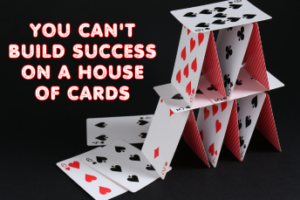
    Without structure, you’re building a house of cards. One small gust – bad news, a missed opportunity, a tough day – and the whole thing collapses.

    Whether you’re job hunting or running a business, structure isn’t optional. It’s the foundation that holds it all together, creating and conveying the kind of confidence that attracts opportunities.

    If you’re in a career transition, structure means having a consistent schedule, a straightforward process, and real accountability. Otherwise, it’s too easy to spiral into self-doubt or sit in front of your computer all day “researching” and calling it progress.

    If you’re trying to grow your coaching business, winging it won’t work anymore (even if it did in the past). You need a plan: Consistent outreach, clear offers, and systems to stay focused.

    Think like a seasoned architect or contractor: Start with the blueprint. Know what you’re building and why. Then, follow a process that’s organized, efficient, and rooted in your goals. That’s how you create something solid that can weather a storm.

    It doesn’t have to be perfect. But you need something concrete – a plan, a schedule, an edifice to shelter and support you.

    If structure is missing for you, it’s time to put it in place. Remember, you don’t have to do it alone.

  • Facts vs. Feelings

    Facts vs. Feelings

    We can be our own worst enemy sometimes.

    The negative self-talk gets brutal some days, doesn’t it? As hurtful as the meanest bully on the planet.

    “Nobody likes me here. I shouldn’t have even come.”
    “That was the dumbest idea ever; no wonder it flopped.”
    “I’ll never hit my revenue goals. I should just quit and get a job.”
    “I’m the worst performer on the team. I can’t do anything right!”

    Berate yourself enough, and you can fall into a funk and get stuck there. Your thoughts and feelings are powerful.

    Why does this happen?

    It’s all due to a misunderstanding. We tend to interpret our feelings as information that is true. Likely, it’s not true.

    How do we stop?

    Check the facts. A feeling is an emotional state or reaction based on a belief. But the belief may be nothing more than a hunch – a sneaking suspicion, not necessarily based in reality and, quite possibly, totally irrational or outright false.

    Are you lying to yourself? What’s really true?

    Did anyone say they didn’t like you? Did someone tell you to leave?
    No.
    Was your idea objectively silly and predestined to fail?
    You have no way of knowing.
    Is the revenue deadline here yet?
    Then you haven’t fallen short.
    Is your performance a done deal? Could you still come out ahead?
    Give it a shot.

    Question the facts and what they mean.

    It’s true that nobody has greeted you or smiled at you. Maybe they’re nervous. Say hi!
    It’s a fact that your idea generated zero sales. Maybe the timing or messaging was off.
    The data confirms revenue is lagging far behind. Perhaps a cash infusion will prove successful.

    Getting the idea? Please don’t make a fact mean more than it does at its most basic face value.

    Am I telling you to ignore your intuition? Absolutely not. I’m referring to negative self-talk – that distracting bully, vying for power and attention, feeding on past traumas and unfortunate mishaps.

    Remember, your intuition tends to be gentle, expansive, and protective. Negative feelings, often based on fear, are more likely to be jarring, critical, and unsettling.

    When things are chaotic and out of control, stick to the facts. Focus on what’s happening right now, without projecting too far into the future. Stop, get quiet, and check in. What’s real? You’ll know.

  • Is It Time for a Reframe?

    Is It Time for a Reframe?

    You’ve probably heard that mindset can make or break you, but it’s really just about how you frame what you’re seeing.

    This has been a theme in recent coaching sessions, so I wanted to break it down.

    Think of those old black and white prints: Two people can look at the same image and see something completely different (A candlestick or two faces? A rabbit or a duck?).

    One of my clients told me she hates selling; it feels manipulative and icky to her. But that’s just one way of seeing it. As a business owner, she needs buyers.

    I see selling as a service. If I can help someone, it’s my job to speak up. When they hesitate, I ask questions and dig deeper – not to push, but to support.

    Another client felt like a failure because his career hadn’t followed a traditional path. But his perspective was off. He’d launched and succeeded in multiple ventures.

    From where I stood, he was already successful. As a coach, I could see that he was just pausing before his next big move.

    In both cases, I helped my clients reframe how they saw things, and that shift set them up for their next phase of success.

    It’s not Polyanna thinking or toxic positivity. It’s truly looking at it from a different angle.

    You have to learn how to be on your own side. If you can’t, find someone who can help. Maybe that’s a coach like me, or maybe it’s a trusted friend. The point is, having a perspective doesn’t mean it’s accurate.

    If your thinking leaves you stuck, spiraling, or playing small, it’s probably time to reframe. Sometimes we’re too close to the situation to see clearly. You need someone who can look at the same picture and point out the butterfly you’re convinced is just an apple core.

    Reframing your perspective matters, and it can change everything.