The Referral Illusion: Why Waiting for Word-of-Mouth Is Killing Your Business
When someone asks where your clients come from, do you say — oh, referrals mostly. Word of mouth?
It sounds great. It sounds humble. It sounds like a flex. It sounds like a real answer.
But today I’m going to tell you an uncomfortable truth.
Saying “I get mostly referrals” is code for I have no marketing system.
Referrals are my system, and I’m at the mercy of other people’s memory.
That’s why I call it the Referral Illusion.
We’re going to look at why it might be quietly killing your business.
What Most People Get Wrong About Referrals
Most coaches, consultants, and experts think a referral-based business is great, and for a while, it really does seem magical.
You don’t have to market. You don’t have to do anything. Clients just show up.
 But . . . the referral-based business has a dirty little secret. Referrals plateau. Sometimes they dip.
And then you go into a panic — you’ve got to do LinkedIn posts, find somebody who’ll be your next client, and you have no idea where the next one is coming from.
Why? Because you’ve built a business entirely dependent on other people remembering you. That’s a lot to ask.
That’s not a business strategy. That’s a wish wearing a strategy costume.
Referrals are wonderful. I love referrals. Everyone should get referrals. But they’re the bonus; they can’t be the plan.
If your entire client acquisition process is hoping someone brings up your name at a cocktail party, you don’t have a client acquisition process – you have a wish.
Why Passive Referrals Plateau
Let me name what’s actually happening when you rely on referrals.
Your referral sources forget about you.
They may love you, but they’re busy, they’ve got lives, they’ve got things going on. How many times a year does someone ask them, “Do you know a good coach? An expert in X, Y, or Z?” Maybe once a year. Even your biggest fans aren’t thinking about you most days; that’s human.
Referrals send you clients they like — not necessarily your ideal client.
Here’s a personal example. In the twenty-five years I spent doing career coaching almost exclusively, I loved the part about helping people figure out what to do with their lives. I didn’t love doing resumes and job search strategy — that wasn’t my jam, that wasn’t what I was great at. But people constantly sent me referrals for exactly that, because they thought career coach, that’s what she wants. No. Your referral sources don’t always know who your ideal client is.
It’s wildly unpredictable.
There are real downsides to being referral-based only. You can’t scale on a wish, invest in a team, build systems, or carry overhead when everything is so random.
Three Practices to Fix It
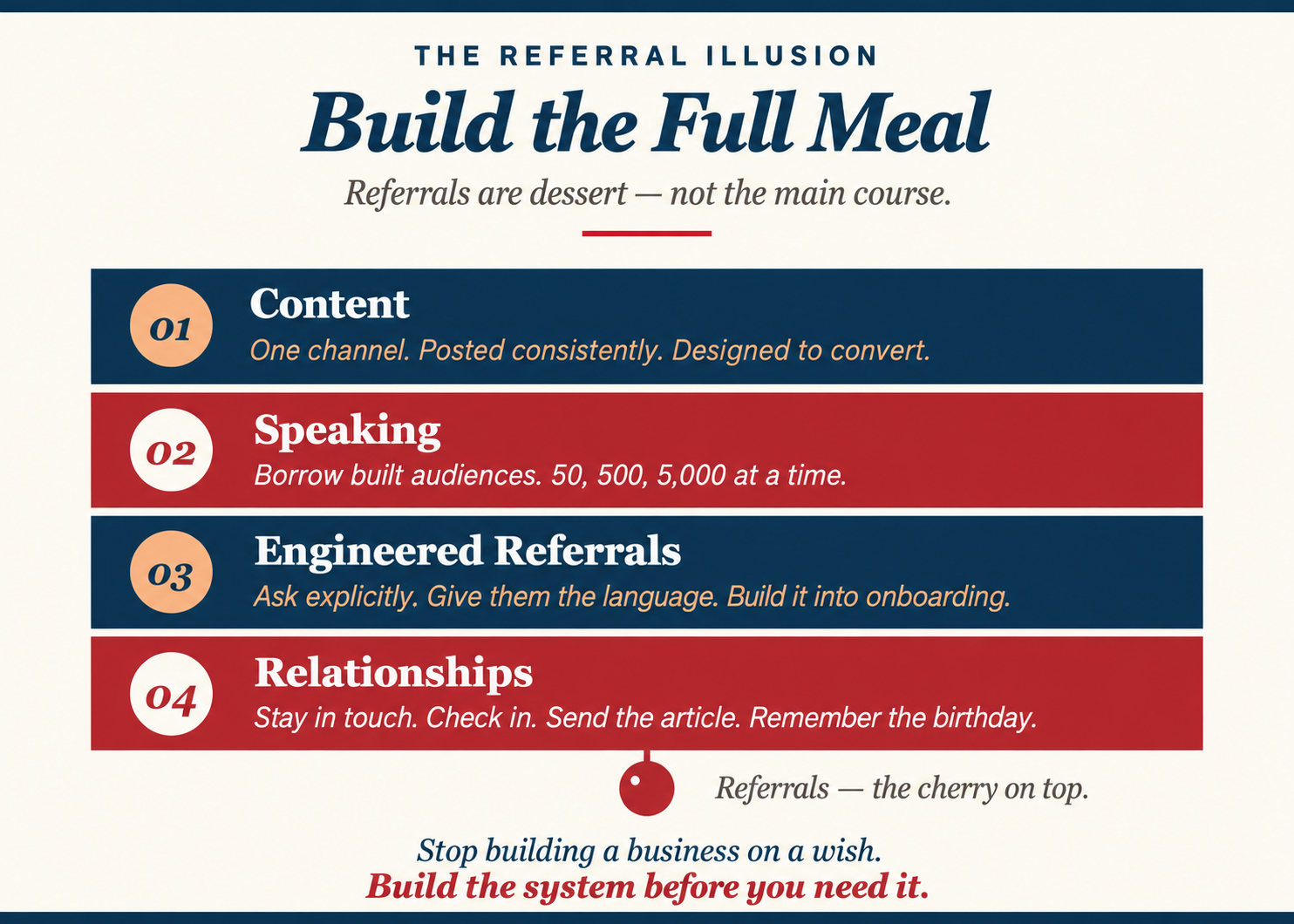
1. Build an actual marketing system alongside the referrals, not instead of them. This has two legs: content and speaking.
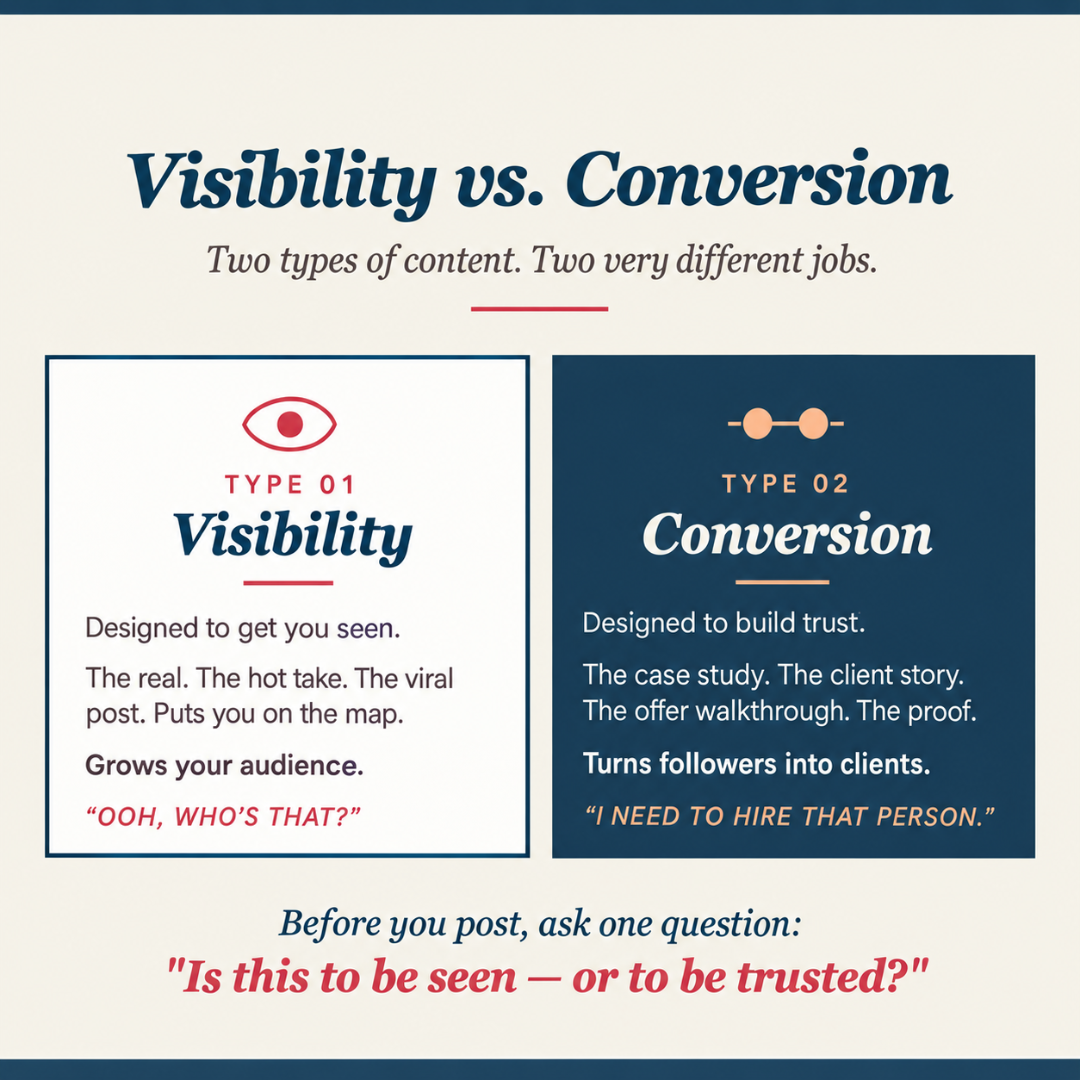
On the content side, pick one consistent channel — your newsletter, LinkedIn, a podcast — and show up regularly with content designed to convert, not just to be seen. (Go back and look at our Content Treadmill episode if you missed it. This is where that comes in.)
Here’s the piece most solopreneurs underuse — speaking. Getting in front of other people’s audiences is one of the most powerful ways to build a real pipeline. When you speak — on a stage, in a webinar, on a podcast, on an industry panel, inside a corporate event — you borrow audiences that someone else has already built. Instead of trying to collect one follower at a time, you’re in front of fifty people, five hundred people, five thousand if you’re lucky. These are people paying attention and getting to know you. They’re spending time with your voice and with your energy. They’re the people who will want to work with you.
We’re talking about volume here — not just the onesie-twosies that happen with referrals. Speaking generates referrals at scale. Every person in that room becomes someone who can hire you or introduce you.
2. Actively engineer referrals instead of waiting for them. Most of your clients would happily refer you — but they don’t know how and they don’t know when. So teach them. At the end of a successful engagement, say explicitly: If you know one person who’s dealing with X, I’d love an introduction. Give them the language they can use. Make an introduction request a normal part of off-boarding your clients. The best referrers aren’t the most generous. They’re the ones who’ve been given a clear directive on how to help you.
3. Stay in touch with your past clients and champions. Really build those relationships. Check in with people. Send birthday cards. Send an article. Tell them you were thinking about them. That’s relationship maintenance, and it’s a high-leverage activity for your business.
The Mindset That Makes It Stick
Here’s what I want you to really let sink in:
Referrals are dessert. They are not the main meal.
A sustainable business is built on a real marketing system — content that attracts the right people, speaking that puts you in front of them, offers that convert, and relationships you actively tend to. Referrals sit on top as a beautiful cherry on the sundae.
If you’re currently relying only on referrals as your primary strategy, you’re not humble, not low-key, not above the marketing game. You’re just one dry quarter away from a crisis. Anyone who’s been through one of those crises knows exactly what they say afterward: I wish I’d built the system sooner.
Build the system now — before you need it.
Your Homework This Week
Ask yourself one honest question:
If every referral source I have dried up tomorrow, how would I generate my next three clients?
If you have a clear answer — awesome! You have a system. Keep tending to it.
If you don’t — that’s your data point. This week, pick one thing. One piece of content to publish. One speaking opportunity to go after — a podcast, a webinar, a group, a conference. One past client to reach out to. One active referral ask to make at your next off-boarding meeting.
Just one step toward building something that doesn’t depend on luck.
Stop waiting for word of mouth to carry you.
Build real systems — content, speaking, intentional relationships.
And then, when the referrals do come, they’ll just be the icing on an already very stable cake.
Yes — go get a referral. But better yet, build a marketing system.