• Skip to primary navigation
  • Skip to main content
  • Skip to primary sidebar
Now What?® Coaching

Now What?® Coaching

from Laura Berman Fortgang

  • Login
  • About
    • About Laura
    • Our Philosophy
    • Praise
  • Hire a Facilitator
    • Hire Laura
  • Become a Facilitator
  • Online Courses
    • Career Clarity & Direction
    • Career Clarity & Direction: Self-Guided Course
    • Job Search Academy
  • Products
  • Blog
  • Contact

Clarity

You Don’t Have to Be a Celebrity to Join the A-List

By Laura Berman Fortgang on March 29, 2026

You Don’t Have to Be a Celebrity to Join the A-List
​
But you do have to act like one.

Here’s what I see coaches and entrepreneurs doing every single day. They’re talented. They create genuine transformations in people’s lives. Yet they’re out there hustling, discounting their prices, watering down their message, trying to reach everybody. They’re treating their business like an open audition that never ends.

I want to ask them one question: What are you auditioning for?

Meryl Streep doesn’t send in audition tapes. Denzel Washington doesn’t line up in hope. At a certain level of this game, we’ve got to stop asking, “Will they pick me?” and start asking, “Do I want to work with them?” That shift — right there — is the A-List mentality.

You don’t get on the A-List by earning it.
You get there by deciding you’re on it, and then bringing it into fruition.

THE PROOF

I’ve had some incredible opportunities in my career, and none of them came the way you might expect. I got to be on the Oprah Winfrey Show. I have a TEDx talk with over two million views. My first book? They asked me to write it. I didn’t send a single query letter.

None of it came from spending all my time trying to engineer my way to the next level. It came from one thing: Showing up one hundred percent, every single time.

Not 90% because I was tired. Not 80% because the fee wasn’t what I wanted. A hundred percent, consistently, and without questioning whether I belonged. Look — I’m human. There are moments of doubt. There are moments of “Who am I to be doing this?” But you’ve got to put those thoughts out of your head as fast as possible. Certainty isn’t a feeling that arrives. It’s a decision you make.

THE 6 RULES OF THE A-LIST

The A-List isn’t something other people deem you worthy of. It’s something you deem yourself worthy of. Here’s how A-List coaches and entrepreneurs actually operate:

  1. They own their niche without apology.

Trying to serve everybody is a hiding strategy. When you’re vague, you’re hiding. Pick your lane; plant your flag. The more specific you are, the more magnetic you become, and the easier it is for the right people to find you.

  1. They set their own terms.

A-Listers aren’t auditioning. They ask for money with the same energy they’d order coffee at Starbucks — no doubt, no hype – just matter of fact. The ideal client doesn’t want the cheapest deal; they want the best.

  1. They protect their energy like it’s a contract clause.

Every yes to the wrong thing is a no to the right thing. A-Listers have learned to create a certain amount of scarcity in the market; not because they’re playing games, but because their time genuinely costs something. That’s the signal.

  1. They never question the room.

They don’t walk into a space wondering if they belong. Their energy precedes them. Certainty — and I’ve said this before — is not a feeling that comes to you. It’s a decision you make. You decide you belong. The energy in a room shifts around that belongingness. It is the most underrated business strategy alive.

  1. They build visibility on purpose.

Being excellent in private gives you a hobby business. Being excellent in public gives you a real one. Write the thing. Take the stage. Post the idea. The world can’t ask for you by name if it doesn’t know your name.

  1. They raise their standard of proximity.

You can’t think A-List thoughts in B-List rooms. It’s who you hang out with, who you’re in conversation with, who you mentor with. Put yourself in the environment that matches where you’re going, not just where you’ve been.

THE DECISION

Here’s what all six of those rules have in common: None of them require a publicist. None require a huge following. None require you to wait until you feel ready because the feeling of ready is often the story fear tells you to stay comfortable.

All they require is a decision. A decision that you’re done shrinking. Done discounting. Done explaining yourself to people who weren’t going to get it anyway. Done auditioning for opportunities that should be auditioning for you.

The A-List begins with you deciding you’re on it. It’s not waiting for you. It’s a decision you make.

Here’s the question I want to leave you with:

What would you do differently today if you already knew you were the person people ask for by name?

Go do that. Start now!

Filed Under: Now What? Newsletter Articles Tagged With: career, Career coach, Career Coaching, career reinvention, Clarity, entrepreneurs, life coach, Now What Coaching

You Can’t Go Back to Before — And That’s the Point

By Laura Berman Fortgang on March 15, 2026

In the musical Ragtime, there’s a character simply called Mother. When her husband leaves for a year-long expedition, she transforms. She takes in a Black couple and champions them — scandalous in early 1900s upper-crust New York society. She makes decisions, finds her voice, and becomes someone new. When her husband returns and tries to fit her back in the box she once occupied, she can’t do it. She sings a song called “Back to Before,” and it’s all about how you simply cannot return to who you were.

I think we can all relate to that tension.

We long for the past.
We long for that thing that
was.

There’s actually a psychological term for it — rosy retrospection — which is our tendency to remember the past as kinder and gentler than it may have actually been. We don’t remember the anxiety of that “easier” chapter. We remember the feeling of being less burdened.

I know that feeling personally. My son has epilepsy. I can remember a time when they were petit mals — frightening, yes, but something our family had learned to navigate. Something that had become, in its own difficult way, our normal. Then came the grand mals, and everything shifted. I remember thinking if I could just get back to before that happened, we could handle this. What I didn’t realize at the time was that “before” wasn’t waiting for me. It had already closed.

That’s the thing about “before.” Even if you could somehow return to that exact moment in time, you would bring this version of yourself with you. You’ve grown. You’ve changed. So you truly can’t go back. What Mother’s song captures so beautifully is that the “before” she mourns was also a version of herself that was smaller, quieter, and less fully alive. Growth and loss are often the same door.

You Can't Go Back to Before — And That's the Point by Laura Berman FortgangWhen we spend our energy facing the rearview mirror, we risk getting stuck there. Nostalgia in small doses is sweet, warm, and deeply human. But when we move in there, it becomes a form of grief that never resolves. It keeps us comparing the present to an idealized past that didn’t quite exist, and the present always loses that competition. We can become so loyal to who we were that we become strangers to who we’re becoming.

Here are four things that can help you move forward:

Honor it, then set it down. You are absolutely allowed to miss what was. Grief is real, and grief is authentic. But there’s a difference between visiting the past and moving in there. Acknowledge what you’ve lost, feel it fully – then deliberately turn toward what remains.

Ask: What does this make possible? Every ending carries a hidden opening. The question can’t only be “what did I lose?” It has to become “what is this new chapter calling forth in me? Who am I becoming?” That’s where the real focus belongs. Not on the closing door, but on the one that’s beginning to open.

Trade nostalgia for gratitude. Nostalgia looks backward. Gratitude — real appreciation — lives in the present. Instead of wishing you could return to a good moment, practice being grateful it happened at all. That single reframe moves you out of longing and into appreciation. And appreciation puts you right back in the present, where your life is actually happening.

Build something to move toward. The pull of the past is strongest when the future feels empty — when there’s nothing on the horizon you’re looking forward to. So put something there. It doesn’t have to be grand; even something small gives forward motion a direction. Once you start moving forward, it becomes easier to keep going. Mother doesn’t end her song with any kind of tidy resolution. She can’t get back to the past, but she stands in the truth of her own change. I think that is actually the bravest thing any of us can do. Not pretending the past didn’t matter and not letting it hold us hostage either. Just standing in who we’ve become.

I still have moments where I’d give anything to go back to before. But I’ve also learned that the version of me who came through what came next is more capable, more compassionate, and more present than I ever was before.

You can’t go back to before.
But you can decide, right now, what you’re moving toward and allow the next chapter to begin.

Filed Under: Now What? Newsletter Articles Tagged With: Change, Clarity, coaching, Laura Berman Fortgang, new direction, Now What Coaching

Faith vs. Fear: What Really Drives Us?

By Laura Berman Fortgang on March 1, 2026

Today I want to dive into something that’s been coming up frequently in my recent coaching conversations: The tension between faith and fear. I’m not talking about religious faith necessarily (though if that’s your thing, I deeply admire it). I’m talking about something more fundamental – the choice we make every single day about which voice we’re going to listen to.

The State of Things

Let’s be real: There’s a lot happening right now. The global economy is doing its unpredictable dance. The world feels heavy with uncertainty. For those of you stepping into entrepreneurship or searching for your next career opportunity, the unknown can feel absolutely overwhelming.

I work with people every day who are navigating these choppy waters, and I see the fear is real. The questions are legitimate. The worry isn’t unfounded. Here’s what I’ve learned after years of coaching and living through my own entrepreneurial journey; it’s not about whether fear shows up. It’s about your relationship with it.

Fear: The Blob vs. The Mosquito Bite

Remember that old 1950s horror movie with the blob? That amorphous glob of goo oozing down the street, consuming everything in its path? That’s what fear looks like when we let it take us over. It becomes this all-consuming force that colors everything we see, every decision we make, every step we take (or don’t take).

But fear doesn’t have to be the blob.

What if fear was more like a mosquito bite? You feel it – that little sting, that moment of “ouch, that’s uncomfortable” – and then you acknowledge it, maybe scratch it for a second, and move on with your day. You don’t let it ruin your entire outdoor experience. You don’t run inside and hide because mosquitoes exist.

The difference between these two experiences?
Your relationship with fear.

What Fear Actually Sounds Like

Here’s the thing about fear:
It’s sneaky. It disguises itself as “just being realistic” or “protecting yourself.”

But listen to the voice:
“You’re not good enough.”
“Other people do it better; nobody needs to hear from you.”
“Who are you to think you can do this?”

That’s fear talking. When we let that voice dominate, we’re operating from a place of scarcity, of lack, of limitation.

What Does Faith Sound Like?

Faith (I’m using this word whether you’re spiritual, religious, or neither) is belief in yourself. It’s belief in possibility.

It’s the voice that says:
“I’m learning and growing.”
“My perspective matters.”
“I’m taking the right actions; it’s just a matter of time.”

Faith is what you have when you plant a seed in the ground. You don’t dig it up every day to check if it’s growing. You trust that with the right conditions – water, sunlight, time – that seed will find its way to the surface. You have faith in the process.

If you’re building a business, looking for a job, or pursuing any significant goal, you’re planting seeds. Every action you take, every connection you make, every skill you build, are seeds. Faith is trusting that they’ll grow.

But What If You’re Deluded?

Here’s where it gets interesting. Someone always asks: “But what if I’m just fooling myself? What if I’m going down the wrong path, and I’m too deluded to see it?”

Valid question.
Here’s the answer: Engage with people who know more than you.

Work with mentors.
Consult experts.
Connect with people who’ve walked the path before you.
Get feedback.
Adjust your course.

Faith vs. Fear: What Really Drives Us? by Laura Berman FortgangWhen you’re taking the right actions and getting guidance from people who know the terrain, you’re not deluded. You’re informed, you’re strategic, and you’re building faith on a foundation of smart decisions.

The delusion isn’t in believing in yourself.
The delusion is in thinking you can succeed while ignoring all wisdom and feedback.
Big difference!

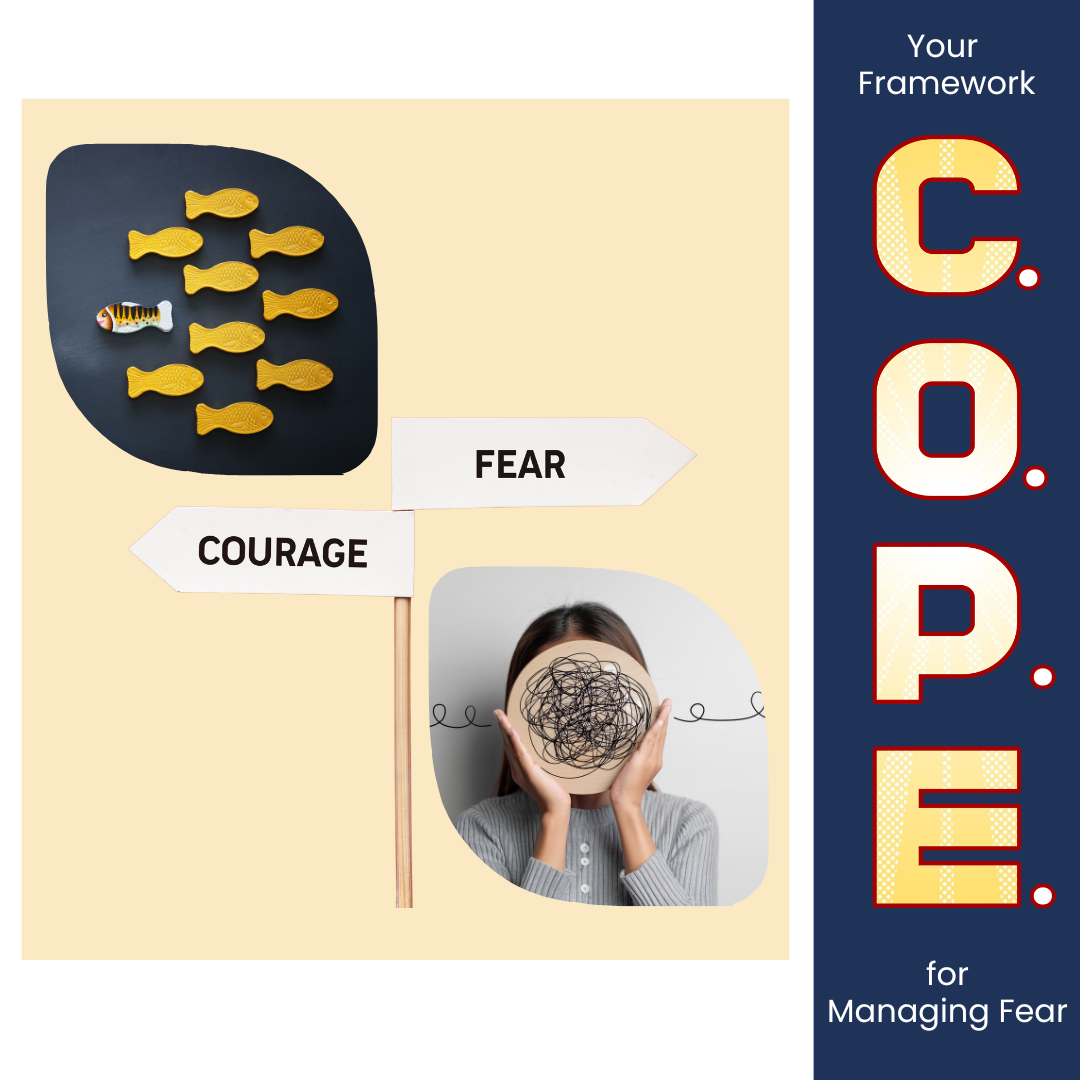
Introducing COPE: Your Framework for Managing Fear

Because I’m a coach and I love a good acronym, I’ve developed a framework for working with fear.
It’s called COPE, and here’s how it works:

C – Catch Yourself

The moment you notice fear creeping in, catch it. Name it. Say out loud if you need to: “Oh, that’s just fear. I see you.” Don’t let it become the blob. Turn it into the mosquito bite. Acknowledge it and move on.

O – Open

Be open to not knowing. Here’s a wild thought: If you’re going to be convinced of an outcome you can’t actually predict, why are you so committed to believing it will be negative? Why not invest that same energy in believing it could work out? You’re making up a story either way – make it a good one.

P – Possibility

Invest in possibility. This isn’t about wearing rose-colored glasses or ignoring reality. It’s about recognizing that if the idea exists in your mind, if the goal calls to you, there’s a reason. Possibility is real. As a coach, I live in the land of possibility because I’ve seen it proven true over and over again. Your dreams wouldn’t exist if they weren’t possible.

E – Exhale

Seriously, just breathe. Stop holding your breath. Release the tension in your shoulders. It’s going to be okay. This exhale is what having faith feels like in your body.

Faith and Fear Can Coexist

Here’s something important: You don’t have to eliminate fear to have faith. They can exist at the same time. In fact, they usually do. The goal isn’t to be fearless; the goal is to act with intention and faith while acknowledging that fear is along for the ride.

You can feel scared and still send the email.
You can worry about the outcome and still show up.
You can doubt yourself and still take the next step.
That’s not contradiction – that’s being human.

Your Challenge

I want you to pay attention to your internal dialogue. Notice when fear is speaking. Catch it. Open yourself to not knowing the outcome. Invest in possibility and exhale.

Practice COPE. See what shifts.

Because here’s the truth:
You’re doing better than you think. You’re further along than you realize.
The seeds you’re planting right now? They’re going to grow.

Have faith.

Filed Under: Now What? Newsletter Articles Tagged With: beat the odds, Clarity, entrepreneurs, Laura Berman Fortgang, Now What Coaching

Visibility – Make This Your Year to Be Visible

By Laura Berman Fortgang on February 22, 2026

Visibility creates opportunity. It’s that simple.

When you show up consistently – whether in meetings, on social media, or at networking events – you put yourself in the right place at the right time. Those “lucky breaks” people talk about? They happen because someone chose to be visible.

Why Visibility Matters

Visibility builds trust and credibility over time. When people see you regularly, they begin to recognize your expertise and value. And here’s the thing: visibility compounds. The more you show up, the more opportunities find their way to you. Careers are built on this foundation.

How to Build Visibility as an Employee

If you work in a company, visibility starts with speaking up. Make sure you get credit for your great work. Contribute thoughtfully in meetings – not just to be heard, but to add real value.

Volunteer for high-visibility projects. Not the ones nobody else wants, but the strategic initiatives that will showcase your skills and get you noticed by decision-makers. Build relationships across departments and levels. Your network inside your organization is just as important as the one outside it.

Visibility - Make This Your Year to Be Visible by Laura Berman FortgangHow to Build Visibility as an Entrepreneur

Show up on platforms where your ideal clients are, but don’t stop there.
Get involved in your community.
Volunteer for opportunities that put you in front of the right people.

Make it easy for people to understand exactly what you do. I recently worked with a new coach who attended one networking meeting, made themselves visible to the group’s leader, and landed a speaking engagement that will put them in front of hundreds of potential clients. That’s the power of visibility.

Remember: ​
There’s visibility on a small scale (one-on-one relationships) and visibility on a larger scale (platforms and speaking).
Both matter.

For Those Who Hate Being Visible

Let me be honest: Being self-conscious is a little egotistical.
You’re assuming everyone is judging you probably because you’re judging yourself and others.
​Get straight with yourself.
Stop judging yourself.
Stop judging other people.

You need to adopt a healthy “I don’t care” attitude. Not that you don’t care enough to do good work, but you can’t care so much about what others think that you hide your light.

Here’s the key: You need a mission bigger than you.
When you focus on the impact you want to make and the people you want to serve, visibility becomes about that mission, not about you.

And introverts, I don’t want to hear that you can’t be visible.
You just need to know yourself, do things your way, and stay connected to your bigger purpose.

Common Visibility Mistakes

Assuming good work speaks for itself. ​
It doesn’t. You need to share your wins, whether you’re presenting results to your boss or sharing client success stories on LinkedIn.

Confusing visibility with bragging. ​
They’re not the same thing. Sharing your accomplishments and expertise is not bragging; it’s informing people about what you can do and who you can help.

Being inconsistent. ​
Disappearing for long periods and then showing up only when you need something (a sale, a favor, a promotion) doesn’t work. Consistency builds trust.

Your Action Step

We’re still in the energy of a new year. Make this your year to be visible.
​Be consistent.
Put yourself forward.
Don’t be afraid to be vocal about your accomplishments.

Visibility creates opportunity, and opportunity is what you’re after.

Filed Under: Lessons Learned, Now What? Newsletter Articles, Taking Action Tagged With: Change, Clarity, entrepreneurs, Laura Berman Fortgang, new direction, Now What Coaching

When the Storm Hits: Your Guide to Weathering What Comes and Emerging Stronger

By Laura Berman Fortgang on February 1, 2026

The meteorologists saw it coming days in advance. The grocery stores emptied of bread and milk. Batteries flew off the shelves. Everyone knew the storm was approaching, yet when it finally arrived, many still found themselves unprepared for its full force.

Life’s storms work the same way. Sometimes we see them gathering on the horizon – a organizational restructuring, a relationship reaching its breaking point, a business model that’s clearly running out of road. Other times, they hit without warning, leaving us scrambling to find our footing while everything we counted on gets rearranged.

The question isn’t whether storms will come. They will.
The question is:
How will you prepare, how will you weather them, and how will you use what they teach you?

Before the Storm: The Art of Strategic Preparation

Here’s what most people get wrong about preparation:
They stockpile supplies, but they forget to strengthen their foundation.

When I work with leaders and entrepreneurs facing major transitions, I ask them a simple question: “What are you anchoring to?” When everything else is moving, you need something solid to hold onto. For some, it’s their core values. For others, it’s their sense of purpose or their commitment to the people they serve.

The coaches I work with who navigate industry changes most successfully aren’t the ones with the biggest emergency funds (though those help). They’re the ones who’ve built what I call “foundational flexibility,” which is a clear sense of who they are and what they stand for, combined with the agility to adapt their methods without compromising their mission.

Practical preparation looks like this:

Know your non-negotiables.
What absolutely must be protected?
What defines you at your core?
When you’re clear on this, you can let go of everything else with much less anxiety.

Build your support system before you need it.
The middle of a crisis is not the time to start looking for allies.
Invest in relationships during the calm, so you have people to call when the winds pick up.

Create options, not just plans.
Plans assume a predictable future.
Options give you choices when the unexpected arrives.
What are three different ways you could respond if X happens?
What resources could you access if Y occurs?

When You’re In It: Weathering the Storm

There’s a moment in every storm when you realize – this is happening.
The preparation phase is over.
Now you’re just trying to stay upright.

This is when your previous work pays off, or when you discover what you missed.

When the Storm Hits: Your Guide to Weathering What Comes and Emerging StrongerThe most important skill for weathering a storm isn’t strength; it’s presence.
The ability to stay aware, stay responsive, and resist the temptation to panic-react your way into worse problems.

I’ve watched brilliant people make terrible decisions in the middle of storms because they were so desperate to make the discomfort stop that they grabbed at the first solution that presented itself.
They pivoted their entire business model after one bad quarter.
They blew up a relationship because they couldn’t tolerate the tension of uncertainty.
They abandoned their vision because it got hard.

Weathering a storm means accepting that some things are out of your control while staying active in the things that aren’t.

You can’t stop the storm, but you can:

Protect your energy.
This is not the time to take on new commitments or push yourself to maintain “business as usual.”
Give yourself permission to focus on essentials.

Stay connected.
Isolation is the enemy of resilience. Reach out. Ask for help. Let people know you’re struggling.
The vulnerability you show now will deepen your relationships later.

Look for the small wins.
You don’t need to solve everything today.
You need to take one right action, then another, then another.
Progress compounds.

After the Storm: Mining the Meaning

Every storm deposits something. Sometimes it’s wreckage that needs clearing. Sometimes it’s nutrients that will feed next season’s growth. Your job is to examine what’s been left behind.

The entrepreneurs I know who’ve built the strongest businesses didn’t do it by avoiding failure. They did it by getting exceptionally good at learning from it. Each setback became data. Each crisis revealed something they didn’t know about themselves, their market, or their model.

The question isn’t “Why did this happen to me?”
The question is “What does this make possible that wasn’t possible before?”

Maybe the storm cleared out deadwood – projects that were draining energy without producing results, relationships that had run their course, assumptions that were holding you back. Maybe it revealed strengths you didn’t know you had. Maybe it showed you who really has your back.

Coming out positive doesn’t mean pretending the storm didn’t hurt.
It means refusing to let the hurt be the only thing that defines what happened.

The storms will come. They always do.

The only real question is: When the next one arrives, who will you be?
Someone who merely survives it, or someone who uses it to become more of who you’re meant to be?

Start preparing now. Not because you’re pessimistic, but because you’re committed to staying in the game no matter what the weather brings.

Filed Under: Lessons Learned, Life Lessons, Now What? Newsletter Articles, Reinventing Yourself, Taking Action Tagged With: Change, Clarity, coaching, Laura Berman Fortgang, life coach, new direction, Now What Coaching, take action, transition

Before You Do, Remember Who You’re Becoming

By Laura Berman Fortgang on January 25, 2026

Every January, millions of people launch into action. They join gyms, open blank documents for that novel they’ve been meaning to write, or register their LLC for the side hustle that’s going to change everything.

By February, most have stopped.

The problem isn’t lack of willpower or poor planning. It’s that they’re trying to change their actions without first transforming their identity.

The Identity-Action Gap

Here’s what typically happens: You decide you want to lose 30 pounds, so you buy meal prep containers and download a fitness app. You want to write a novel, so you block out time on your calendar and create the perfect workspace. You’re ready to launch that consulting business, so you design business cards and build a website.

These are all smart actions.
But they’re built on a foundation of sand.

When you take action without first shifting who you believe yourself to be, every choice becomes an internal negotiation. The alarm goes off at 5:30 AM for your workout, and you have to convince yourself – again – that you’re the kind of person who does this. You sit down to write, but that blank page mocks you because you don’t yet believe you’re actually a writer. You need to make sales calls for your new business, but impostor syndrome screams that you’re just pretending to be an entrepreneur.

This exhausting internal debate is why most ambitious goals fail. You’re constantly fighting against your own self-concept.

The Power of Identity-First Change

Consider weight loss. Most people approach it as a behavior problem: “I need to eat less and move more.” But sustainable transformation happens when you shift from “I’m trying to lose weight” to “I’m someone who takes care of my body.”

That subtle shift changes everything. When you’re someone who takes care of your body, choosing the salad isn’t deprivation; it’s consistency with who you are. Missing a workout creates genuine discomfort because it conflicts with your identity, not because you’re failing at a resolution.

The same principle applies to writing your novel. You don’t need to wait until you’re published to be a writer. You become a writer the moment you decide that’s who you are. Real writers write on days they don’t feel inspired. They protect their writing time. They study this craft. Once you embody that identity, sitting down to write becomes natural rather than forced.

And for your side hustle? Stop “trying to start a business” and start being an entrepreneur. Entrepreneurs solve problems. They learn from failure. They show up consistently even when results are slow. When that’s who you are – not what you’re attempting – the difficult actions become expressions of identity rather than items on a to-do list.

Before You Do, Remember Who You're BecomingHow to Shift Your Beingness

This isn’t about positive thinking or affirmations. It’s about genuine identity transformation.

1. Define the identity clearly.
Don’t just say “I want to be healthy.” Get specific: “I’m someone who honors my body’s needs, makes conscious food choices, and moves daily because it feels good.”

2. Find your evidence.
Your brain needs proof. Identify any moment (no matter how small) when you’ve already been this person. That time you took the stairs? That counts. The paragraph you wrote last Tuesday? Evidence. The helpful advice you gave a friend? Entrepreneurial.

3. Make identity-consistent choices.
Ask yourself throughout the day: “What would the person I’m becoming do right now?” Then do that thing, even when it’s small,
especially when it’s small.

4. Speak it into existence.
Change your language. Not “I’m trying to lose weight,” but “I take care of my body.” Not “I want to write a book,” but “I’m writing a book.” Not “I’m thinking about starting a business,” but “I’m an entrepreneur building my business.”

The Truth About Tough Actions

Yes, losing weight requires tough choices. Writing a novel demands discipline and vulnerability. Building a business means facing rejection and uncertainty.

Here’s what makes those tough actions infinitely easier: Alignment.

When your actions flow from a clear sense of who you are, they stop feeling like obligations and start feeling like integrity. You’re not forcing yourself to do hard things; you’re simply being consistent with who you’ve become.

The action is still challenging, but it’s no longer a battle with yourself.

Before you revise your goals or create your action plan, pause.
Get clear on who you’re becoming.
Let that identity settle into your bones.

Then watch how naturally the right actions follow.

Filed Under: Now What? Newsletter Articles Tagged With: Change, Clarity, coaching, Laura Berman Fortgang, new direction, take action, transition

  • « Go to Previous Page
  • Page 1
  • Page 2
  • Page 3
  • Page 4
  • Page 5
  • Interim pages omitted …
  • Page 23
  • Go to Next Page »

Primary Sidebar

Pinpoint–and plan-a fulfilling "next chapter" of your career with the Now What?® Program

Start Today

Buy Now

Sign up for Laura’s mailing list so you don’t miss a thing!

[gravityform id=”3″ title=”false” description=”false” ajax=”true”]

Disclaimer |
Site Usage and Privacy Policy  |  Facilitator Zone

Copyright © 2026 Now What?® Coaching. All Rights Reserved.

Login

Lost Your Password?