
• Skip to primary navigation
  • Skip to main content
  • Skip to primary sidebar
Now What?® Coaching

Now What?® Coaching

from Laura Berman Fortgang

  • Login
  • About
    • About Laura
    • Our Philosophy
    • Praise
  • Hire a Facilitator
    • Hire Laura
  • Become a Facilitator
  • Online Courses
    • Career Clarity & Direction
    • Career Clarity & Direction: Self-Guided Course
    • Job Search Academy
  • Products
  • Blog
  • Contact

Now What? Facilitator Grads

What “I Don’t Know” Really Means

By Laura Berman Fortgang on January 28, 2024

I love helping people make big changes in their lives.

Seeing someone go from being completely miserable or frustratingly unfulfilled in their career to being content, aligned, and fired up about their work is what makes what I do so rewarding.

But change isn’t easy, especially when you won’t admit what you want that change to be.

Notice I didn’t say when you don’t know what you want? I’m willing to bet you do know.

What "I Don't Know" Really Means by Laura Berman FortgangHere’s the thing —

I’ve been doing this for a long time. I talk to a lot of people who want to make a change, and their story often starts something like this:

“I want to do something different, but I don’t know what I want to do.”

I used to believe them. I’d jump right in and help them figure it out! But then I started to notice a pattern. By the time we got to the bottom of it, they almost always admitted knowing the answer all along.

So these days, if you tell me you don’t know what you want to do with your life — I believe you do know – but that you don’t want to admit it — even to yourself.

You’re afraid — to dream, to dare, and to do what it takes. You have a fear of failure and looking foolish or a fear of success and the change that comes with it … or both!

Walking into the unknown is scary stuff, but it shouldn’t stop you from moving forward.

You don’t have to know how to get there or what to do. Your change will come from pointing yourself in the direction you want to go and putting one foot in front of the other, one step at a time.

It comes down to this: “I don’t know” is just fear, and “I don’t know how” is just more fear.

You know. It’s simply scary because it seems impossible.

Here’s my motto: Do one thing a day towards your dream.

One phone call, one hour of research, one class. One step, another tomorrow, and another the next day. You’ll get there!
Filed Under: Acknowledgements, Following Your Passion, Job Change, Job Satisfaction, Lessons Learned, Life Goals, Life Lessons, Motivational Quotes, Now What? Facilitator Grads, Now What? Newsletter Articles, Now What? Q & A, Now What?® Program Events, Personality Development, Quotes to Live By, Reinventing Yourself, Taking Action Leave a Comment

#MotivationalQuotes: What to Accept and What to Never Lose

By Laura Berman Fortgang on August 27, 2018

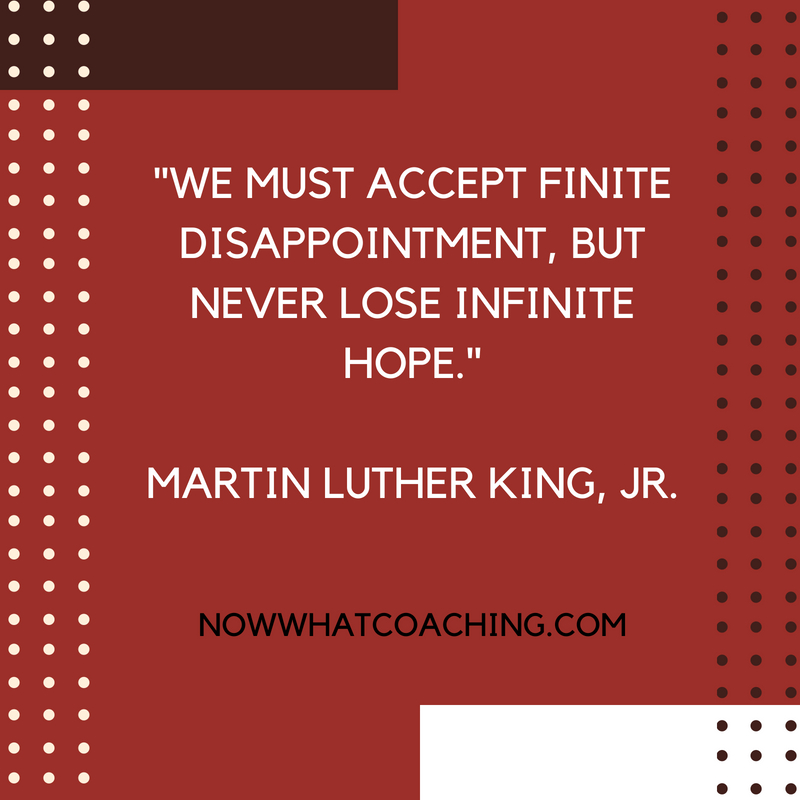
"We must accept finite disappointment, but never lose infinite hope." Martin Luther King, Jr.

Filed Under: Inspirational Quotes, Lessons Learned, Life Lessons, Motivational Quotes, Now What? Facilitator Grads, Quotes to Live By Tagged With: coaching, entrepreneurs, Following your passion, life coach, Now What CoachingLeave a Comment

5 Things To Consider Before Making A Career Change

By Laura Berman Fortgang on March 22, 2018

by Nancy Friedberg, Now What? Facilitator
Career Leverage

When transitioning into a new line of work, you want to make sure you’re prepared. As with embracing any type of change, it can be a bit rocky at first—and the uneasiness can be even harder when it’s about your career, which holds so much value.

However, by preparing yourself for what’s to come and asking yourself the necessary questions to guarantee you’re directed on the right path, you’ll be more likely to secure a smoother transition and come out feeling confident in your decisions.

Here are 5 things to consider before making a career change, to determine how best to go about it and what outcome you’re searching for.

1872be3d1cfbf2b3c7f61fb8aa894da4--job-career-career-change-(002)

What Lifestyle You Desire

What lifestyle do you want to create? What aspects will improve your quality of life and wellbeing?

Many of my clients want to enjoy a more relaxed and balanced life with more time for simple pleasures, especially as they get older and are approaching their second act. Having this work-life balance is really important for personal and professional fulfillment, so you’ll want to make sure you’re transitioning into a career that can give you what you need.

Also, consider the pace. Fast? Slow? Do you envision making a geographic move? Freedom and flexibility?

Here’s a client example. Alison moved south to Florida and took a big pay cut to start her own business in providing home safety services for the elder care population. She let go of a 30-year career and senior manager role with a prominent NYC publishing company at the age of 49. She longed to be out of a corporate career and build something meaningful.

She now lives on the water in Florida with a relaxed pace. She loves her new home office, and I helped her devise an exit plan and negotiate a buyout package. She established her second act with her new husband, and they created their “dream come true” together.

Your Life Story, Not Your Resume

The book “Now What? 90 Days To a New Life Direction” by Laura Berman Fortgang contains a time-tested method for reinventing your career and life when faced with a crossroads. With my clients, I use this method to guide them towards career clarity. Most clients use conventional methods for job search but often end up more confused and frustrated than before.

Instead, with this book’s expertise, I coach them in a more non-conventional way to look for clues as to what they really want to do. We look to remove things that are draining energy first, then we consider the new identity to pursue, we work on reframing limiting beliefs and identifying their purpose statement, and from there, we create fictitious scenarios, so they can see themselves soar.

Many conventional methods are focused on logic and stifle creativity. So, together we can help them see that their future direction is probably not in their résumé, but rather contained within their life story.

Michelle is an excellent example of a professional who proactively set out to develop her second act by examining her life story. She conducted a career assessment using Now What? to plan a 5-7 year strategic process for manifesting a career that would move her into retirement. She went back to school while continuing to work full-time for a leading publishing company and got her master’s degree in library science.

As an introverted type, she realized she wanted a calmer, less draining role with fewer hours and no leadership and staff responsibilities. Now, at the age of 58 she’s still working a full-time job, with normal hours and doing the research she loves in a marketing career.

How Your Career-Related Values Have Changed

What are the most pressing needs you can’t live without fulfilling? What are your highest values? These typically can change, so it’s important to re-evaluate every so often to make sure you’re still happy in the career industry and path you’re pursuing.

Most of my clients have had to do some serious soul-searching and inner reflection to figure out their core values. A few weeks ago a client called me with a serious values dilemma. He was offered a very good position as a content writer for a very prominent law firm, but he felt as though he’d be selling his soul if he accepted.

The money was too good to turn down and something he seriously needed to consider at age 50 with 3 kids to put through college. The amount of time spent ruminating about money and sleepless nights would abate once taking the job. I had him consider the possibility of enjoying the work and team. He accepted the position with much relief.

How Long It’ll Take To Get There

I have many clients that fantasize about making a radical change, but after seeing the reality of it, they’re overwhelmed. This is not a quick process. You must be in it for the long haul if you really want to discover something new.

Most major career changes take an average of 18 months to 3 years to fully execute. Many clients have timed their exits very carefully before leaving and have often secured a package. Those who haven’t gotten a package have banked their money carefully.

Still, while you must be financially prepared, don’t let the money stop you. You can say to yourself, “This is not a never issue. It may just be not right now.” Be proactive, and plan 3 years ahead of when you want to make the change.

For instance, this is often the case with millennials who aren’t financially secure so early in life but are looking to make a drastic career change. A 25-year old girl was in PR and wasn’t making much money, working endless hours, both at the office and out entertaining in the evenings. She wanted to exercise, see friends, sleep, and maybe cook a meal or two at home.

Yet, she wasn’t in a position to leave with a package or enough years under her belt. So, she figured out what avenue she wanted and planned to head there in three years. She worked with clients in the industry she coveted and built a network, so once the time arrived, she’d have several people to reach out to.

Taking A Bridge Job Before Making The Leap

I’m a big fan of creating a 2-step plan, and this has consistently led to greater success for my clients.

For example, an opportunity might be right under your nose within your current organization. I have a client who went into banking, where he could work and live abroad in Hong Kong, and travel all over from there as part of his senior role. He fulfilled his desire to travel, while maintaining his career.

Here’s another example: you may have grown tired of being self-employed, but rather than abandoning your profession, you explore making a lateral move by leveraging your skill set with an employer offering a job opening in the same industry.

Whatever awaits you, see if it makes sense as a middle point before your next life-changing move.

Please feel free to leave any comments or personal stories. Helping others find their way is what inspires me to do my life’s work.

Filed Under: Following Your Passion, Inspiration to Follow Your Blueprint, Job Change, Job Satisfaction, Job Search, Now What? Facilitator Grads, Taking Action Tagged With: career, Career Change, Career Coaching, career path, career transition, Opportunity, take actionLeave a Comment

How Might Gratitude Support You?

By Laura Berman Fortgang on November 22, 2017

By Barb Klein
Now What? Facilitator and Deputy Editor
Originally published for Inspired Possibility’s blog

At this time of year gratitude and thankfulness are everywhere. So I have been reflecting on how gratitude serves us, particularly when times are tough.

gratitude_orig

Gratitude in times of Transition

Transition and change, whether they are wanted or not, are uncomfortable and challenging. They rock our world and throw us into unfamiliar and even more uncertain than usual territory. Recently having gone through a big move, I’ve had a chance to feel this earth-shattering reality, even though I was making a change I very much wanted.

One of the things that kept me grounded throughout the ups and downs of house buying and selling was my daily gratitude practice. Why? Because at times when I was irrationally terrified, it balanced my perspective with a look at the things that were at least all right in my daily life.

It offset the natural human tendency to look at what’s wrong or anticipate the next disaster that might be lurking just around the corner.

When I was filled with excitement, joy, and eager anticipation, gratitude helped me to celebrate and take that in. As much as we have a tendency to notice the “negative,” we also often seem to be conditioned to downplay or dismiss “positive” moments. The pause of appreciative reflection allows us to take in and enjoy these happy moments.

What is Gratitude?

Gratitude is about noticing things we appreciate and coming into relationship with what IS. Sometimes we can even be grateful for fear, anger, or sadness because they reveal something to me that needs to be seen – they uncover a layer of reality.

Gratitude isn’t always about sunshine and rainbows! It also isn’t about jumping over sad, angry or fearful feelings to get to a place of feeling good or looking for the silver lining. But, it can help open us to see beyond what’s right in front of us that may feel all-consuming.

How Can Gratitude Support Me?

So, how might gratitude support you if you are going through a transition? If you’ve recently lost a job or a relationship, and you’re not sure what lies ahead, it might be tough to see or feel anything positive.

But if you were to take a few moments each day to find even the smallest thing to appreciate, it could shift not only your view of life but how you show up in life, to your family, and to the world at large (including to people you might be interviewing with or asking for support).

Research has shown that people who practice gratitude are healthier, have more optimism and happiness, create stronger relationships, and are more generous. These sound like traits of someone I’d want to be around (or hire!) … how about you?
​
What IS a Gratitude Practice?

What’s a gratitude practice look like? Whatever you want it to! The key is to not make it a big “to do” or one more thing to add to your list of tasks to complete. Find a way to bring in gratitude that feels supportive and nourishing for you. Different things work for different people.

The first step is to slow down enough to even make the inquiry and notice what am I grateful for? If you’re not in the habit of thinking this way or asking yourself that question, it may take a while to shift from your regularly programmed thinking.

Here are some ideas to get you started. Maybe upon waking you reflect on a few things you are grateful for before you even get out of bed; this is a beautiful way to start your day and can really influence how you approach whatever is before you. You might want to keep a gratitude journal and jot down things you appreciate throughout the day.

Perhaps what works for you is an evening reflection before bed. It’s a soothing bedtime routine and a great counter to the all too common thought that often creeps in that says “That day was a waste.” or “Wow, what a horrible day I had!” It doesn’t matter whether you write, mentally note, or speak out loud your gratitude as long as you’ve taken some time to notice and acknowledge it.

Even on some of my most horrible days, I’ve been able to find things that I am truly, honestly grateful for – the cleansing tears that allowed my broken heart to crack open a little bit more and relieved me of having to hold it together; having a pillow to scream into and punch when my anger consumed me; loud music and a good car scream; the friend who made me laugh even when I wanted to cry or the friend who simply sat with me and let me feel what I was feeling.

Don’t know where to get started? How about appreciating having clean air to breathe, fresh running water to drink, sunshine, a roof over your head, a fresh idea, or the beauty of birdsong.

Don’t force it. Begin with what feels true to you. Notice something you truly do appreciate. Then mentally reflect, write it, draw it, paint it, sing it, share it with a loved one… whatever works for you!

If you’d like some practices to support you in cultivating gratitude, you might visit Greater Good In Action, where you will find several simple meditations and exercises to get you started or to enhance an existing practice.

Have fun exploring how gratitude might support you. Please let us know what you discover!!

Filed Under: Global Impact, Inspiration to Follow Your Blueprint, Lessons Learned, Life Lessons, Now What? Facilitator Grads Tagged With: Change, Clarity, Laura Berman Fortgang, new directionLeave a Comment

Purpose is Practical

By Laura Berman Fortgang on December 11, 2015

By Ginny Kravitz, Now What?® Facilitator

fac_kravitz_ginnyTo the Mountaintop and Back

Who am I? Why am I here? Whether it’s for you personally or in an organizational context, identifying your core purpose can have a profound and lasting impact.
When I guideginny post someone through the process of discovering his/her purpose, I describe it this way: We’re going to the mountaintop and back.

It’s “to the mountaintop” because it feels lofty to consider the big P-word and it does require a higher vantage point.

While there is much to say about how best to explore those mountaintop questions, today it’s the “and back” part that I’d like to address because the real value is what purpose does for you once you return from that metaphorical mountaintop and are walking around in real life.

Three Things Happen

Once you acknowledge your purpose, you can expect three things to happen rather quickly:

#1) Decisions are clarified. Even before you decipher the larger questions such as your next career move or direction to take in life, you can start using your purpose to make everyday decisions.

When my client, Catina, realized her purpose is: to stimulate growth, I supplied her with the following list of questions to use throughout the day – at work, parenting, or anytime:

Which decision or course of action will stimulate growth? What can I nurture today (in myself or others whom I encounter)? What supports growth here?  What inspires me to grow? What would bring new life to this situation, project, or conversation?

It’s been over five years now and Catina says that her purpose continues to influence her choices – sometimes in surprising ways – and has led her to challenge herself and accomplish things, both in her personal life (running her first marathon, teaching dance to children), as well as in her career as a Business Intelligence professional.

#2) Communication is amplified. As the themes that comprise your purpose start to gel, you’ll find that they pop up in your conversations: as you share ideas at work, deliver presentations, update your resume, or summarize the why-you on a job interview or sales call.

How you communicate your point of view gets a big boost. Instead of limiting yourself to job description bullet points, you start articulating the difference you care about making. And it’s not tag line snazzy or slick – it is simply and authentically you.

Communicating your purpose helps people see you. Tina, a Project Management Professional, recently accepted a new job within her company. As she explored various positions and submitted her applications, Tina incorporated language that conveyed her unique perspective.

When the hiring manager who is now her new boss initially interviewed Tina, this is the feedback she gave: Your resume leapt off the page in a sea of resumes. It created a clear image of who you are and what you value. It was compelling. I didn’t just want to interview you… I wanted to meet you.

#3) Motivation is fortified. The third thing that happens once you identify your core purpose is that you now have direct access to a powerful source of motivation. The work involved feels worthy when the through-line to purpose is there.

Purpose is your touchstone and the reminder of who you are and aspire to be. It clarifies, aligns, decides, communicates, and motivates. Connecting with it feels good and brings joy.

Purposeful & Practical

Whether you have a definite sense of purpose or are at the clue-collecting stage, allow what you know about your purpose to influence how you move around in the world.
Call To Action:
  • What are the themes that appear to be part of your purpose? Insert them into the questions that I shared with Catina (see #1 above) and use them to guide your decisions.
  • Reinforce the times when you feel connected to your purpose. Before bed, review the day in your mind and note when you acted from your purpose in ways large or small.
Seeking your purpose is a worthy endeavor. It might feel a bit abstract or lofty to consider, but it is actually extremely practical.


Filed Under: Inspiration to Follow Your Blueprint, Now What? Facilitator Grads Tagged With: acknowledge your purpose, discovering your purpose, Ginny KravitzLeave a Comment

It Really isn’t too Late!

By Laura Berman Fortgang on November 12, 2015

Wanting to start over in midlife and wondering if you’ve missed your chance? The answer is a resounding, “No!” Here are some key questions to consider as you reinvent yourself. The answers do not lie in your resume. Now What?® facilitator, Nancy Friedberg, one of the featured coaches, says, “You have to begin with a deeper dive into not just what you’ve done, but who you are.”

“How to Launch a Second Career at Age 50 and Beyond.”

Filed Under: Inspiration to Follow Your Blueprint, Now What? Facilitator Grads Tagged With: career at 50, new careerLeave a Comment

  • « Go to Previous Page
  • Page 1
  • Interim pages omitted …
  • Page 5
  • Page 6
  • Page 7
  • Page 8
  • Page 9
  • Interim pages omitted …
  • Page 12
  • Go to Next Page »

Primary Sidebar

Pinpoint–and plan-a fulfilling "next chapter" of your career with the Now What?® Program

Start Today

Buy Now

Sign up for Laura’s mailing list so you don’t miss a thing!

Disclaimer |
Site Usage and Privacy Policy  |  Facilitator Zone

Copyright © 2026 Now What?® Coaching. All Rights Reserved.

Login

Lost Your Password?