Blog

  • The Entrepreneurial Roller Coaster: How to Ride It (And Actually Survive)

    The Entrepreneurial Roller Coaster: How to Ride It (And Actually Survive)

    If you’ve ever been on a roller coaster, you know that moment right before the first drop – you grip the bar, your stomach tightens, you take a deep breath, and you wonder what the heck you just got yourself into.

    Welcome to entrepreneurship.

    Except this ride lasts years instead of minutes. There’s no operator doing safety checks. You can’t see the track ahead. And the drops? They’re steeper than anything at Six Flags.

    After 32 years of running my own business, I can tell you this: The roller coaster never really smooths out. You just get better at riding it. That’s what I want to share with you today – how to not just survive the ride, but actually thrive on it.

    Build Your Reserves (Both Kinds)

    First things first: You need cushions for the falls. I’m talking about two types of reserves that most entrepreneurs overlook.

    Financial reserves are the obvious one, but let me be specific. You need at least six months of operating expenses, plus personal savings. Not the optimistic spreadsheet version where everything goes perfectly. You need the realistic version where your biggest client ghosts you or that investor pulls out at the last minute.

    I run my business on a ten-month year. Not because I take two months off, but because I know things will fluctuate and some months will be lean. Building in that buffer keeps me from making decisions out of desperation.

    Here’s what most people miss: Emotional reserves. This is your hobbies, your relationships, exercise, meditation, therapy – whatever fills your tank. The entrepreneurs who burn out aren’t the ones who work hard; they’re the ones who work hard with an empty emotional tank. When you have people you can talk to, activities that restore you, and a life outside your business, you create an emotional cushion that lets you weather the storms.

    You can’t pour from an empty cup, so protect both reserves like your business depends on it because it does.

    On Low Days: Do ONE Thing That Moves the Needle

    There will be days when you wake up convinced you’ll never get another client.
    When the weight of it all feels crushing.
    When you question everything.

    person on roller coasterOn those days, forget your massive to-do list.
    Pick ONE thing that will actually move the needle and do that.

    Not busy work. Not cleaning your desk or organizing files. One meaningful action: Make that scary sales call, have that critical conversation you’ve been avoiding, fix that tech bug that’s been haunting you, send that partnership proposal.

    Here’s the magic: Mood follows action. We’re often waiting for the mood to hit us before we take action. But it works the opposite way. You don’t need to feel motivated to act; you act and the motivation follows. Take the action first, and watch your mood improve.

    After a Win: Attack, Don’t Relax

    This might be the most counterintuitive advice, but it’s critical. Your most dangerous moment isn’t after a failure; it’s after a success.

    You just closed a major client. You just hit your revenue target. Every instinct tells you to take your foot off the gas, to relax a little, to enjoy the moment.

    Don’t.

    Celebrate that evening, absolutely. But the very next day? Double down. Already in a good mood? Take more action. Make another call. Close another client. Do something that makes a difference while you’re riding that high.

    Here’s why: Wins create momentum, open doors, and boost confidence. You’re never more attractive to potential clients, partners, or investors than right after a visible success. Use that fuel. Don’t let it evaporate.

    Know the Difference: Dip or Dead End?

    Not every low point is worth pushing through. Seth Godin talks about “The Dip,” that valley between starting something and mastering it where most people quit. Winners push through strategic dips because there’s something valuable on the other side.

    But dead ends are different. A dead end is when the market fundamentally doesn’t want what you’re selling, when the economics will never work, when there’s nothing pointing to it coming back.

    The hard part? They feel the same in the moment.

    That’s why you need trusted advisors – friends, coaches, mentors – who can help you see clearly. People who will tell you the truth when you need to hear it because it’s really hard for us to know the difference between a dip and a dead end when we’re the ones on the ride.

    Hold On Tight

    The ride is terrifying.
    The ride is exhilarating.
    For those of us crazy enough to strap in, it leads to something incredible: freedom.

    You get better at riding it.
    You build your reserves.
    You take action when you’re low.
    You attack when you’re high.
    You surround yourself with people who help you know when to push through and when to pivot.

    Buckle up, buttercup.
    This is what you signed up for, and it’s worth every twist and turn.
  • When the Storm Hits: Your Guide to Weathering What Comes and Emerging Stronger

    When the Storm Hits: Your Guide to Weathering What Comes and Emerging Stronger

    The meteorologists saw it coming days in advance. The grocery stores emptied of bread and milk. Batteries flew off the shelves. Everyone knew the storm was approaching, yet when it finally arrived, many still found themselves unprepared for its full force.

    Life’s storms work the same way. Sometimes we see them gathering on the horizon – a organizational restructuring, a relationship reaching its breaking point, a business model that’s clearly running out of road. Other times, they hit without warning, leaving us scrambling to find our footing while everything we counted on gets rearranged.

    The question isn’t whether storms will come. They will.
    The question is:
    How will you prepare, how will you weather them, and how will you use what they teach you?

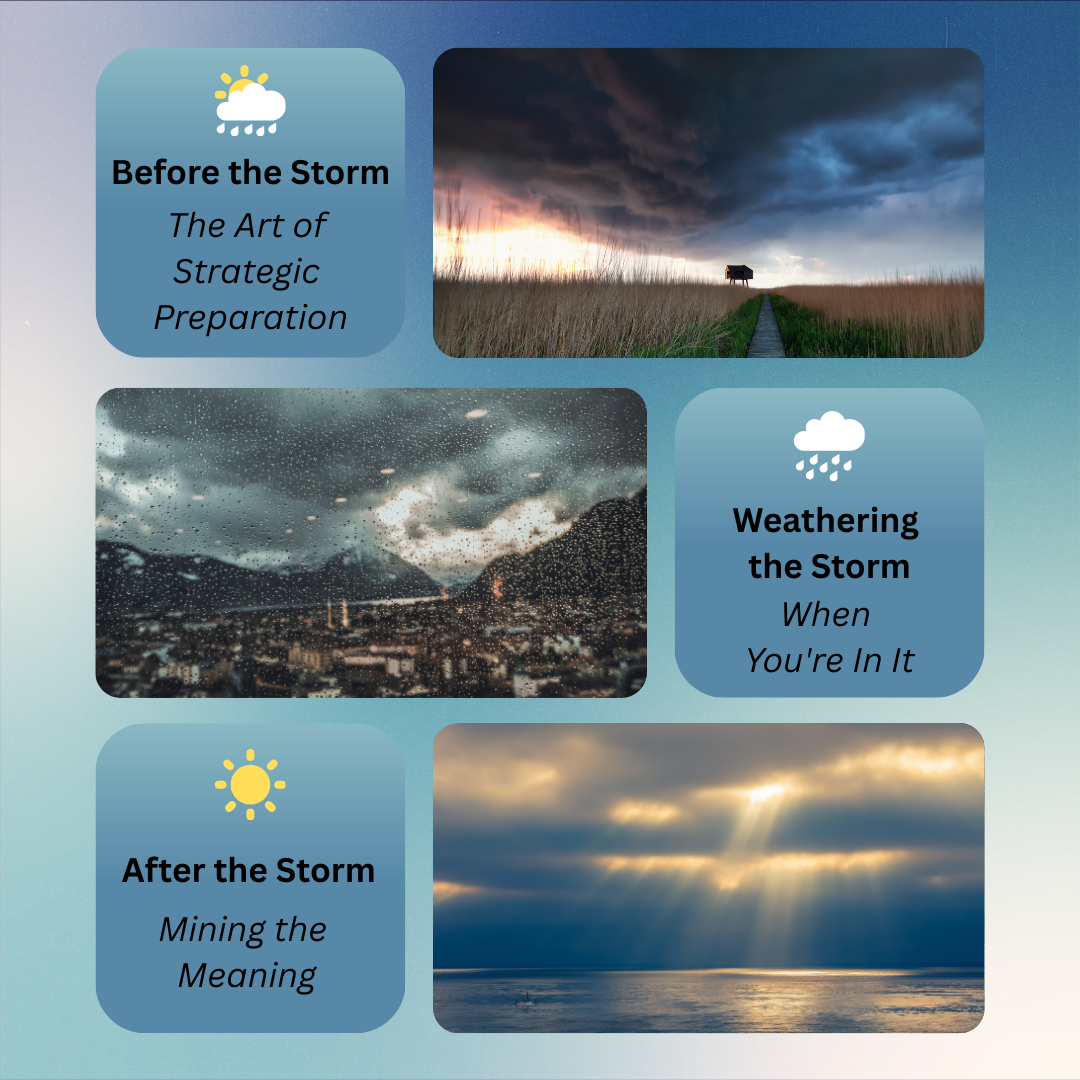
    Before the Storm: The Art of Strategic Preparation

    Here’s what most people get wrong about preparation:
    They stockpile supplies, but they forget to strengthen their foundation.

    When I work with leaders and entrepreneurs facing major transitions, I ask them a simple question: “What are you anchoring to?” When everything else is moving, you need something solid to hold onto. For some, it’s their core values. For others, it’s their sense of purpose or their commitment to the people they serve.

    The coaches I work with who navigate industry changes most successfully aren’t the ones with the biggest emergency funds (though those help). They’re the ones who’ve built what I call “foundational flexibility,” which is a clear sense of who they are and what they stand for, combined with the agility to adapt their methods without compromising their mission.

    Practical preparation looks like this:

    Know your non-negotiables.
    What absolutely must be protected?
    What defines you at your core?
    When you’re clear on this, you can let go of everything else with much less anxiety.

    Build your support system before you need it.
    The middle of a crisis is not the time to start looking for allies.
    Invest in relationships during the calm, so you have people to call when the winds pick up.

    Create options, not just plans.
    Plans assume a predictable future.
    Options give you choices when the unexpected arrives.
    What are three different ways you could respond if X happens?
    What resources could you access if Y occurs?

    When You’re In It: Weathering the Storm

    There’s a moment in every storm when you realize – this is happening.
    The preparation phase is over.
    Now you’re just trying to stay upright.

    This is when your previous work pays off, or when you discover what you missed.

    When the Storm Hits: Your Guide to Weathering What Comes and Emerging StrongerThe most important skill for weathering a storm isn’t strength; it’s presence.
    The ability to stay aware, stay responsive, and resist the temptation to panic-react your way into worse problems.

    I’ve watched brilliant people make terrible decisions in the middle of storms because they were so desperate to make the discomfort stop that they grabbed at the first solution that presented itself.
    They pivoted their entire business model after one bad quarter.
    They blew up a relationship because they couldn’t tolerate the tension of uncertainty.
    They abandoned their vision because it got hard.

    Weathering a storm means accepting that some things are out of your control while staying active in the things that aren’t.

    You can’t stop the storm, but you can:

    Protect your energy.
    This is not the time to take on new commitments or push yourself to maintain “business as usual.”
    Give yourself permission to focus on essentials.

    Stay connected.
    Isolation is the enemy of resilience. Reach out. Ask for help. Let people know you’re struggling.
    The vulnerability you show now will deepen your relationships later.

    Look for the small wins.
    You don’t need to solve everything today.
    You need to take one right action, then another, then another.
    Progress compounds.

    After the Storm: Mining the Meaning

    Every storm deposits something. Sometimes it’s wreckage that needs clearing. Sometimes it’s nutrients that will feed next season’s growth. Your job is to examine what’s been left behind.

    The entrepreneurs I know who’ve built the strongest businesses didn’t do it by avoiding failure. They did it by getting exceptionally good at learning from it. Each setback became data. Each crisis revealed something they didn’t know about themselves, their market, or their model.

    The question isn’t “Why did this happen to me?”
    The question is “What does this make possible that wasn’t possible before?”

    Maybe the storm cleared out deadwood – projects that were draining energy without producing results, relationships that had run their course, assumptions that were holding you back. Maybe it revealed strengths you didn’t know you had. Maybe it showed you who really has your back.

    Coming out positive doesn’t mean pretending the storm didn’t hurt.
    It means refusing to let the hurt be the only thing that defines what happened.

    The storms will come. They always do.

    The only real question is: When the next one arrives, who will you be?
    Someone who merely survives it, or someone who uses it to become more of who you’re meant to be?

    Start preparing now. Not because you’re pessimistic, but because you’re committed to staying in the game no matter what the weather brings.

  • Before You Do, Remember Who You’re Becoming

    Before You Do, Remember Who You’re Becoming

    Every January, millions of people launch into action. They join gyms, open blank documents for that novel they’ve been meaning to write, or register their LLC for the side hustle that’s going to change everything.

    By February, most have stopped.

    The problem isn’t lack of willpower or poor planning. It’s that they’re trying to change their actions without first transforming their identity.

    The Identity-Action Gap

    Here’s what typically happens: You decide you want to lose 30 pounds, so you buy meal prep containers and download a fitness app. You want to write a novel, so you block out time on your calendar and create the perfect workspace. You’re ready to launch that consulting business, so you design business cards and build a website.

    These are all smart actions.
    But they’re built on a foundation of sand.

    When you take action without first shifting who you believe yourself to be, every choice becomes an internal negotiation. The alarm goes off at 5:30 AM for your workout, and you have to convince yourself – again – that you’re the kind of person who does this. You sit down to write, but that blank page mocks you because you don’t yet believe you’re actually a writer. You need to make sales calls for your new business, but impostor syndrome screams that you’re just pretending to be an entrepreneur.

    This exhausting internal debate is why most ambitious goals fail. You’re constantly fighting against your own self-concept.

    The Power of Identity-First Change

    Consider weight loss. Most people approach it as a behavior problem: “I need to eat less and move more.” But sustainable transformation happens when you shift from “I’m trying to lose weight” to “I’m someone who takes care of my body.”

    That subtle shift changes everything. When you’re someone who takes care of your body, choosing the salad isn’t deprivation; it’s consistency with who you are. Missing a workout creates genuine discomfort because it conflicts with your identity, not because you’re failing at a resolution.

    The same principle applies to writing your novel. You don’t need to wait until you’re published to be a writer. You become a writer the moment you decide that’s who you are. Real writers write on days they don’t feel inspired. They protect their writing time. They study this craft. Once you embody that identity, sitting down to write becomes natural rather than forced.

    And for your side hustle? Stop “trying to start a business” and start being an entrepreneur. Entrepreneurs solve problems. They learn from failure. They show up consistently even when results are slow. When that’s who you are – not what you’re attempting – the difficult actions become expressions of identity rather than items on a to-do list.

    Before You Do, Remember Who You're BecomingHow to Shift Your Beingness

    This isn’t about positive thinking or affirmations. It’s about genuine identity transformation.

    1. Define the identity clearly.
    Don’t just say “I want to be healthy.” Get specific: “I’m someone who honors my body’s needs, makes conscious food choices, and moves daily because it feels good.”

    2. Find your evidence.
    Your brain needs proof. Identify any moment (no matter how small) when you’ve already been this person. That time you took the stairs? That counts. The paragraph you wrote last Tuesday? Evidence. The helpful advice you gave a friend? Entrepreneurial.

    3. Make identity-consistent choices.
    Ask yourself throughout the day: “What would the person I’m becoming do right now?” Then do that thing, even when it’s small,
    especially when it’s small.

    4. Speak it into existence.
    Change your language. Not “I’m trying to lose weight,” but “I take care of my body.” Not “I want to write a book,” but “I’m writing a book.” Not “I’m thinking about starting a business,” but “I’m an entrepreneur building my business.”

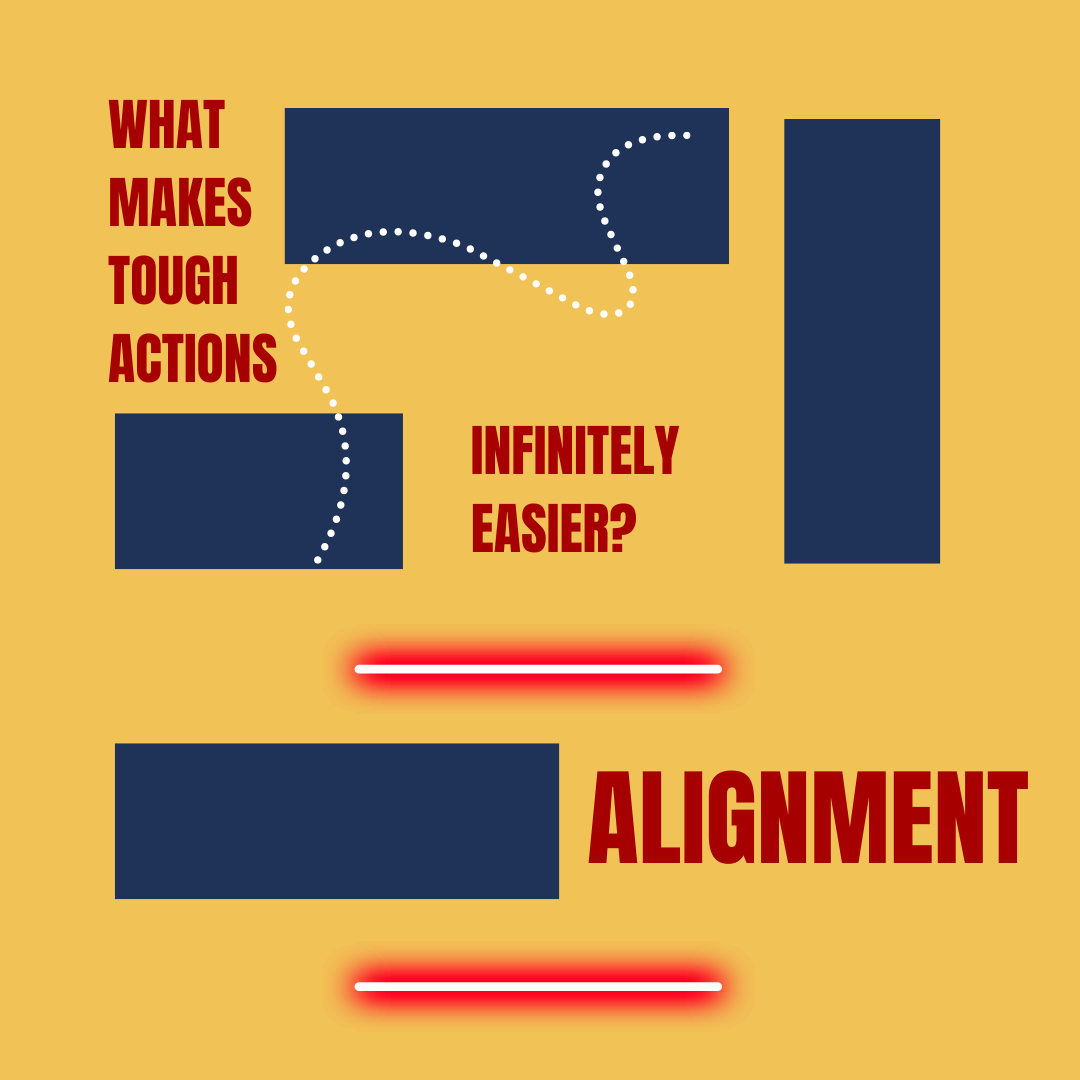
    The Truth About Tough Actions

    Yes, losing weight requires tough choices. Writing a novel demands discipline and vulnerability. Building a business means facing rejection and uncertainty.

    Here’s what makes those tough actions infinitely easier: Alignment.

    When your actions flow from a clear sense of who you are, they stop feeling like obligations and start feeling like integrity. You’re not forcing yourself to do hard things; you’re simply being consistent with who you’ve become.

    The action is still challenging, but it’s no longer a battle with yourself.

    Before you revise your goals or create your action plan, pause.
    Get clear on who you’re becoming.
    Let that identity settle into your bones.

    Then watch how naturally the right actions follow.

  • The Flying Coach Class Survival Guide: Hard-Won Wisdom from 30,000 Feet

    The Flying Coach Class Survival Guide: Hard-Won Wisdom from 30,000 Feet

    TRIGGER WARNING:
    This is for entertainment purposes only.
    Don’t come after me for not being coach-like and PC.

    The Survival Guide for Flying Coach

    Look, I get it. We’re all trying to save the company some money. “Book coach for your flight; it’s only a few hours,” they said. Nobody mentioned I’d be entering what I can only describe as a full-contact sport involving personal space violations, questionable hygiene, and the kind of audacity that should require a permit.

    Let me paint you a picture: You’ve finally achieved that elusive airplane sleep – the one that requires the perfect storm of exhaustion, white noise, and convincing yourself that neck angle won’t cause permanent damage. Then you feel it. A weight. A presence. You open one eye to discover your seatmate, a twenty-something gentleman who apparently believes deodorant is a suggestion, has transformed your shoulder into his personal pillow. He’s not just asleep, but in REM. There might be drooling.

    The Flying Coach Class Survival Guide: Hard-Won Wisdom from 30,000 Feet by Laura Berman FortgangAnd this, dear reader, happened to me TWICE – once each way on my flights!

    Here’s where it gets truly magnificent: After using me as a human body pillow for an hour, this same individual has the sheer nerve to wake ME up because HE needs to use the bathroom. The math isn’t mathing. The audacity is audacious.

    What can we learn from this airborne nightmare?
    Plenty.

    Action Item #1: Master the Defensive Seating Position

    Forget what your mother taught you about sitting up straight. In coach, you need to adopt what I call the “Do Not Disturb Porcupine Stance.” Elbows out. Knees angled. Reading light on at full blast pointing vaguely in their direction. You’re creating a physical and psychological barrier that says, “I am not a pillow, I am not your friend, and I certainly don’t want to smell whatever that is.”

    Action Item #2: Invest in the Aisle Seat Like Your Dignity Depends On It …

    … because it does. Yes, you’ll get bumped by every cart and human traffic jam that passes. Yes, everyone will use your headrest to steady themselves. But you know what you won’t be? Trapped. When your seatmate starts listing like the Titanic, you can simply stand up and let gravity do what their mother apparently couldn’t – teach them boundaries.

    Action Item #3: Pack Your Olfactory Defense Kit

    I’m talking essential oils, scented lotion, maybe even a small container of coffee beans like you’re at a perfume counter. When the aromatic assault begins – and it will begin – you need options. Hold that lavender oil right under your nose. Tell people you have allergies. You’re not being dramatic; you’re being a survivor.

    Action Item #4: Perfect the Wake-Up Face

    When they inevitably need to disturb YOUR sleep after they’ve been using you as furniture, you need a facial expression that communicates the following: “I am awake. I am not happy about it. I will remember this.” Practice in the mirror. Make it memorable. They should feel (at least) 40% ashamed.

    Action Item #5: Embrace the Passive-Aggressive Cough

    The moment you feel that first lean, deploy a series of concerned, contagious-sounding coughs. Maybe add a sniffle. Mention something about “probably just allergies … or that thing that’s been going around.” Watch how quickly personal space becomes sacred again.

    Action Item #6: Bring Photographic Evidence

    Next time – and there will be a next time – take a selfie with your sleeping seatmate using you as a headrest. Not to shame them publicly (though tempting), but to show your boss when you submit that expense report requesting business class for your next trip. Sometimes a picture is worth a thousand upgrade approvals.

    The Final Lesson

    Here’s what traveling coach for business really teaches us: Dignity is expensive, personal space is a luxury, and sometimes the real cost savings aren’t worth the full-body experience of someone else’s poor in-flight choices.

    The next time your company asks you to fly coach “just this once,” remember: You’re not just saving them money. You’re providing free sleeping accommodations, tolerating amateur-hour hygiene, and somehow becoming the villain when you’d like to occasionally use the restroom during your OWN flight.

    Book business class. Your shoulders will thank you.

    Safe travels, and may the odds be ever in your favor.

  • When Life Gets in the Way, What’s Your Plan?

    I don’t have to tell you that sometimes life gets in the way; we’ve all experienced it.

    We get sick, have an accident, face a disappointment, deal with a busted hot water heater — you name it! Life can be unpleasant or inconvenient.

    Every time, life gets in the way — if you let it!

    Last week, I held a big launch event for my business, which you may have noticed. But what you couldn’t have known was that life got in the way, right in the middle of the launch.

    There I was, all set to present a 3-day Masterclass I’d been planning for weeks, ready to share my proven Headliner Method for catapulting a coaching business. People were fired up and ready to learn.

    And then I had to take my kid to the ER!

    Thankfully, he’s A-OK, and that’s what’s most important! But I’m also grateful I had the support system and fortitude to pull off the event without a hitch.

    As a coach, I would be remiss not to turn this ordeal into a learning experience for you, so consider this a reminder.
    1.   Life gets in the way.                                                                                                                                                                                          2.   You should always have a backup plan in place.

    I realize this is easier for some people than others (psst: if you tend to do everything yourself and hate asking for help, I’m talking to you.) But the reality is, you have to figure it out.

    Anything can happen at any time. Why let a bout of food poisoning, a crashing laptop, or a traffic jam on your way home from the airport derail your business?

    When life gets in the way, the show must go on.

    If you’ve neglected to build a support system, who will help to keep things on track?

    If you’re not mentally prepared to handle a crisis, how will you keep rolling?

    You need the will and a way.

    I know you’re up to big things — building a business, changing careers, growing your family, pursuing dreams — and I want you to be able to carry on.

    I encourage you to give this some thought and urge you to make it a priority.

  • Why Humility is Bad for Business

    A conversation that keeps coming up with clients lately is money guilt. This is always a thing, but the wonky uncertainty in the economy is really getting to people.

    Whether they’re asking for a raise, quoting a potential client, or considering raising their prices, they hit a wall – not because the numbers don’t make sense, but because guilt gets in the way.

    Here’s what I tell them:
    If you’ve ever avoided asking for more because you felt bad, it’s not really about money. It’s about self-worth. You have to keep the fact that you provide value front and center and ahead of your concerns about other people’s wallets, which is based on an assumption.

    Why Humility is Bad for Business by Laura Berman FortgangBut I get it. Sometimes this is easier said than done.

    When clients get stuck on the guilt train, I walk them through a simple 3-step process to shift their mindset:

    Calculate your true costs.
    Not just your billable time – Everything. What does it take to run your business, stay trained, and deliver excellent work? You’re not being greedy. You’re covering your investment and deserve a return.

    List your contributions.
    What results do you create? What problems do you solve? What value do you add? Get specific. If you’re a coach, what transformation are you making possible? If you’re in-house, what success do you make easier?

    Reframe the conversation.
    It’s not about “Can I ask for this much?” It’s about “Here’s what you gain when you hire me.”
    One client of mine was charging $500 for work that saved her clients $5,000 in avoidable mistakes. Once she saw that clearly, the guilt disappeared, and I was finally able to help her align her pricing with her impact.

    Here’s the truth: Undercharging isn’t noble. It leads to resentment, burnout, and half-hearted effort. This kind of sacrifice never pays off the way you think it will. Nobody wins.

    Take time this week to write down the actual wins you help make happen. Strip the guilt. Look at the facts.

    Reply below and tell me: What’s one powerful contribution you make? Let’s name it and celebrate it.

    You provide great value. It’s time to charge like it.